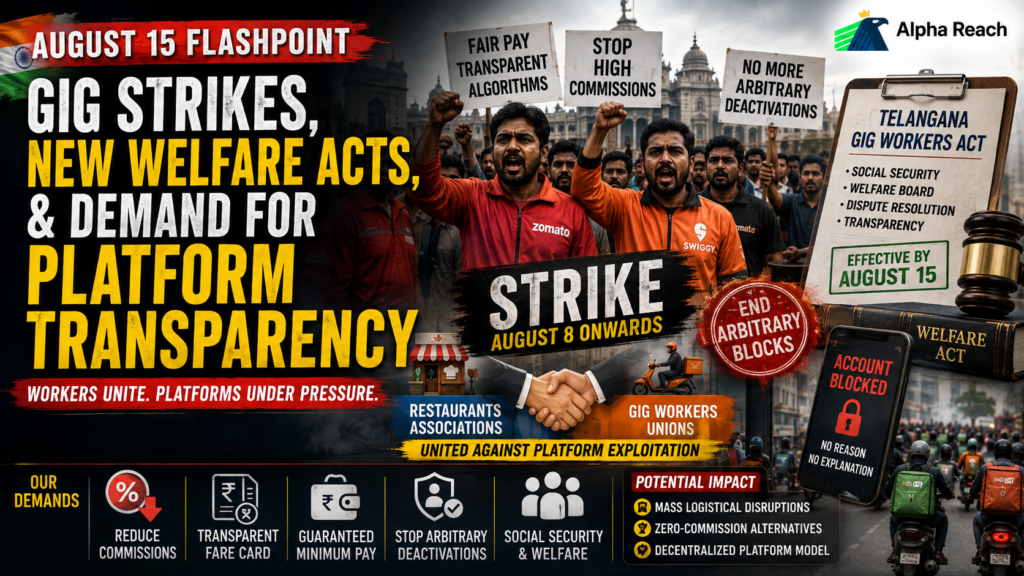
August 2026 has emerged as a historical flashpoint for gig worker rights in India, culminating around Independence Day. Across major southern tech hubs, including Bengaluru and Hyderabad, worker unions are initiating massive strikes against platform exploitation. The Karnataka App-Based Workers Union (KAWU) has built an unprecedented alliance with local hotel and restaurant associations. Traditionally operating at opposite ends of the platform ecosystem, both delivery partners and restaurant owners have united against a common adversary: the monolithic duopoly of food delivery aggregators. This coalition signals a major shift in the power dynamics of the platform economy, where merchant partners and labor forces are collaborating to challenge corporate policies.
The Core Grievances: Commissions and Algorithmic Transparency
For restaurant owners, the primary point of contention is the exorbitant commission structure. Aggregators currently charge between 25% and 30% per order, alongside mandatory advertising fees and discounting pressures that severely erode restaurant profit margins. Small and medium-sized eateries claim these predatory pricing models make it nearly impossible to sustain operations independently. On the worker side, the grievances center on opaque payout algorithms, shrinking base pay, and arbitrary account terminations. Delivery partners report that despite fuel inflation and rising living costs, their per-kilometer earnings have stagnated. They are demanding a transparent fare card, a guaranteed minimum wage, and an end to sudden, unexplained ID blocks which instantly strip them of their livelihood.
The Telangana Welfare Act and Approaching Deadlines
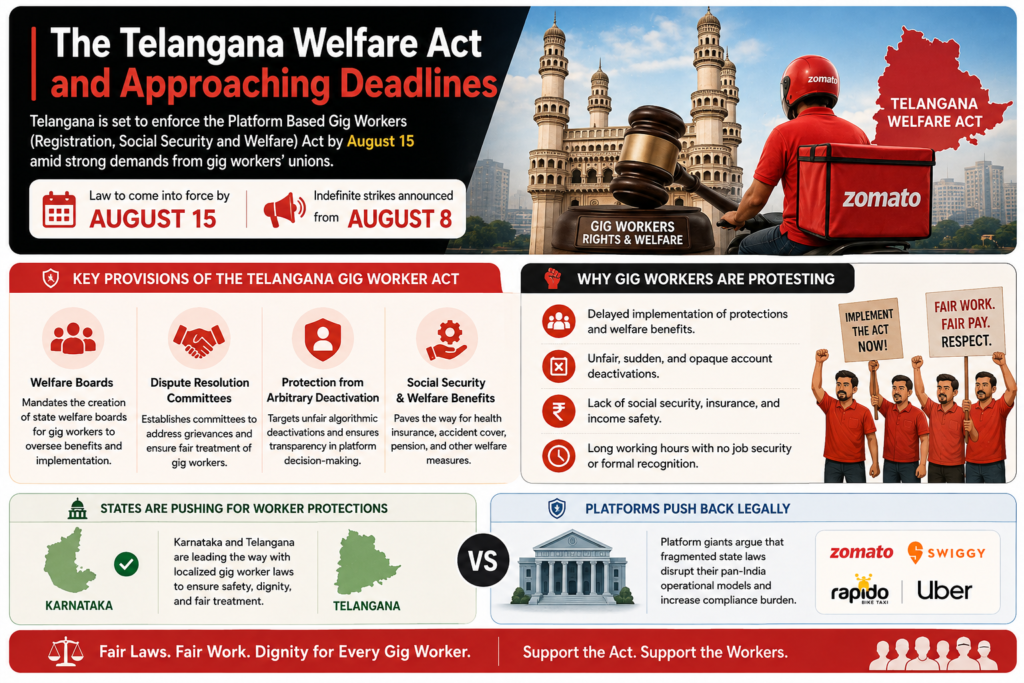
Adding fuel to the fire, the state of Telangana is finalizing operational guidelines for its Platform Based Gig Workers (Registration, Social Security and Welfare) Act, explicitly aimed to come into force by August 15. This move comes amid mounting pressure from gig workers’ unions, which announced indefinite strikes starting August 8 to demand swift implementation. The new legislation mandates the creation of welfare boards and dispute resolution committees, directly targeting the arbitrary algorithmic deactivations that platforms use to manage their fleets. As states like Karnataka and Telangana push forward with localized gig worker protections, platform giants are pushing back legally, claiming that fragmented state laws disrupt their pan-India operational models.
Potential Impact on the Industry
If these strikes and localized legislative actions proceed as planned, India’s bustling tech capitals will face massive logistical blackouts. This coordinated pushback is more than a one-day disruption; it represents a broader structural demand for decentralized, zero-commission alternatives. The ongoing strikes serve as a pressure test for state governments to enforce laws that genuinely protect the workforce against the lobbying power of multi-billion-dollar tech enterprises.
Final Word / Thought / Conclusion
The converging events of August 15 represent a watershed moment for India’s platform economy. The fact that restaurant owners and gig workers have allied against aggregators proves that the current high-commission, low-wage model is financially unsustainable for everyone except the platforms. The successful implementation of the Telangana Gig Workers Act could trigger a domino effect, forcing aggregators to finally abandon arbitrary algorithmic management in favor of transparent, fair-trade practices. The gig economy is maturing, and the era of unregulated platform dominance is rapidly drawing to a close.