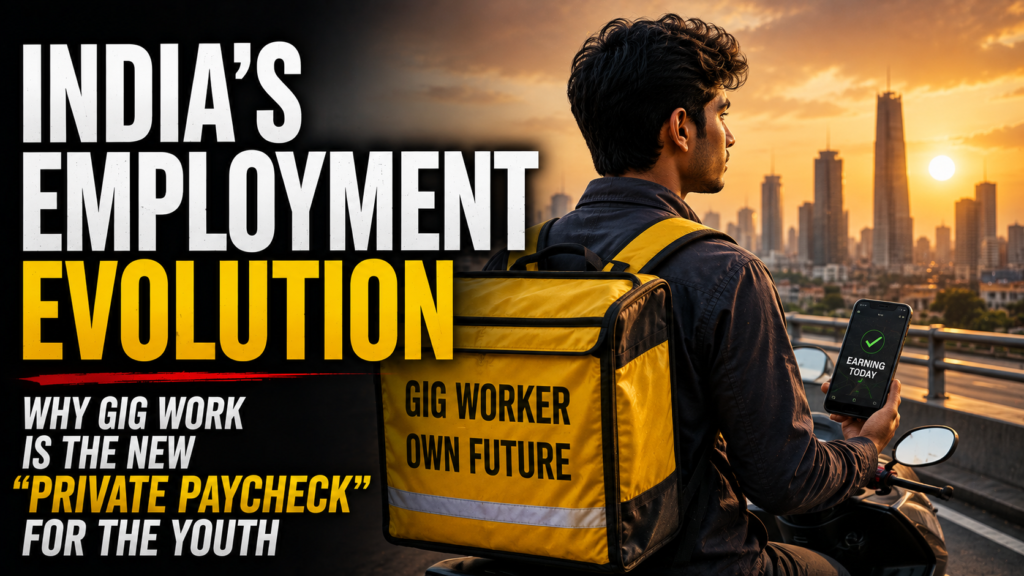
As India approaches its 79th Independence Day in 2026, economists are reflecting on the radical transformation of the nation’s employment landscape. According to labor experts at EY India, the job market has navigated five distinct phases since the pivotal 1991 economic reforms. Two generations ago, the ultimate goal was a secure government job with a fixed pension. The subsequent IT boom shifted ambitions toward the corporate “private paycheck”. Today, however, the paradigm has shifted entirely again: security is no longer tied to an employer, but rather to the next “gig” and the continuous acquisition of immediately deployable skills.
Bridging the Graduate Unemployment Gap
The explosive rise of the platform economy is heavily fueled by systemic failures in traditional job creation. The recent ILO India Employment Report painted a grim picture, noting a 29.1% unemployment rate among young graduates. The formal corporate sector is simply not generating enough entry-level positions to absorb the millions of educated youths entering the workforce annually. Consequently, gig work—ranging from food delivery to freelance cloud architecture—has become the default safety net. For over 50% of the platform workforce, app-based gigs are their very first form of paid employment, effectively bypassing the traditional corporate ladder entirely.
The Path to Viksit Bharat 2047
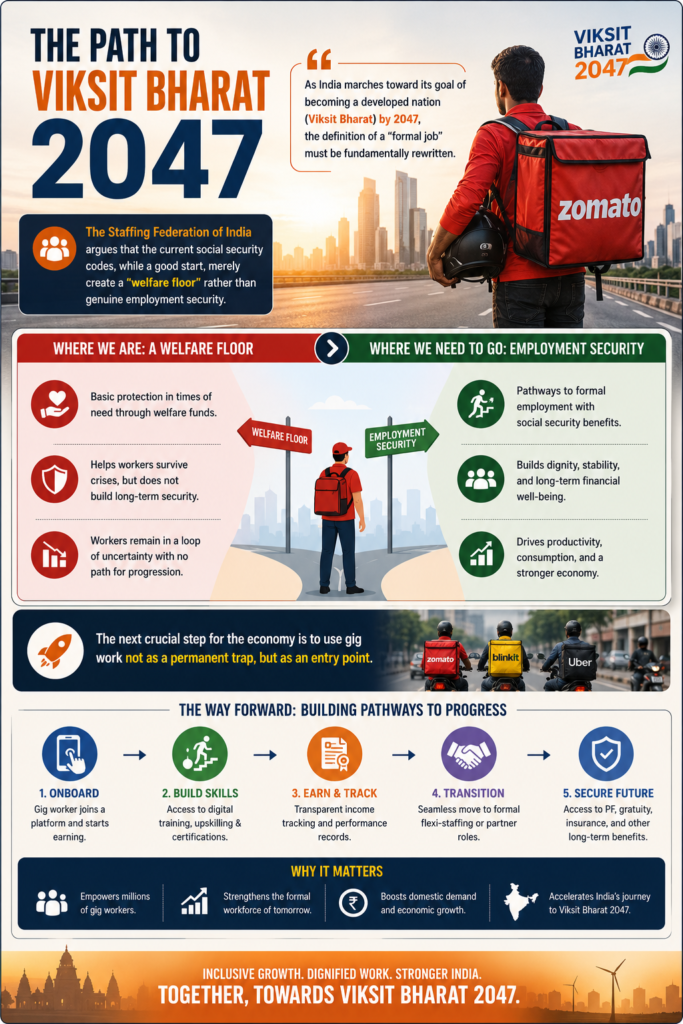
As India marches toward its goal of becoming a developed nation (Viksit Bharat) by 2047, the definition of a “formal job” must be fundamentally rewritten. The Staffing Federation of India argues that the current social security codes, while a good start, merely create a “welfare floor” rather than genuine employment security. The next crucial step for the economy is to use gig work not as a permanent trap, but as an entry point. Policy makers must create pathways for gig workers to transition seamlessly into formal flexi-staffing, where they can accumulate provident funds and gratuity while maintaining the flexibility of platform work.
Conclusion
The evolution from the 1991 IT boom to the 2026 gig economy proves that Indian labor is infinitely resilient and adaptable. However, relying on quick-commerce apps to solve the nation’s youth unemployment crisis is a dangerous long-term strategy. Gig work provides excellent immediate liquidity, but it offers zero upward mobility for the vast majority of its participants. If India wishes to harness its demographic dividend by 2047, the state must build continuous, free upskilling infrastructure that allows a 19-year-old delivery rider to eventually become the software engineer programming the very algorithm that once managed him.