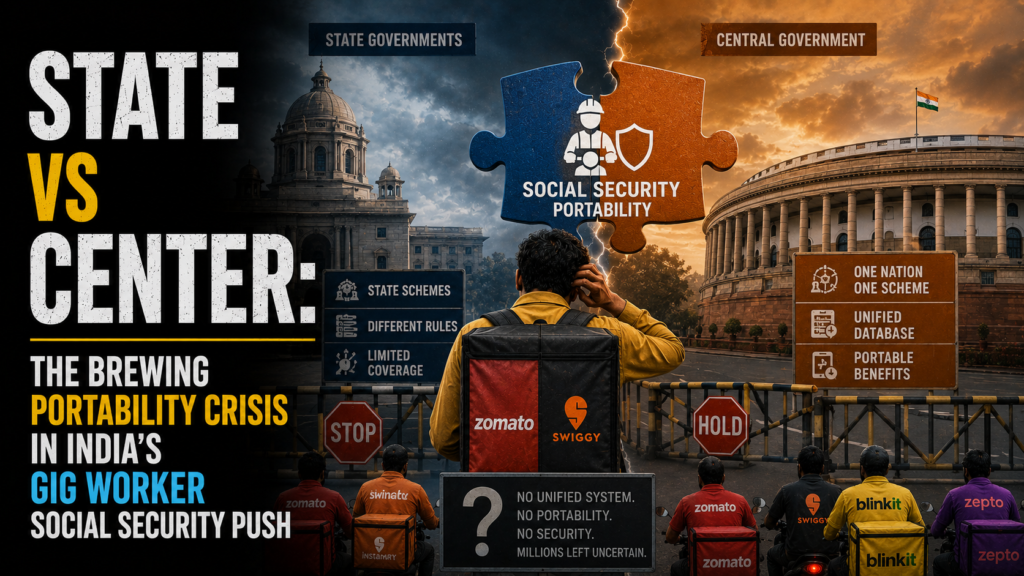
As the central government operationalizes the Code on Social Security 2020 to bring gig workers into the formal welfare net, a massive administrative collision is brewing. Because labor falls under the “concurrent list” in the Indian Constitution, highly active states like Karnataka, Rajasthan, and Telangana are rapidly passing their own localized, state-specific gig worker protection acts. While these state laws often offer superior protections (such as transaction-level welfare funding and algorithmic grievance cells), labor economists are deeply concerned about the impending lack of benefit portability.
The Danger of Administrative Silos
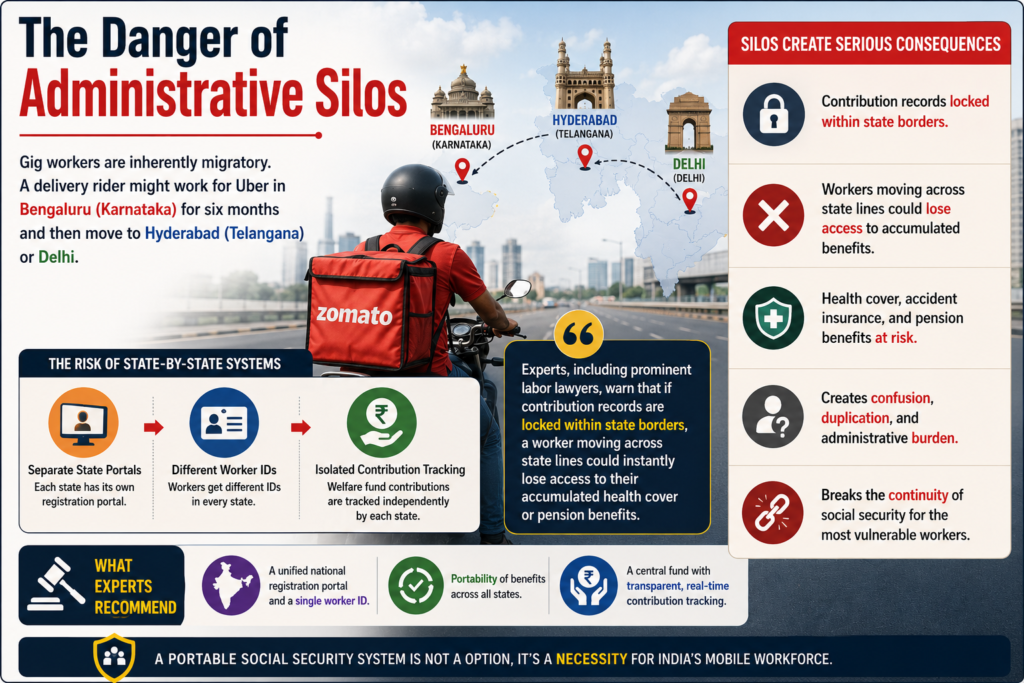
Gig workers are inherently migratory. A delivery rider might work for Uber in Bengaluru (Karnataka) for six months and then move to Hyderabad (Telangana) or Delhi. If each state mandates its own separate gig-worker registration portal, distinct worker IDs, and isolated welfare fund contribution tracking, the system will collapse into administrative silos. Experts, including prominent labor lawyers, warn that if contribution records are locked within state borders, a worker moving across state lines could instantly lose access to their accumulated health cover or pension benefits.
The Need for a Central Digital Spine
To prevent this logistical nightmare, policy experts are urgently calling for the central e-Shram portal to act as the single, immutable “digital and legal spine” for the entire country. Under this proposed framework, platforms would only need to authenticate a worker once through the central database. States would then be free to build additional, localized welfare layers (like specific housing or education subsidies) on top of this central ID, without disrupting the core portability of the worker’s national health and pension accumulation.
Conclusion
The race to protect gig workers is commendable, but creating 28 different state-level worker registries will be a bureaucratic disaster for a highly migratory workforce. Social security is only effective if it seamlessly follows the worker wherever they go. The Central Labour Ministry must immediately convene a council with state governments to mandate API interoperability between state welfare boards and the e-Shram portal. Without a unified, portable digital ID, millions of gig workers will see their hard-earned welfare contributions trapped in states they no longer live in.