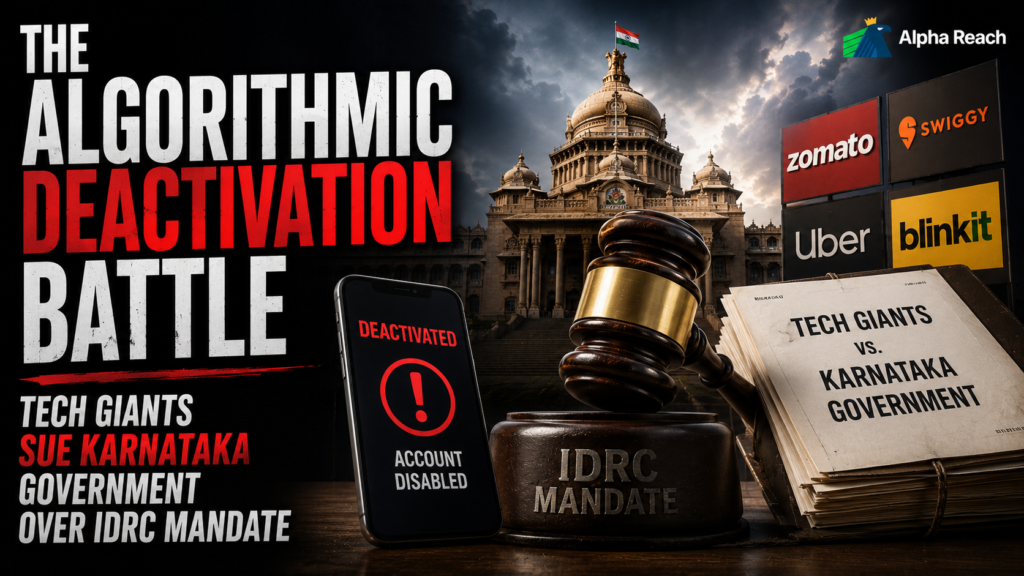
The escalating tension between state legislatures and massive tech aggregators has finally reached the courtroom. On June 29, 2026, the Internet and Mobile Association of India (IAMAI)—representing corporate heavyweights like Swiggy, Zepto, Urban Company, and Eternal Ltd. (the parent company of Zomato and Blinkit)—filed a comprehensive writ petition before the Karnataka High Court. The tech coalition is seeking to completely quash the landmark Karnataka Platform-Based Gig Workers (Social Security and Welfare) Act, arguing that its recent enforcement notices are unconstitutional and create an impossible operational environment for pan-India digital platforms.
The Core of the Conflict: IDRCs and Due Process
While the platforms are challenging various aspects of the Act, the absolute core of this legal showdown revolves around “algorithmic deactivation.” On May 21, 2026, the Karnataka government issued a strict notice directing platforms to immediately constitute Internal Dispute Resolution Committees (IDRCs). This mechanism legally requires platforms to provide gig workers with valid, documented reasons before blocking their IDs or permanently deactivating their accounts, effectively granting them the right to be heard. Platforms argue that their dynamic matching algorithms cannot be paused for manual dispute resolutions, while labor advocates argue that it is a basic human right to know why you are being stripped of your livelihood. For example, a beautician who has built a five-year client base on an app could currently lose her income overnight due to a single automated flag.
The Constitutional Argument of Repugnancy
In their legal defense, the IAMAI-led petition heavily relies on the constitutional doctrine of repugnancy under Article 254. The tech platforms argue that because the Union Parliament has already legislated on gig worker welfare through the central Code on Social Security, a state legislature like Karnataka cannot legally impose its own overlapping procedural framework and localized welfare fee taxes. However, in early July 2026, Justice M. Nagaprasanna delivered a preliminary blow to the platforms by explicitly refusing to stay the implementation of the Act. Furthermore, he ordered the companies to deposit their disputed state welfare fees directly with the Court registry, turning down their request to merely offer a bank guarantee.
Final Word / Thought / Conclusion
The Karnataka High Court litigation is poised to become one of the most important labor law cases globally this decade. The underlying question is profound: does an algorithm have the unchecked legal authority to fire a human being without due process? If the platforms succeed in striking down the IDRC mandate, the only state-level attempt in India to import natural justice into algorithmic management will collapse. Conversely, if the court upholds the state’s right to enforce due process, tech aggregators will be forced to entirely redesign their backend software to prioritize human empathy, transparent communication, and fair dispute resolution over ruthless efficiency.