SEO Meta Title: IAMAI Sues Karnataka Govt Over Gig Worker Welfare Act 2026
SEO Meta Description: Major platforms including Swiggy, Zepto, and Urban Company have filed a writ petition in the Karnataka High Court against the state’s new Gig Workers Act, citing operational hurdles and algorithmic deactivation limits.
Target Keywords: Karnataka gig worker act 2026, IAMAI Swiggy Zomato lawsuit, algorithmic deactivation India, Internal Dispute Resolution Committees, High Court gig workers.
A Legal Showdown in India’s Silicon Valley
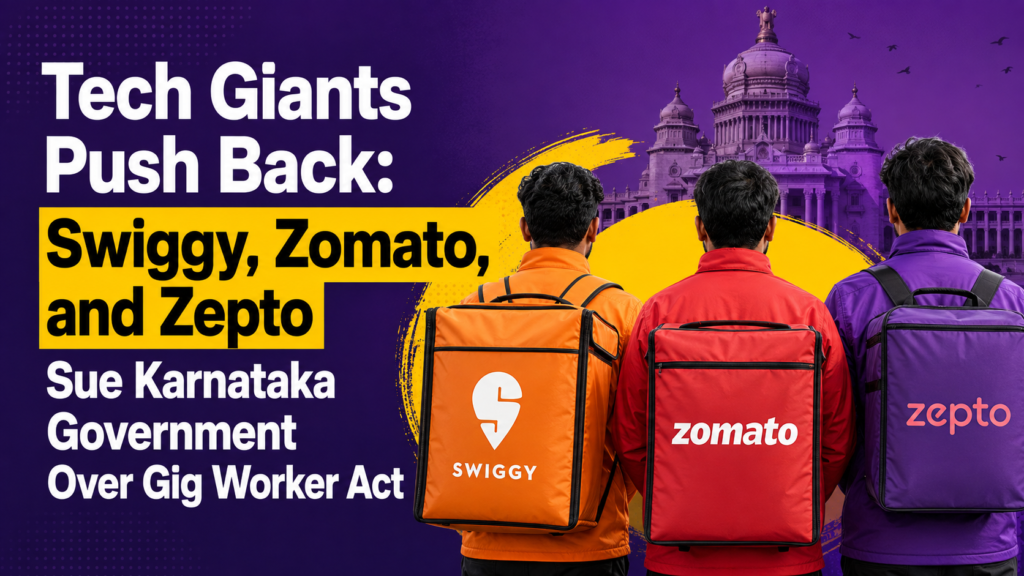
The escalating tension between state governments and platform monopolies has officially spilled over into the judiciary. The Internet and Mobile Association of India (IAMAI)—representing major platform companies including Swiggy, Zepto, Urban Company, and Eternal Ltd. (operator of Zomato and Blinkit)—recently filed a sweeping writ petition in the Karnataka High Court. The tech giants are seeking to declare the landmark Karnataka Platform-Based Gig Workers (Social Security and Welfare) Act, its associated rules, and recent enforcement notices entirely unconstitutional and liable to be quashed.
The Core Issue: Algorithmic Deactivation and IDRCs
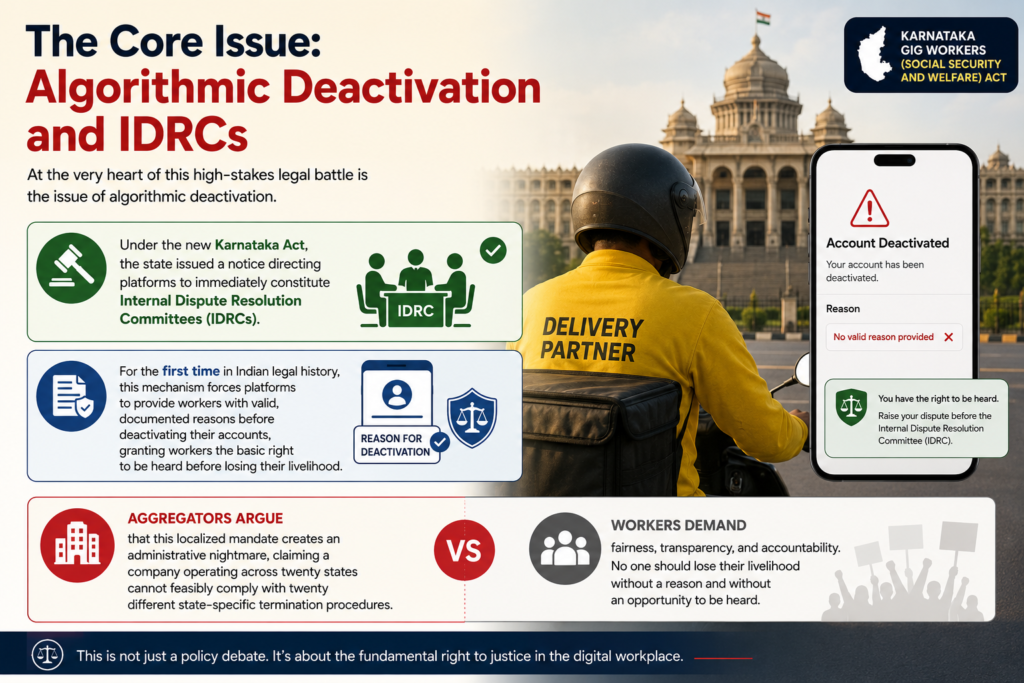
At the very heart of this high-stakes legal battle is the issue of algorithmic deactivation. Under the new Karnataka Act, the state issued a notice directing platforms to immediately constitute Internal Dispute Resolution Committees (IDRCs). For the first time in Indian legal history, this mechanism forces platforms to provide workers with valid, documented reasons before deactivating their accounts, granting workers the basic right to be heard before losing their livelihood. Aggregators argue that this localized mandate creates an administrative nightmare, claiming a company operating across twenty states cannot feasibly comply with twenty different state-specific termination procedures.
The Constitutional Argument of Repugnancy
The IAMAI-led petition heavily relies on the constitutional principle of repugnancy under Article 254. The tech platforms argue that the Union Parliament has already occupied the field of gig worker welfare through the central Code on Social Security. Therefore, a state legislature like Karnataka cannot legally layer its own overlapping procedural framework and localized welfare fee taxes on top of a federal mandate. During the preliminary hearings in July 2026, Justice M. Nagaprasanna of the Karnataka High Court refused to stay the Act. Instead, in a blow to the platforms, the judge ordered the companies to deposit their disputed state welfare fees directly with the Court registry rather than offering a simple bank guarantee.
Conclusion
The Karnataka High Court litigation is a defining watershed moment for global gig economy jurisprudence. The fundamental question being asked is simple yet profound: does an algorithm have the unchecked legal authority to fire a human being without due process? While platforms argue that fragmented state laws disrupt their pan-India tech infrastructure, worker unions maintain that localized protections are necessary because federal codes have been notoriously slow to implement. The court’s final ruling will either force aggregators to fundamentally redesign their management algorithms to include human empathy and due process, or it will strip states of their power to protect gig workers entirely.