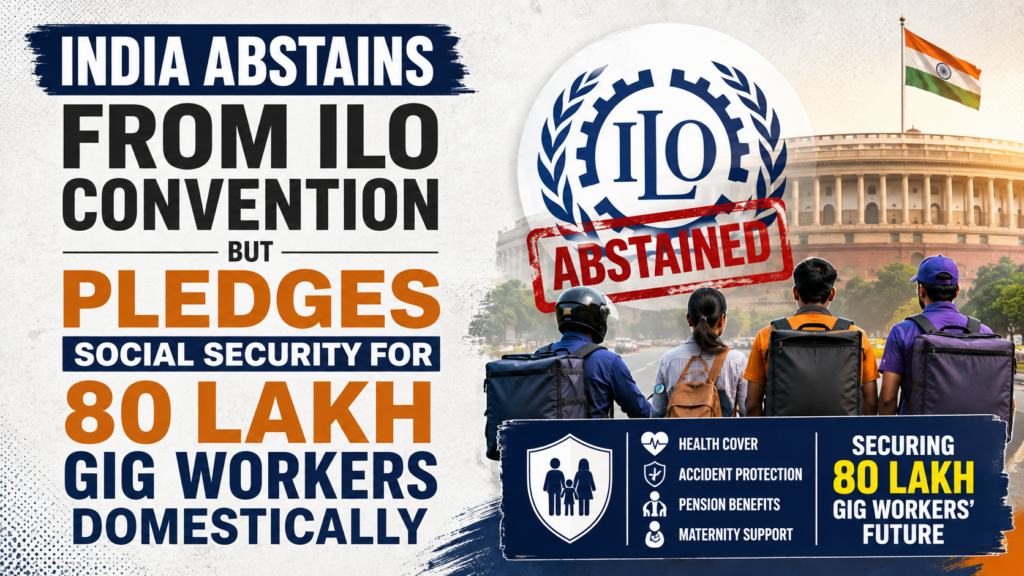
In a move that has sparked intense debate among labor economists, India recently abstained from voting on the International Labour Organisation’s (ILO) landmark convention regarding “Decent Work in the Platform Economy”. India was among 36 countries that opted out of the vote, which was designed to regulate gig economy work through strictly enforceable international obligations. Experts argue that this abstention was a highly calculated move. By avoiding binding international commitments, the Indian government preserves its domestic policy flexibility. Crucially, it sidesteps the massive litigation risk of being internationally forced to reclassify its millions of gig workers as full-time “employees”—a move that could drastically inflate operating costs for companies and stifle the creation of entry-level jobs.
The Domestic Pledge: Assuring Social Security
While stepping back internationally, the government is leaning in domestically. In a recent session of the Rajya Sabha, Union Labour and Employment Minister Mansukh Mandaviya provided a firm assurance that the government will ensure gig workers have access to vital social security schemes exclusively through the implementation of India’s new Labour Codes. Acknowledging the rapid scale of this newly emerging employment sector, Mandaviya cited NITI Aayog data indicating that there are currently around 80 lakh (8 million) gig workers operating across the country.
The e-Shram Registration Drive
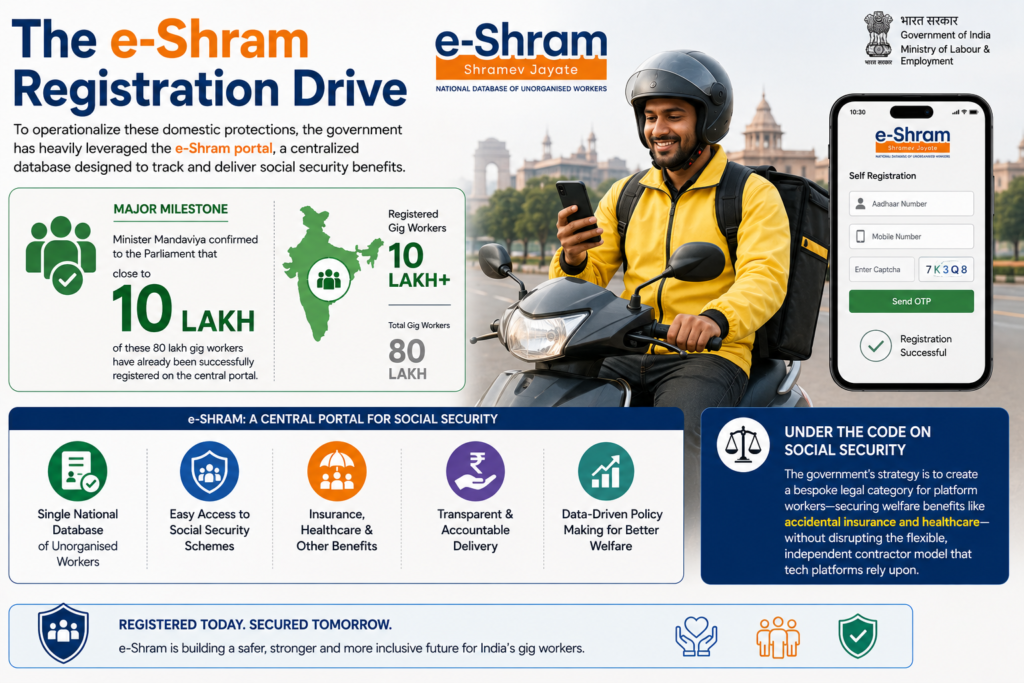
To operationalize these domestic protections, the government has heavily leveraged the e-Shram portal, a centralized database designed to track and deliver social security benefits. Minister Mandaviya confirmed to the Parliament that close to 10 lakh of these 80 lakh gig workers have already been successfully registered on the central portal. Under the Code on Social Security, the government’s strategy is to create a bespoke legal category for platform workers—securing welfare benefits like accidental insurance and healthcare—without disrupting the flexible, independent contractor model that tech platforms rely upon.
Conclusion
India’s decision to abstain from the ILO convention while simultaneously pushing the domestic e-Shram registration drive highlights a tightrope walk between hyper-capitalist growth and baseline human welfare. The government clearly wants to protect its booming digital economy from rigid western labor classifications that might kill the industry. However, by making these promises in Parliament, the state has cornered itself: it must now deliver. If the Labour Codes fail to actually deploy medical and pension funds to the 10 lakh registered e-Shram workers quickly, the ILO abstention will be viewed not as a strategic policy flex, but as a corporate bailout at the expense of India’s working class.