
After years of operating in a legal and regulatory grey area, India’s massive gig workforce is finally seeing concrete legislative action at the federal level. In a historic session of the Rajya Sabha in August 2026, Union Labour and Employment Minister Mansukh Mandaviya provided a firm, on-the-record assurance that the government will ensure gig workers have access to vital social security schemes through the implementation of the new Labour Codes. Recognizing the gig ecosystem as a rapidly emerging and defining employment sector, the central government is officially moving to formalize welfare benefits that have historically been denied to independent contractors.
The Scale of the Workforce and ITR Initiatives
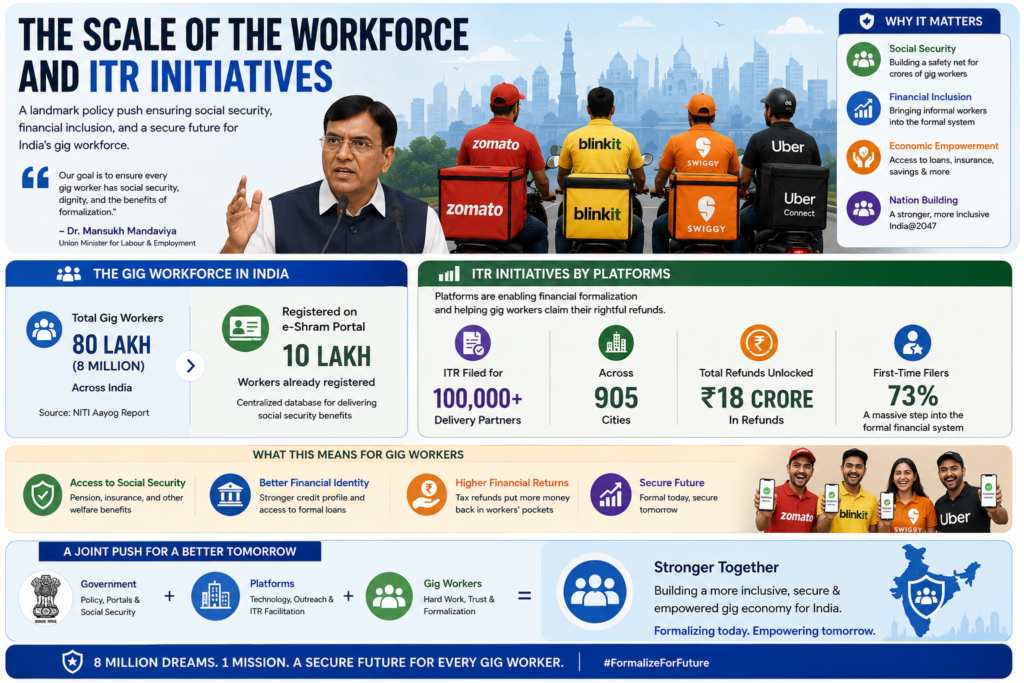
The sheer volume of the gig economy makes this policy intervention absolutely critical. Citing a recent NITI Aayog report, Minister Mandaviya noted that there are currently around 80 lakh (8 million) gig workers operating across India. The formalization process is scaling rapidly, with close to 10 lakh of these workers already successfully registered on the Centre’s e-Shram portal, a centralized database designed to track and deliver social security benefits. Parallel to government efforts, the platforms themselves are driving formalization. Recently, Zomato and Blinkit successfully facilitated Income Tax Return (ITR) filings for over 100,000 delivery partners across 905 cities, unlocking ₹18 crore in refunds. Remarkably, 73% of these individuals were first-time filers, marking a massive shift of informal workers stepping securely into the formal financial system.
Navigating International Pressure and Domestic Reality
The push for domestic regulation coincides with India’s careful navigation of international labor standards. Recently, India abstained from voting on the International Labour Organisation’s (ILO) convention regarding “Decent Work in the Platform Economy”. Experts suggest this abstention was a highly strategic move designed to preserve domestic policy flexibility. By avoiding strict, one-size-fits-all international bindings, the Indian government mitigates the risk of premature litigation that could force the rigid reclassification of gig workers as traditional “employees”. Such a reclassification could drastically increase platform operating costs and potentially stifle entry-level job creation in a sector that is actively absorbing millions of young Indians.
What the Social Security Framework Entails
The implementation of these Labour Codes represents a total paradigm shift. Moving forward, platforms will have direct, undeniable welfare obligations. Frameworks managed in part by the government are expected to extend crucial benefits such as accidental insurance, medical coverage, and potential maternity benefits to workers who meet specific active-day thresholds.
Final Word / Thought / Conclusion
Minister Mandaviya’s assurances in the Rajya Sabha, combined with massive ITR filing drives by platforms like Zomato, signal the end of the “wild west” era of gig work in India. The government has correctly recognized that you cannot have 80 lakh citizens operating entirely outside the social safety net. While the decision to abstain from ILO conventions shows a desire to protect business flexibility, the domestic Labour Codes mandate that this flexibility can no longer come at the total expense of worker welfare. The ultimate success of this initiative will now depend entirely on strict enforcement and ensuring that platform companies contribute their fair share to the welfare funds without passing the costs back down to the workers.