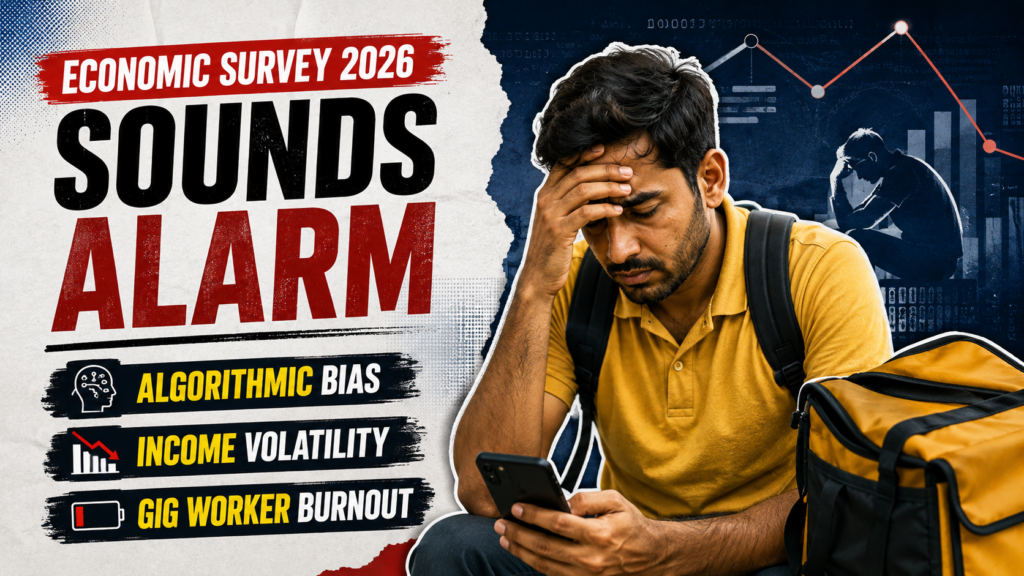
The highly anticipated Economic Survey 2026, tabled in Parliament, has taken a surprisingly critical and protective stance regarding India’s rapidly expanding gig economy. While acknowledging that platform-based jobs have surged by 55%—growing from 7.7 million workers in FY21 to 12 million in FY25—the Survey paints a sobering picture of the ground reality. The government document stresses that the overarching policy goal must shift immediately: gig work should become an area of “real choice” governed by fair social contracts, rather than people being pushed into it due to weak labor demand, skill mismatches, or the absence of a safety net.
Income Volatility and Algorithmic Dominance
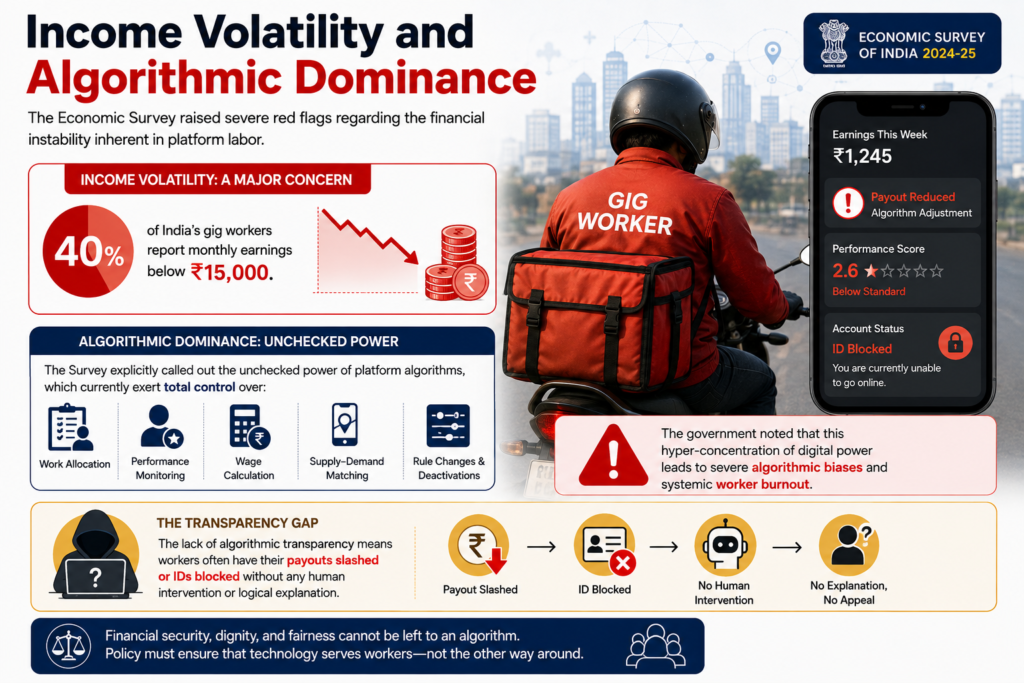
The Economic Survey raised severe red flags regarding the financial instability inherent in platform labor. Astonishingly, the data revealed that roughly 40% of India’s gig workers report monthly earnings below ₹15,000. The Survey explicitly called out the unchecked power of platform algorithms, which currently exert total control over work allocation, performance monitoring, wage calculation, and supply-demand matching. The government noted that this hyper-concentration of digital power leads to severe algorithmic biases and systemic worker burnout. The lack of algorithmic transparency means workers often have their payouts slashed or IDs blocked without any human intervention or logical explanation.
“Thin-File” Credit and Upskilling Against AI
Another major highlight of the Survey is the urgent need to stop treating gig workers as a homogeneous block. Because gig workers are classified as “independent contractors”, they lack traditional employment benefits and suffer from “thin-file” credit access, making it nearly impossible to secure conventional bank loans to upgrade their vehicles or equipment. The Survey also highlighted that limited skilling leaves this massive workforce exceptionally vulnerable to future job displacement triggered by Artificial Intelligence (AI) and Machine Learning (ML). It recommended that platforms actively co-invest in training programs and that the market introduce low-cost emergency savings schemes tailored for platform workers.
Conclusion
The Economic Survey 2026 is a breath of fresh air because it finally addresses the technological “elephant in the room”—the tyranny of the algorithm. For the first time, an apex government document has officially acknowledged that algorithmic bias and opaque digital management are causing extreme psychological burnout and financial distress among the working class. The ultimate takeaway is a direct warning to the tech sector: the government will no longer accept “the algorithm did it” as an excuse for labor exploitation. Moving forward, platforms must be legally compelled to make their dispatch and payout algorithms transparent, open to audit, and fundamentally fair.