
If you’re searching for a BPO to delivery job switch, you already know the real problem isn’t the pay — it’s the target sheet, the forced night shift, and eight hours a day staring at a screen with a supervisor tracking your every call. Thousands of BPO agents and back-office/data-entry clerks are making this move in 2026, and the pitch is simple: trade KPI stress and a fixed desk for open hours and open income.
This hub compares BPO and data-entry pay against real, sourced 2026 delivery partner earnings, and links out to a detailed guide for each segment.
Why Are BPO & Office Workers Switching to Delivery Jobs in 2026?
BPO, call center, and back-office roles share a structural problem that retail or warehouse workers don’t face in the same way: the job is designed around someone else’s targets. Average handle time, calls per hour, keystrokes per minute, night-shift rosters set months in advance — none of it is in your control, and none of it changes even when you perform well.
There’s also a health cost that rarely gets discussed openly: rotating night shifts disrupt sleep cycles, and eight-plus hours at a desk each day contributes to the back, eye-strain, and weight-gain complaints common across the BPO industry. Delivery work flips both problems — you set your own login hours, and the job itself keeps you physically active instead of sedentary.
BPO & Call Center Agents → Delivery Partner: What Changes?
BPO and call center agents typically earn ₹15,000–25,000/month at entry-to-mid level, with domestic voice/non-voice processes at the lower end (₹12,000–18,000) and international processes higher (₹18,000–25,000). With 2+ years of experience, pay can climb to ₹25,000–35,000, and team-lead roles go higher still (Indeed, PayScale — 2026 data).
The trade-off for that pay: rotating or permanent night shifts, strict average-handle-time targets, mandatory login/logout tracking, and call-quality audits that can affect your incentive even on a good month.
As a delivery partner, there’s no shift roster and no call-quality scorecard — your earnings track completed orders, not a supervisor’s dashboard. For the full side-by-side numbers, see BPO Job vs Delivery Partner Salary: Which Pays More in 2026?
Data-Entry & Back-Office Clerks → Delivery Partner
Data-entry operators and back-office clerks average around ₹22,000/month nationally, with most roles falling between ₹18,000–24,000 depending on city and employer (Indeed, 2026 data). Pay typically rises slowly with tenure rather than performance, since the role is measured on volume and accuracy rather than output you control.
The job is also almost entirely sedentary and indoors, often in open-plan offices with fixed 9-to-6 or shift-based hours. Delivery work is the direct opposite: active, outdoors, and self-scheduled. Full comparison here: Data Entry Clerk vs Delivery Partner: 2026 Income Comparison
How Much Can You Actually Earn as a Delivery Partner in 2026?
Be skeptical of any number that isn’t sourced — platform ads often lead with best-case figures. Here’s what’s currently verifiable:
- Base pay per order: ₹15–35, with Blinkit and Zepto typically at ₹25–35 for short-distance orders — see live Blinkit and Zepto per-order rate cards.
- Recent cuts: some zones have seen base pay drop to ₹12–16/order — confirm current rates in your city before committing full-time hours.
- Realistic monthly take-home: ₹25,000–30,000 in metro cities for full-time riders, and ₹12,000–15,000 in Tier-2/3 cities after fuel and deductions — full breakdown in our delivery partner earnings guide.
Check current pay by platform: Blinkit · Zomato · Swiggy · Zepto
Prefer to stay indoors? Platforms also run dark-store picker/packer roles capped around ₹25,000/month — a middle-ground option if you want off the phones without full road delivery.
Side-by-Side: Your Current Job vs. Delivery Partner Pay
| Current job | Typical monthly pay | Delivery partner (metro) | Delivery partner (Tier-2/3) |
|---|---|---|---|
| BPO/call center agent (entry-mid) | ₹15,000–25,000 | ₹25,000–30,000 | ₹12,000–15,000 |
| BPO agent (2+ yrs experience) | ₹25,000–35,000 | ₹25,000–30,000 | ₹12,000–15,000 |
| Data entry/back-office clerk | ~₹18,000–24,000 | ₹25,000–30,000 | ₹12,000–15,000 |
In metro cities, full-time delivery income clears entry-to-mid BPO and data-entry pay comfortably, and matches or narrowly trails experienced BPO pay — without the mandatory night shift or handle-time target.
No More Night Shift Targets
Ask any BPO agent what they’d change first and “the night shift” usually comes before “the pay.” Rotational or permanent night rosters disrupt sleep, family time, and health in ways a fixed salary doesn’t compensate for. Delivery work has natural demand peaks (breakfast, lunch, evening, late-night food orders) but you choose which of those windows to work — there’s no forced 10pm–7am roster set by an operations manager. We cover this shift specifically in No More Night Shift Targets: How Call Center Employees Are Switching to Gig Delivery.
What About Job Security, PF, and Insurance?
This is the most common objection office workers raise before switching — a BPO job usually comes with a formal appointment letter, EPF deduction, and group health insurance; gig work doesn’t look the same on paper. But it isn’t unprotected: register on the government’s official e-Shram portal (register.eshram.gov.in) to access social security benefits for unorganized and gig workers, including accident insurance.
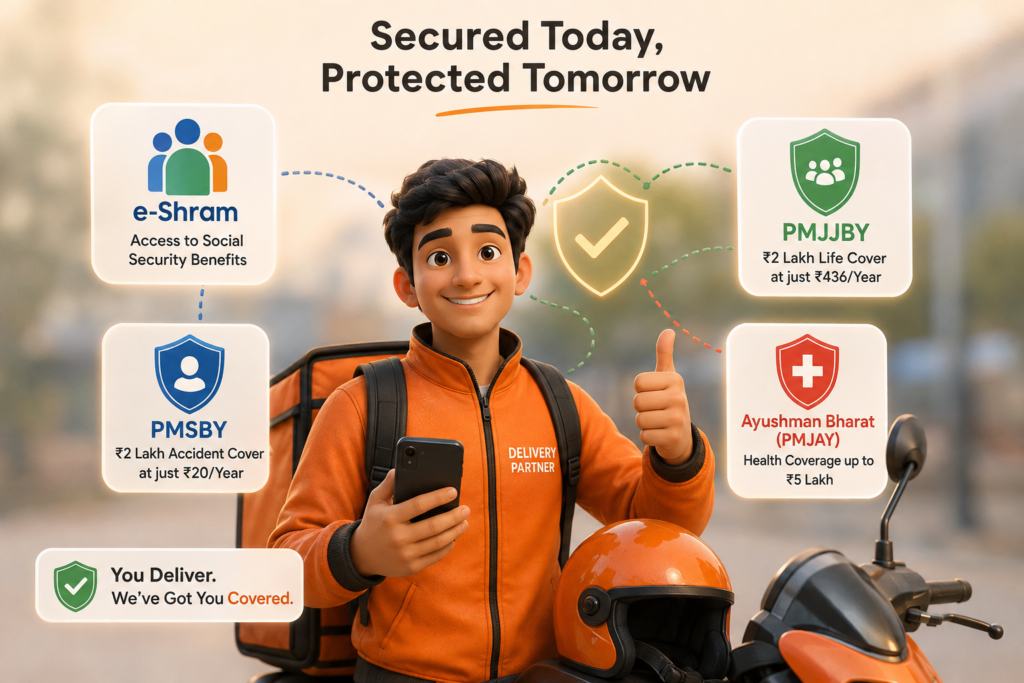
Beyond e-Shram, delivery partners can access PMSBY (₹2 lakh accident cover for ₹20/year), PMJJBY (₹2 lakh life cover for ₹436/year), and Ayushman Bharat-PMJAY (healthcare coverage, with gig workers slated for coverage up to ₹5 lakh under recent policy expansion) — see our e-Shram portal guide, government schemes for delivery partners, and the new Labour Codes’ social security provisions for gig workers. We cover this in dedicated depth in E-Shram, PF & Insurance for Delivery Partners: What Office Workers Should Know Before Switching.
How to Switch — 3 Steps to Get Started
- Check your documents. You’ll need:
- A valid driving license (two-wheeler category, for bike/scooter delivery)
- Aadhaar card
- PAN card
- A bank account in your own name for payouts
- Your own two-wheeler, or confirmation of a rental/partner-vehicle scheme in your city
- Apply online. Submit your details through Alpha Reach’s delivery partner application — no interview, no resume, no waiting for a callback.
- Get verified. Document checks are typically completed within 24–48 hours of applying.
- Start earning. Most applicants are active on the road and completing orders within 3 days of applying — many while still finishing notice period at their current job.
Should you quit first, or switch gradually? Most BPO and data-entry staff who make this move well start part-time — early mornings or evenings around their current shift — for 1–2 weeks before deciding to switch fully. That validates real earnings in your specific city and zone before giving up a fixed (if capped) salary.
Not the Right Fit? See the Segment That Matches You
This hub focuses on indoor, high-stress, night-shift roles. If you’re already doing delivery-adjacent informal work, the switch is even more direct — see that guide instead. If you’re starting from zero experience with no local job network, including students, women re-entering the workforce, or new-to-the-city workers, see our eligibility hub for that segment.
Frequently Asked Questions
Is switching from a BPO job to delivery work risky?
It’s a different kind of risk — you trade a fixed (but capped) monthly salary and formal benefits for variable income tied to hours worked. Most BPO and data-entry staff start delivery work part-time alongside their current job before switching fully.
Will I lose my EPF and health insurance if I switch from a BPO job?
Formal-sector EPF from your current employer stays in your account even after you leave — it doesn’t disappear. As a gig worker, register on the e-Shram portal to access separate unorganized-worker social security schemes including accident and life insurance.
Do I need any experience to become a delivery partner?
No prior delivery experience is required. You’ll need a valid driving license, Aadhaar, PAN, and a bank account — see the “How to Switch” section above for the full document checklist.
How is delivery partner pay different from a BPO salary?
Your BPO salary is fixed regardless of call volume or targets hit. Delivery pay is per-order — more active hours and completed orders generally mean more income, though it varies with local demand and current base-pay rates.
Can I avoid night shifts completely as a delivery partner?
Yes. Unlike a BPO roster set by an operations manager, you choose your own login hours. Many delivery partners work daytime and evening peak windows only and skip late-night hours entirely.
Ready to Make the Switch?
Whether you’re on a BPO floor answering calls under a target sheet, or entering data at a back-office desk under a fixed shift, the math is the same: your current job has a ceiling and a fixed schedule, and delivery work has neither. Apply to become a delivery partner today and get verified within days.