If you’re comparing data entry job vs delivery job salary numbers, the short version is: delivery partner income clears typical data-entry pay in metro cities, and trades a fixed desk for open hours.
Data Entry Clerk Salary in 2026: What You Actually Earn
Data-entry operators and back-office clerks in India average ₹22,000/month nationally (Indeed, 2026 data), with regional variation — slightly lower in some states (~₹20,800/month), slightly higher in others (~₹24,000/month). Most roles cluster in the ₹18,000–24,000/month band regardless of location.
Unlike a role with clear performance-linked incentives, data-entry pay tends to rise with tenure and seniority rather than volume or speed — a clerk with 8+ years of experience earns meaningfully more than an entry-level hire, but the year-over-year jump within the same role is usually small. The job itself is repetitive, screen-based, and offers little variety day to day.
Delivery Partner Salary in 2026: What You Actually Earn
Delivery partner pay works on a different structure — you’re paid per order, not per hour or per data entry batch. Current base pay runs ₹15–35 per order depending on platform and distance, with some zones recently cut to ₹12–16/order. Realistic full-time take-home lands at ₹25,000–30,000/month in metro cities, and ₹12,000–15,000/month in Tier-2/3 cities after fuel and deductions.
If you’d still rather work indoors, some platforms run dark-store picker/packer roles capped around ₹25,000/month — closer to a warehouse-style job than road delivery, but still without the fixed-desk data-entry grind.
Side-by-Side: Data Entry vs Delivery Partner Salary (2026)
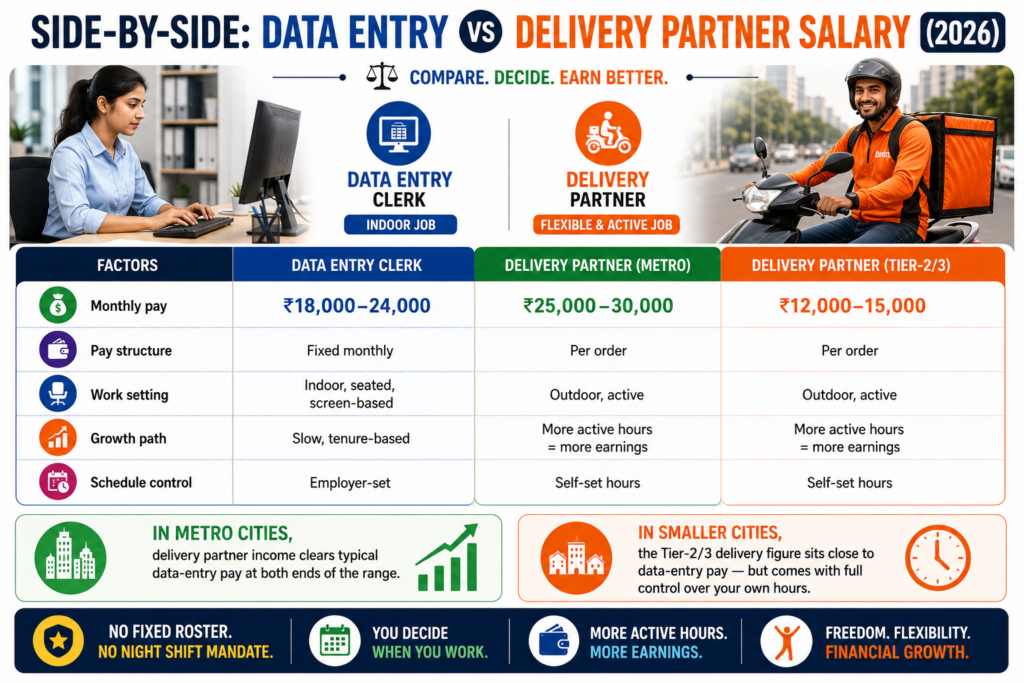
In metro cities, delivery partner income clears typical data-entry pay at both ends of the range. In smaller cities, the Tier-2/3 delivery figure sits close to data-entry pay — but comes with full control over your own hours.
Do the Math: Take-Home After Costs
Data-entry pay is close to what lands in your account — no fuel or vehicle cost involved. Delivery income needs one more step before comparing fairly.
- Fuel: Budget roughly ₹150–250/day for a two-wheeler doing full-time delivery hours.
- Vehicle wear: Servicing, tyres, and minor repairs add up faster with daily riding.
- Phone data: A stable data plan for the delivery app runs through battery and data quickly across a full shift.
The ₹25,000–30,000/month metro and ₹12,000–15,000/month Tier-2/3 figures already account for typical fuel and deductions — that’s what makes them fair to compare directly against data-entry’s largely cost-free wage.
Which Job Should You Choose?
Stick with data entry if: you prefer predictable indoor work and steady tenure-based growth, or you’re on track toward a supervisory back-office role.
Switch to delivery if: the repetitive, sedentary nature of the job is affecting your health or motivation, your pay has plateaued, and you’d rather your income track hours worked.
For the broader picture across BPO and back-office roles, see our BPO to Delivery Job Switch Hub. If you’re weighing a call-center role instead, see BPO Job vs Delivery Partner Salary: Which Pays More in 2026?
What About Job Security?
Formal data-entry roles typically come with an appointment letter but rarely with meaningful benefits beyond statutory PF. Gig work trades that for flexibility — and it isn’t unprotected. Register on the government’s e-Shram portal (register.eshram.gov.in) as a delivery partner to access accident insurance and other unorganized-worker benefits. See our full rundown of government schemes for delivery partners.
Frequently Asked Questions
Does delivery partner pay really beat data entry salary?
In metro cities, yes — ₹25,000–30,000/month for full-time delivery partners clears the typical ₹18,000–24,000/month data-entry range. In smaller cities the gap narrows, but delivery income still scales with hours worked.
Do I need computer skills for delivery work?
No — you’ll need basic comfort using a smartphone app for order navigation and payments, which is a lower bar than the typing speed and accuracy typically required for data-entry roles.
Can I try delivery work part-time before quitting my data entry job?
Yes — many data-entry staff start with early-morning or evening delivery shifts around their existing roster for 1–2 weeks to validate real local earnings before switching fully.
Is data-entry experience useful for delivery work?
Data-entry builds accuracy, discipline, and comfort following structured processes — useful habits, though delivery work relies more on route familiarity, punctuality, and physical stamina.
Ready to Compare Your Own Numbers?
Apply to become a delivery partner and see what you’d actually earn in your city — verification typically takes 24–48 hours.