If you’re a chowkidar, a newspaper or milk delivery agent, a petrol pump attendant, or a local courier boy, you’re already doing the hardest parts of a delivery job — early starts, being out in all weather, moving through your area on foot or on a bike. As an informal worker moving to delivery partner work, the switch is smaller than it looks, because you’re not learning a new skill. You’re getting paid properly for one you already have.
This hub compares four common informal and delivery-adjacent jobs against real, sourced 2026 delivery partner earnings, and links to a detailed comparison for each.
Why Are Informal Workers Switching to Delivery Jobs in 2026?
Chowkidars, newspaper agents, milk delivery boys, petrol pump attendants, and local courier boys all share one problem that’s different from a typical blue-collar job: the pay is informal, often cash-in-hand, with no fixed hours, no overtime, no leave, and usually no insurance. You’re doing physical, outdoor, route-based work — literally delivery in most cases — but the pay structure hasn’t caught up with what the work actually is.
App-based delivery platforms pay per completed order, verify your income digitally, and give you access to formal social-security registration through schemes like e-Shram. For someone already doing informal delivery-adjacent work, this isn’t a career change. It’s a format change — same daily grind, properly tracked and properly paid.
Chowkidars & Watchmen → Delivery Partner
Informal, non-agency chowkidars — the kind hired directly by a housing society, shop, or street of houses — typically earn ₹8,000–15,000/month in cash, often for 10–12 hour night shifts with no weekly off. Agency-employed security guards do somewhat better, generally ₹15,000–18,000/month entry-level, since agencies bill clients well above what they pay the guard (Indeed, PayScale, SecurityForce — 2026 data).
Both sit well below realistic full-time delivery partner take-home. See the full numbers: Chowkidar vs Security Guard vs Delivery Partner: Full Salary Comparison 2026, or go straight to the step-by-step switch process: From Chowkidar to Delivery Partner: Step-by-Step Guide (2026).
Newspaper & Milk Delivery Agents → Delivery Partner
Newspaper hawkers and milk delivery agents work early-morning rounds — usually 2–4 hours before most jobs even start — earning ₹5,000–12,000/month combined on a per-subscriber commission that barely moves even as the route gets bigger. There’s no path to double that income without doubling the physical route.
App-based delivery work uses the same early-morning stamina and route familiarity but pays per order, all day, not just for a few morning hours. Full comparison: Newspaper & Milk Delivery Agent vs App-Based Delivery Partner: 2026 Earning Guide, or jump to the switch guide: Milk & Newspaper Vendors: How to Start Earning 2-3X More on Delivery Apps.
Petrol Pump Attendants → Delivery Partner
Petrol pump attendants average ₹9,000–15,000/month for long standing shifts, largely fixed no matter how many vehicles they serve that day (Indeed, PayScale, WageIndicator — 2026 data). It’s steady, but it has the same ceiling problem as any fixed-wage job — busy days and slow days pay exactly the same.
The switch to delivery work trades a fixed pump-side shift for a route where more completed orders directly means more pay. See the numbers: Petrol Pump Attendant vs Delivery Partner: Which Job Pays More in 2026?, or the case for switching in detail: 5 Reasons Petrol Pump Workers Are Switching to App-Based Delivery Jobs.
Local Courier & Parcel Boys → Delivery Partner
Local courier and parcel delivery boys working for regional logistics firms typically earn ₹12,000–18,000/month, sometimes on a fixed-plus-small-incentive structure that caps out fast regardless of how many parcels they clear (Indeed, Glassdoor — 2026 data).
This is the closest profession on this list to app-based delivery work already — same bike, same city roads, same daily parcel-drop rhythm. The difference is largely in who pays better per stop. Full comparison: Local Courier Boy vs Zomato/Swiggy/Blinkit Partner: Salary Comparison 2026, or go straight to registration: Local Courier to Verified Delivery Partner: Registration Guide (2026).
In Bangalore? See our city-specific breakdown: Chowkidar & Courier Jobs vs Delivery Partner Salary in Bangalore (2026).
How Much Can You Actually Earn as a Delivery Partner in 2026?
Be skeptical of any number that isn’t sourced — platform ads often lead with best-case figures. Here’s what’s currently verifiable:
- Base pay per order: ₹15–35, with Blinkit and Zepto typically at ₹25–35 for short-distance orders — see live Blinkit and Zepto per-order rate cards.
- Recent cuts: some zones have seen base pay drop to ₹12–16/order — confirm current rates in your city before committing full-time hours.
- Realistic monthly take-home: ₹25,000–30,000 in metro cities for full-time riders, and ₹12,000–15,000 in Tier-2/3 cities after fuel and deductions — full breakdown in our delivery partner earnings guide.
Check current pay by platform: Blinkit · Zomato · Swiggy · Zepto
Side-by-Side: Informal Job vs Delivery Partner Pay (2026)
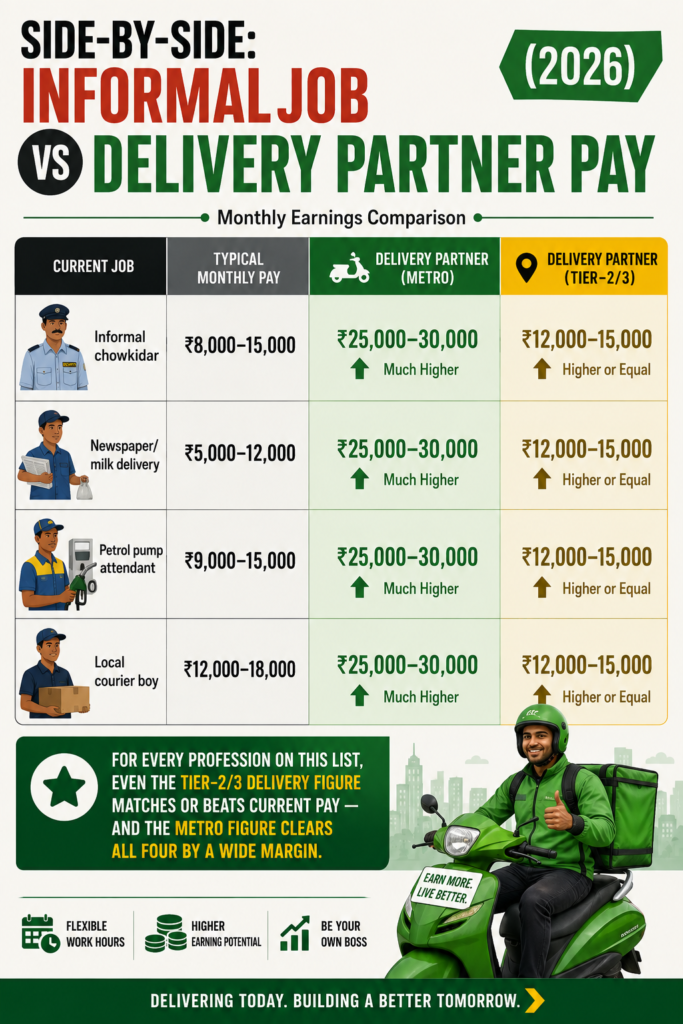
For every profession on this list, even the Tier-2/3 delivery figure matches or beats current pay — and the metro figure clears all four by a wide margin.
What About Job Security, PF, and Insurance?
This is the most common objection informal workers raise, and it’s a fair one — most chowkidar, hawking, pump-attendant, and courier jobs already pay informally with zero benefits, so “no safety net” isn’t a new risk from switching. It’s often an improvement.
Register on the government’s official e-Shram portal (register.eshram.gov.in) to access social security benefits for unorganized and gig workers, including accident insurance coverage — see our full walkthrough: e-Shram portal for gig workers. The government’s new Labour Codes have also expanded social security coverage for gig workers nationally, alongside existing schemes covered in our government schemes for delivery partners guide. We cover this in dedicated depth in E-Shram, PF & Insurance for Delivery Partners: What Office Workers Should Know Before Switching.
Not an Informal Worker? See the Other Pillars
This hub focuses on informal and delivery-adjacent jobs. If your situation is different:
- Stuck in a high-stress office or BPO job instead? See the Escape the Desk: BPO to Delivery Job Switch Hub.
- Starting from zero experience with no informal job history at all? See the Who Can Become a Delivery Partner in 2026? Eligibility Guide.
- Coming from a fixed-wage retail, warehouse, hotel, or construction job? See the Blue-Collar to Delivery Partner Career Switch Hub.
How to Switch — 3 Steps to Get Started
- Check your documents. You’ll need:
- A valid driving license (two-wheeler category, for bike/scooter delivery)
- Aadhaar card
- PAN card
- A bank account in your own name for payouts
- Your own two-wheeler, or confirmation of a rental/partner-vehicle scheme in your city
- Apply online. Submit your details through Alpha Reach’s delivery partner application — no interview, no resume, no waiting for a callback.
- Get verified. Document checks are typically completed within 24–48 hours of applying.
- Start earning. Most applicants are active on the road and completing orders within 3 days of applying — many while still working their current night-watch shift, milk round, or pump duty.
Should you quit first, or switch gradually? Most informal workers who make this move well start part-time — early mornings before a pump shift, or evenings after a chowkidar duty — for 1–2 weeks before deciding to switch fully. That lets you validate real local earnings before giving up whatever informal income you currently have.
Frequently Asked Questions
Is delivery work more or less secure than my current informal job?
Most informal jobs like chowkidar duty, newspaper rounds, and pump-attendant work already have no written contract, no PF, and no fixed leave. Delivery work isn’t more insecure — and it adds access to e-Shram registration and accident insurance that most informal jobs never offer.
Do I need my own vehicle to become a delivery partner?
Most platforms require a two-wheeler and a valid driving license. Some city zones offer rental or partner-vehicle programs — confirm availability in your city during application.
I already have a bike from my courier or pump job — does that help?
Yes. If you already own or have regular access to a two-wheeler, you meet one of the main requirements immediately — many courier boys and pump attendants already do.
Can I do delivery work part-time alongside my current chowkidar or courier job?
Yes — many informal workers start with a few hours before or after their current shift to test real earnings in their zone before switching fully.
How is delivery partner pay different from my current per-round or fixed pay?
Chowkidar, hawking, and pump-attendant pay is fixed regardless of effort. Delivery pay is per-order — more active hours and completed orders generally mean more income, though it varies with local demand and current base-pay rates.
Ready to Get Paid Properly for the Work You Already Do?
Whether you’re standing night watch, running a paper round, manning a pump, or running local parcels, the pattern is the same: you’re already doing delivery-adjacent work for less than it’s worth. Apply to become a delivery partner today and get verified within days.