
If you’re trying to figure out the best job to switch to delivery partner work from, the honest answer is: it depends on your current profession, but almost every fixed-wage or informal job on the market today sits at or below what a full-time delivery partner can realistically earn in 2026. This guide puts all 14 professions we’ve researched across this site side-by-side — with real, sourced pay figures — so you can find your own job in the table below and see exactly where you stand.
Why Compare 14 Professions at Once?
Across this site, we’ve built four separate pillar guides — for fixed-wage blue-collar workers, informal and delivery-adjacent workers, indoor high-stress office staff, and new entrants to the job market — each comparing 2–4 professions against delivery partner pay. This roundup pulls all of that sourced data into one place, because the honest answer to “should I switch?” often depends less on which pillar you’re in and more on how your specific current wage stacks up against the two numbers that matter most: ₹25,000–30,000/month in metros and ₹12,000–15,000/month in Tier-2/3 cities for realistic full-time delivery partner take-home (full breakdown in our delivery partner earnings guide).
The Full Comparison: 14 Professions vs Delivery Partner Pay (2026)
| # | Profession | Pillar | Typical Current Monthly Pay | Delivery Partner (Metro) | Delivery Partner (Tier-2/3) |
|---|---|---|---|---|---|
| 1 | Retail sales staff | A | ₹16,000–25,000 | ₹25,000–30,000 | ₹12,000–15,000 |
| 2 | Warehouse/loader staff | A | ~₹17,900 | ₹25,000–30,000 | ₹12,000–15,000 |
| 3 | Waiter/hotel staff | A | ₹13,900–17,000 (+tips) | ₹25,000–30,000 | ₹12,000–15,000 |
| 4 | Construction labour (unskilled–semi-skilled) | A | ₹9,000–19,500* | ₹25,000–30,000 | ₹12,000–15,000 |
| 5 | Informal chowkidar/watchman | B | ₹8,000–15,000 | ₹25,000–30,000 | ₹12,000–15,000 |
| 6 | Newspaper & milk delivery agent | B | ₹5,000–12,000 | ₹25,000–30,000 | ₹12,000–15,000 |
| 7 | Petrol pump attendant | B | ₹9,000–15,000 | ₹25,000–30,000 | ₹12,000–15,000 |
| 8 | Local courier/parcel boy | B | ₹12,000–18,000 | ₹25,000–30,000 | ₹12,000–15,000 |
| 9 | BPO/call center agent (entry–mid) | C | ₹12,000–25,000 | ₹25,000–30,000 | ₹12,000–15,000 |
| 10 | Data entry/back-office clerk | C | ~₹18,000–24,000 | ₹25,000–30,000 | ₹12,000–15,000 |
| 11 | Students/freshers (part-time) | D | No fixed prior wage | Scales with hours** | Scales with hours** |
| 12 | Women re-entering workforce | D | Variable (career break) | ₹25,000–30,000 | ₹12,000–15,000 |
| 13 | Retired/ex-servicemen | D | Pension-dependent | ₹25,000–30,000* | ₹12,000–15,000* |
| 14 | Migrant workers, new to city | D | Variable, contractor-dependent | ₹25,000–30,000 | ₹12,000–15,000 |
Construction range assumes 25–30 working days/month at sourced daily rates (₹300–450/day unskilled, ₹450–650/day semi-skilled); daily-wage work is frequently interrupted, so real monthly totals are often lower. Student/part-time earnings scale roughly with hours logged rather than a fixed monthly figure — see the student delivery job guide for hour-by-hour detail. Figures shown are on top of any existing pension; delivery partner registration has no upper age limit.
Sources: Indeed, PayScale, Glassdoor, SecurityForce, and WageIndicator 2026 salary data, as cited in each linked pillar and spoke article below — every figure above is pulled from research already published on this site, not re-derived here.
Pillar A: Fixed-Wage Blue-Collar Jobs
Retail, warehouse, hotel, and construction work share one structural problem: a wage ceiling. You can work every extra hour available and your pay slip looks the same at month-end. Delivery partner income tracks completed orders instead — more active hours generally means more pay. See the full Blue-Collar to Delivery Partner Career Switch Hub, or the detailed breakdown for retail staff specifically: Retail Sales Job vs Delivery Partner Salary: Which Pays More in 2026?
Pillar B: Informal & Delivery-Adjacent Workers
Chowkidars, newspaper and milk agents, petrol pump attendants, and local courier boys are already doing outdoor, route-based work — often literally delivery — for informal, irregular pay with zero benefits. This is the smallest behavior change of any pillar on this list, since the daily physical work barely changes. See the Pillar B hub, or the numbers for the closest comparison: Chowkidar vs Security Guard vs Delivery Partner: Full Salary Comparison 2026
Pillar C: Indoor, High-Stress, Night-Shift Jobs
BPO agents and data-entry clerks face a different problem than a low ceiling — it’s target pressure, forced night shifts, and sedentary health issues, with little control over the schedule. Delivery work trades KPI stress and a fixed desk for open hours and physical activity. See the Pillar C hub, or the direct comparison: BPO Job vs Delivery Partner Salary: Which Pays More in 2026?
Pillar D: New Entrants & Underemployed Segments
Students, women re-entering the workforce, retired professionals and ex-servicemen, and migrant workers new to a city share a different pain point: no local job network, no experience required elsewhere, and a need for income now. Delivery work’s low eligibility bar — no résumé, no interview — fits all four segments. See the Pillar D eligibility hub, or the student-specific breakdown: Part-Time Delivery Job for Students: Earn While You Study (2026 Guide)
Real Stories: One Rider From Each Pillar
Numbers only tell part of the story — here’s what the switch actually looks like for someone in each of the four pillars, told as representative, illustrative profiles built on the same sourced data used throughout this roundup (not verified accounts of specific named individuals):
- Pillar A: Real Story: How a Retail Worker in Pune Doubled His Income as a Delivery Partner
- Pillar B: Real Story: A Chowkidar’s Journey to Earning ₹30,000+ as a Delivery Partner
- Pillar C: Real Story: Why a BPO Employee Quit Her Desk Job for Delivery Work
- Pillar D: Real Story: A Student’s Part-Time Delivery Job Journey (2026)
Each story walks through the same pattern seen across the comparison table above: a fixed or informal wage with a hard ceiling, a period of testing delivery work part-time to validate real local earnings, and then a decision — informed by numbers, not guesswork — about whether to switch fully.
How Delivery Partner Pay Actually Works
Unlike every fixed-wage job in the table above, delivery partner income is paid per completed order, not per shift or per month. Current base pay runs ₹15–35 per order depending on platform and distance, with Blinkit and Zepto typically at the ₹25–35 end for short trips and Swiggy Instamart ranging higher for longer distances — see live Blinkit, Zomato, Swiggy, and Zepto payout pages for current rates. Some zones have recently cut base pay to ₹12–16/order — always confirm current rates in your city before committing full-time hours.
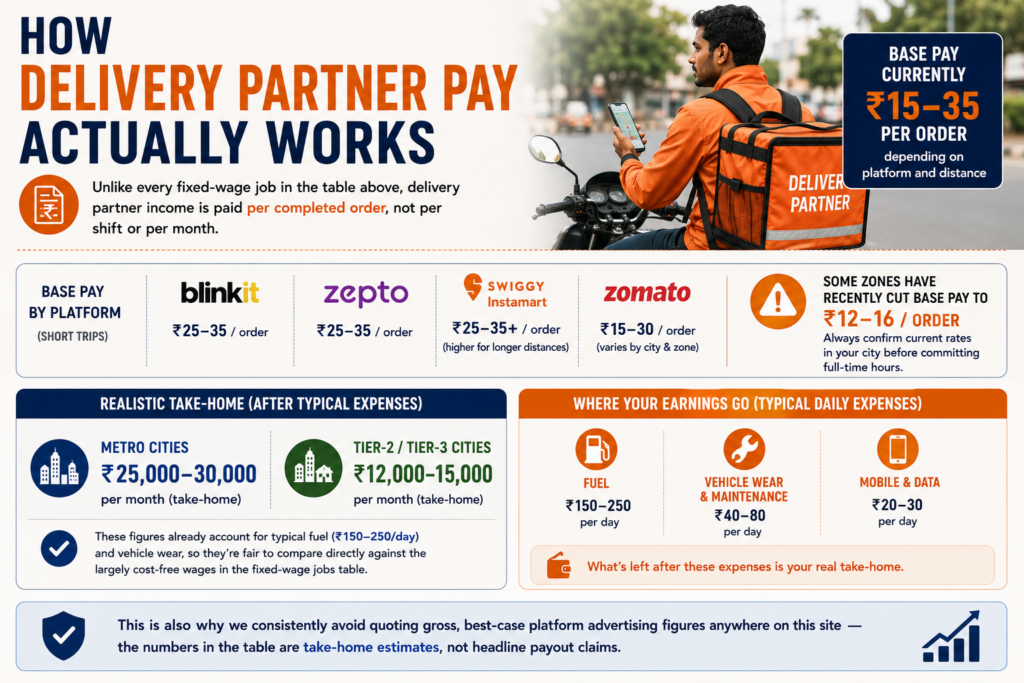
The realistic take-home figures used throughout this comparison — ₹25,000–30,000/month in metros and ₹12,000–15,000/month in Tier-2/3 cities — already account for typical fuel (₹150–250/day) and vehicle wear, so they’re fair to compare directly against the largely cost-free wages in the table above. This is also why we consistently avoid quoting gross, best-case platform advertising figures anywhere on this site — the numbers in the table are take-home estimates, not headline payout claims.
Which Segment Sees the Biggest Jump?
Ranking the professions in the table by percentage gap against the metro delivery figure puts the informal, Pillar B segment at the top: newspaper and milk delivery agents (₹5,000–12,000/month) and informal chowkidars (₹8,000–15,000/month) see the widest gap, since their current pay is both low and structurally capped by a fixed subscriber list or a single employer’s discretion. Data-entry clerks and experienced BPO agents (Pillar C) see the narrowest gap, since their formal-sector pay already sits closer to the delivery range — though they typically gain more in schedule control and reduced health strain than in raw income.
For new-entrant segments in Pillar D — students, women re-entering work, ex-servicemen, and migrant workers — the comparison isn’t against a prior wage at all in most cases, but against zero or unreliable income. That makes delivery work’s combination of a low eligibility bar and predictable per-order pay arguably the most valuable of any pillar on this list, even though it doesn’t show up as a single dramatic percentage figure in the table.
What About Job Security, PF, and Insurance?
This is the most common objection across every profession on this list, and it’s a fair one — gig work doesn’t come with a traditional appointment letter. But most workers considering this switch already have limited or no benefits: informal chowkidars, newspaper agents, and petrol pump attendants typically have no written contract at all, and even formal-sector EPF from a retail, BPO, or warehouse job stays untouched in your account after you leave.
Register on the government’s official e-Shram portal (register.eshram.gov.in) to access social security benefits for unorganized and gig workers, including accident insurance. Delivery partners can also access PMSBY, PMJJBY, and Ayushman Bharat coverage — see our full government schemes for delivery partners guide, and how the government’s new Labour Codes have expanded social security coverage for gig workers nationally.
How to Switch, Regardless of Your Current Profession
The eligibility bar is identical no matter which of the 14 professions above you’re coming from:
- Check your documents: valid two-wheeler driving license, Aadhaar card, PAN card, and a bank account in your own name.
- Apply online through Alpha Reach’s delivery partner application — no interview, no resume.
- Get verified — document checks typically complete within 24–48 hours.
- Start earning — most applicants are active on the road within 3 days.
Should you quit first, or switch gradually? Across all four pillars, the pattern that works best is the same: start part-time for 1–2 weeks around your current job to validate real local earnings, before deciding whether to switch fully.
Frequently Asked Questions
Which profession benefits most from switching to delivery work?
Informal, delivery-adjacent workers (Pillar B — chowkidars, newspaper/milk agents, petrol pump attendants, courier boys) tend to have the smallest behavior change, since the daily physical work is already similar. But in raw income terms, anyone earning below ₹15,000/month sees the largest percentage gap versus metro delivery pay.
Is delivery partner pay really higher than all 14 professions compared here?
In metro cities, yes — the ₹25,000–30,000/month range clears every fixed current wage in the table. In Tier-2/3 cities, the ₹12,000–15,000/month range still matches or beats most of the lower-paying professions (chowkidar, newspaper/milk delivery, petrol pump) while narrowing against higher-paying ones (experienced BPO, courier boy).
Do I need experience to become a delivery partner, regardless of my current job?
No. Every pillar and profession above shares the same eligibility bar: a valid driving license, Aadhaar, PAN, and a bank account — no prior delivery or driving-job experience required.
How fast can someone from any of these 14 professions start earning?
Document verification typically takes 24–48 hours across all profiles, and most applicants are completing their first orders within 3 days of applying.
Will I lose my current job’s benefits if I switch?
Formal-sector EPF or gratuity from a retail, BPO, or warehouse job stays in your account after you leave — it isn’t forfeited. Informal jobs (chowkidar, newspaper delivery, petrol pump) typically have no such benefits to lose in the first place. Either way, e-Shram registration provides separate gig-worker social security coverage.
Ready to See Where You Stand?
Whichever of these 14 professions matches your current situation, the pattern across every pillar is consistent: delivery partner income has no structural ceiling, and most current wages sit at or below what full-time delivery work realistically pays in 2026. Apply to become a delivery partner today and get verified within days.