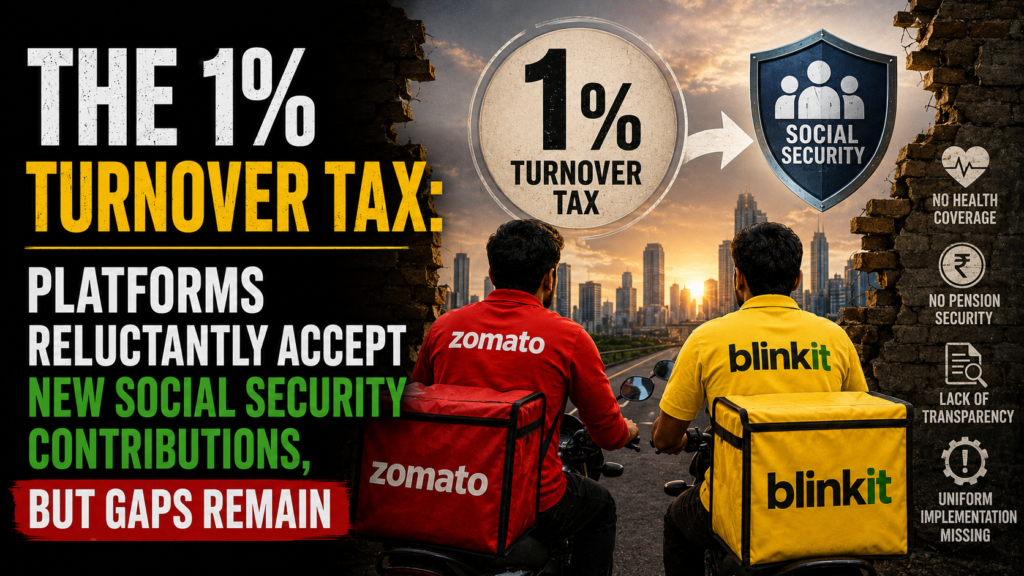
After years of intense legislative debate, the central government has finally notified the rules under the Code on Social Security, 2020, forcing tech aggregators to take direct financial responsibility for their fleets. The most consequential mandate of the new framework requires major platforms—including Uber, Ola, Swiggy, Zomato, and Flipkart—to contribute between 1% and 2% of their annual turnover towards a designated, state-managed social security fund for gig workers. This fund is explicitly earmarked to provide vital benefits like accident insurance, health cover, disability compensation, and old-age protection for a workforce projected to reach 2.35 crore by 2030.
The Controversial “90-Day” Eligibility Hurdle
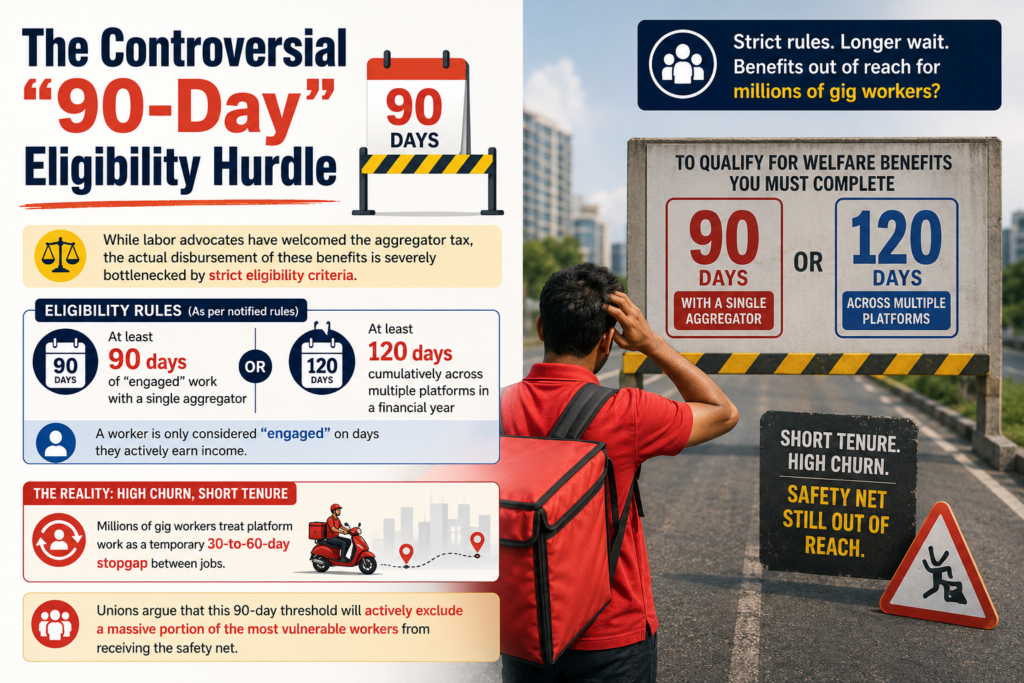
While labor advocates have welcomed the aggregator tax, the actual disbursement of these benefits is severely bottlenecked by strict eligibility criteria. Under the notified rules, a gig worker must complete at least 90 days of “engaged” work with a single aggregator, or 120 days cumulatively across multiple platforms in a financial year, to qualify for any welfare benefits. A worker is only considered “engaged” on days they actively earn income. Given the massive churn rate in the gig economy—where millions treat platform work as a temporary 30-to-60-day stopgap between jobs—unions argue that this 90-day threshold will actively exclude a massive portion of the most vulnerable workers from receiving the safety net.
The Threat of “Pass-Through” Costs
Legal experts are also raising red flags regarding the economic realities of this new compliance burden. Because gig workers remain legally classified as independent contractors rather than formal employees, there are no statutory wage protections. Experts warn there is a distinct risk that aggregators will simply treat this 1-2% turnover tax as a “pass-through” compliance cost. Instead of absorbing the hit to their profit margins, platforms might subtly slash the per-order base payouts, effectively forcing the gig workers to unknowingly fund their own social security schemes.
Conclusion
The mandate forcing multi-billion-dollar aggregators to contribute a fraction of their turnover to a welfare fund is a historic, overdue structural correction. However, a welfare fund is useless if the people who need it most cannot access it. The 90-day eligibility rule fails to understand the highly transient, hyper-flexible nature of gig work. Furthermore, without an iron-clad minimum wage floor, platforms will inevitably offload this new tax burden onto the workers. The government must introduce strict wage auditing to ensure the 1% contribution comes out of the aggregator’s profits, not the driver’s pocket.