
When the Government of Rajasthan passed the Platform Based Gig Workers (Registration and Welfare) Act on July 24, 2023, it made history as the first state in India to legally regulate the engagement of digital platform workers. Fast forward to the release of the Rajasthan Economic Survey 2025–26, and the data paints a highly successful picture of this pioneering legislative experiment. The official state survey highlights that the gig economy has expanded rapidly under this formalized framework, now accounting for approximately 2% of the state’s total formal and informal workforce. This statistical inclusion reflects a massive shift from treating gig work as invisible labor to recognizing it as a critical engine of inclusive state growth.
The Mechanics of the Welfare Framework
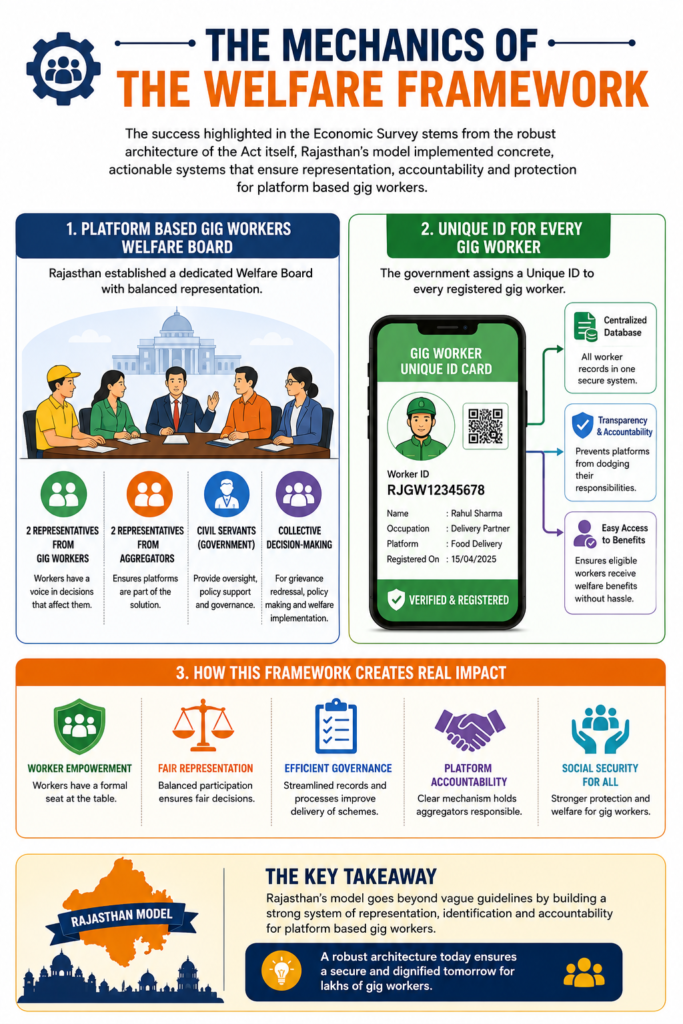
The success highlighted in the Economic Survey stems from the robust architecture of the Act itself. Unlike vague federal guidelines, the Rajasthan model implemented concrete, actionable systems. The state established a dedicated “Platform Based Gig Workers Welfare Board,” uniquely comprising two representatives from the gig workers, two from the aggregators, and civil servants. This ensured that workers actually had a seat at the table for grievance redressal and policy-making. Furthermore, the government actively assigned a Unique ID to every registered gig worker, allowing for efficient, centralized record-keeping that prevents platforms from dodging their responsibilities.
Funding Welfare Through Transaction Surcharges
The most revolutionary aspect of the Rajasthan Act, which has now proven economically viable in the 2025-26 survey period, is its funding mechanism. Instead of relying solely on taxpayer money, the state mandates that aggregators pay a designated “Welfare Fee” based on the value of every single transaction processed through their apps. This micro-surcharge is automatically funneled into a ₹200 crore “Platform Based Gig Workers Fund and Welfare Fee” corpus. Aggregators who attempt to bypass this fee face severe penalties, ranging from ₹5 lakhs for a first offense to a crippling ₹50 lakhs for subsequent violations. This ensures the fund remains liquid and capable of dispensing real social security and insurance benefits to the workers.
Final Word / Thought / Conclusion
The data from the Rajasthan Economic Survey 2025-26 proves that regulating the gig economy does not destroy it. Tech platforms consistently argue that state-imposed welfare fees and registration mandates will kill innovation and force them to shut down operations. Rajasthan’s experience proves the exact opposite: providing a social safety net actually stabilizes the workforce, leading to sustained sector growth (now 2% of the state labor market). The Rajasthan model is a proven, scalable blueprint; the rest of India’s state governments now have no excuse to delay implementing their own transaction-funded welfare boards.