Short answer: to get more rides in Uber Moto, wait near metro stations in the morning rush (about 8–11 AM) and outside tech parks in the evening (about 5–9 PM), accept most requests, cancel very few, and take the next trip the app sends before your current drop. Keep GPS and data on, and set battery use for the Uber Driver app to ‘Unrestricted’.
In the booming on-demand two-wheeler taxi market across Indian metros, sitting idle on your motorcycle waiting for a ride ping eats directly into your daily profits. Thousands of bike owners looking for bike taxi and delivery jobs turn to Uber Moto for flexible working hours and instant trip starts. However, mastering how to get more rides in uber moto requires a technical grasp of passenger demand corridors, dynamic surge heatmaps, and Uber’s proximity matching algorithm in 2026.
Unlike food and grocery delivery where couriers wait for restaurant preparation or dark store packing, Uber Moto drivers move people directly from point A to point B. There are zero waiting times for kitchen packaging, zero heavy backpacks straining your shoulders, and immediate earnings upon drop-off. But because passenger ride requests cluster heavily around transit hubs, corporate corridors, and metro stations, positioning yourself strategically dictates whether you complete 12 rides or 24+ rides per day.
This tactical operational guide breaks down passenger dispatch algorithms, peak office transit corridors, positioning rules around metro stations and railway terminals, and technical smartphone tweaks that keep your Uber Driver app ringing with high-fare ride requests.
Understanding these dispatch secrets allows bike taxi captains to eliminate unpaid idle waiting, qualify for high-tier trip milestone bonuses, and maximize daily take-home earnings.
Deconstructing Uber Moto’s Algorithmic Ride Dispatch System
To command a steady stream of high-fare passenger trips, you must understand how Uber’s dispatch engine pairs commuters with two-wheeler captains. Ride-hailing apps aim to keep passenger wait times short, so they mostly match each request to a nearby, available captain.
When a commuter opens the Uber app and requests an Uber Moto ride, the dispatch server scans active, available drivers within a 1.5 to 3.0-kilometer radius. The algorithm calculates the driver’s Estimated Time of Arrival (ETA) based on real-time traffic speeds, turn restrictions, and road congestion.
However, the matching server does not evaluate physical distance alone. It strongly factors in your Driver Acceptance Rate (accepting incoming pings promptly), Cancellation Percentage (canceling fewer than 3% of accepted trips), and your Driver Rating (maintaining 4.85+ stars). Drivers with high reliability scores receive priority matching when multiple bikes are parked in the same commercial cluster.
Top-earning captains also monitor flight and train arrival schedules. Positioning yourself near major inter-city bus terminals and railway stations right when long-distance trains arrive guarantees immediate long-distance passenger pickups.
Ride Volume Optimization: Average Rider Habit vs High-Earning Uber Captain
Small adjustments to your daily positioning routine and route selection can double your daily completed trips. The table below illustrates the contrast between an average idle driver and an algorithmic top-earner in 2026:
| Operating Parameter | Average Idle Driver Habit | Pro High-Volume Captain Strategy |
| Waiting Location | Parked in quiet residential colonies | Stationed 100m from high-traffic metro exits |
| Morning Rush Focus (08–11 AM) | Scattered logins in random sectors | Positioned at suburban metro stations feeding IT parks |
| Acceptance Behavior | Rejects short trips; waits for long rides | Accepts short trips rapidly to complete daily quests |
| Evening Commute Focus (05–09 PM) | Wandering against commuter traffic flow | Positioned inside corporate tech parks catching departures |
| Device & Network Health | Aggressive battery saver kills background GPS | Unrestricted GPS & dual-SIM data connectivity |
Looking for bike taxi or delivery work? See jobs near you.
Top 5 Hotspot Strategies to Trigger Instant Uber Moto Pings
Implementing these field-tested positioning techniques will keep your Uber Driver app continuously active throughout your shifts:
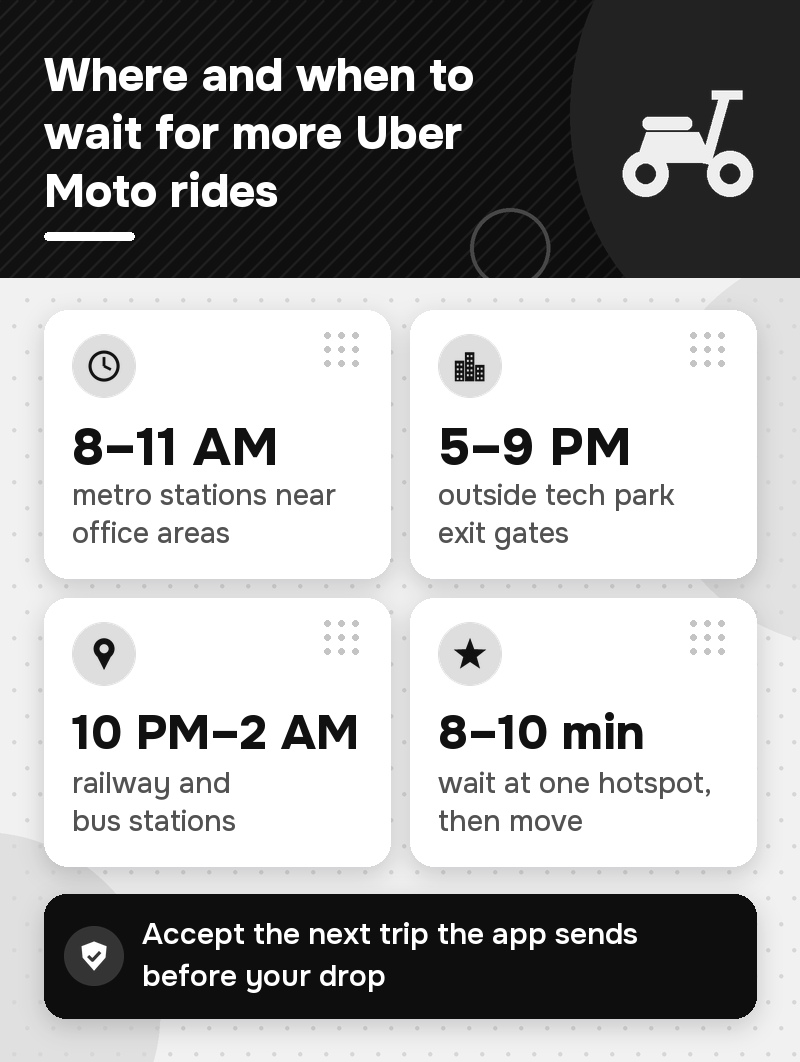
- The Metro Station Feeder Corridor Rule: Many urban Uber Moto trips are short ‘first-mile and last-mile’ rides between homes and metro stations. Park within 100 to 150 meters of busy metro feeder stations during morning (08:00 AM – 11:00 AM) and evening (05:00 PM – 09:00 PM) rush hours.
- Station Yourself Outside Tech Parks at Shift End: In major IT hubs (such as Whitefield in Bengaluru, DLF Cyber City in Gurugram, or HITEC City in Hyderabad), corporate employees leave offices in waves between 05:30 PM and 08:30 PM. Waiting along arterial exit roads guarantees immediate surge-priced trips.
- Capitalize on Rain & Extreme Weather Surges: When sudden rain showers hit, demand for auto-rickshaws and cabs jumps, and fares often surge, by an estimated 1.5x–2.0x at busy times. Surge changes by city, time and weather, so check the heat map in the app. Drivers equipped with waterproof gear who remain active capture continuous high-fare trips.
- Maintain High Acceptance to Build Dispatch Momentum: Declining several rides in a row can put you in a short cool-down with fewer requests. Accepting consecutive trips signals reliability, and the app may send you the next trip before your current passenger gets off.
- Use Uber’s ‘Set Destination’ Feature Wisely: When heading home after a long shift, use the ‘Driver Destination’ filter twice a day. This ensures the app only assigns trips heading in the exact direction of your residence, turning your return commute into paid mileage.
How Do You Get Back-to-Back Rides on Uber Moto?
Accept the next trip the app sends you near the end of your current ride. This is called forward dispatch. When your passenger gets off, you ride straight to the next pickup with no waiting.
- How it works: close to your drop-off, the app alerts you with a nearby pickup. Your next trip starts as soon as this one ends.
- Accept it: it saves the minutes you would spend parked and waiting for a new request.
- Don’t switch off new requests: use ‘Stop new requests’ only when you really want a break.
Airport, Railway and Tech Park Tips for Bike Captains
- Virtual queues: at some airports and big stations, the app puts you in a queue when you enter the pickup zone. If you ride out of the zone, you lose your place. Use only the pickup points the app shows.
- Wait at the side exits: stand near walking exits, away from the car lanes. Bike taxi passengers want a quick pickup away from the jam.
- Show your spare helmet: keep the passenger helmet where people can see it, so your passenger spots your bike quickly in a crowd.
- Late nights (about 10 PM – 2 AM): railway junctions and inter-state bus stations stay busy when most other areas are quiet.
Why Acceptance Rate and Low Cancellations Drive Dispatch Flow
Uber tracks driver reliability with extreme precision. While drivers operate as independent contractors with the legal right to decline trips, the dispatch engine naturally rewards dependable drivers who accept over 90% of requests.
Drivers who frequently cancel trips after accepting them—especially after calling the passenger to ask for their destination or requesting off-app cash payments—face algorithmic throttling, losing access to premium surge multipliers and lucrative weekly trip quest bonuses.
Maintaining a pristine cancellation record under 3% keeps your profile in the top tier of driver reliability, ensuring you stay at the front of the virtual queue.
Technical Smartphone & GPS Network Calibration Hacks
Because Uber calculates passenger ETAs down to the exact second, any cellular latency or GPS drifting can cause the dispatch system to bypass your motorcycle in favor of another driver.
Ensure your phone’s battery settings for the Uber Driver app are set to ‘Unrestricted’ in Android settings, preventing the operating system from suspending background location tracking when the screen locks. Keep the Uber Driver app updated from the Play Store too.
Clear your Uber Driver app cache weekly to remove corrupted navigation tokens and temporary map files. Carrying a dual-SIM smartphone allows you to switch data networks instantly if one telecom carrier suffers tower congestion in crowded commercial zones.
Frequently Asked Questions (FAQs)
Why am I not getting ride requests on Uber Moto even in busy areas?
Lack of ride pings usually occurs due to high driver overcrowding in that specific block, GPS location drifting caused by phone battery savers, or your account entering a temporary algorithmic cool-down after rejecting recent ride offers.
How many rides can an Uber Moto driver complete in a full-time shift?
A disciplined full-time driver working 9 to 10 hours across morning and evening commuter peaks typically completes 18 to 24 passenger trips per day.
Do short metro feeder trips pay enough to be profitable?
Yes. While individual short trips have lower fares (₹35–₹55), they can be completed in 8 to 12 minutes with minimal fuel use, allowing you to quickly hit lucrative daily trip quest targets that pay extra cash bonuses.
Can I use Uber Moto to earn extra money while commuting to my regular office job?
Yes. Thousands of professionals use Uber’s ‘Driver Destination’ filter to pick up a paying passenger heading along their exact morning and evening office commute routes, covering their monthly petrol costs completely.
Does driving an electric motorcycle or scooter increase profits on Uber Moto?
Yes. Electric two-wheelers run at approximately ₹0.30 to ₹0.40 per kilometer compared to ₹1.80 to ₹2.20 per km for petrol bikes, saving ₹150 to ₹200 in daily fuel expenses and significantly boosting net take-home pay.
Does declining a low-fare ride hurt my trip priority?
Declining now and then is fine. Letting the timer run out or declining several rides in a row lowers your acceptance rate and can mean fewer requests for a while.
Should I keep riding around or park at one spot while waiting?
Park. Riding around with no passenger burns fuel. Wait near a busy metro gate or mall exit for 8 to 10 minutes, then move to the next hotspot if nothing comes.
Can I use Uber Moto and Rapido together to get more bookings?
Many captains keep both apps on and take whichever sends the closest passenger first. Go offline on one app once you accept a trip on the other, so you don’t have to cancel.
Want to hear about bike taxi and delivery jobs near you? Leave your details and our team will call you back. We never charge riders.
Conclusion
Mastering how to get more rides in uber moto is a science of strategic positioning, high acceptance discipline, and commuter transit synchronization. By positioning near metro stations, working morning and evening office corridors, accepting back-to-back trips and keeping cancellation rates low, bike taxi captains can cut idle waiting and complete more trips every day.