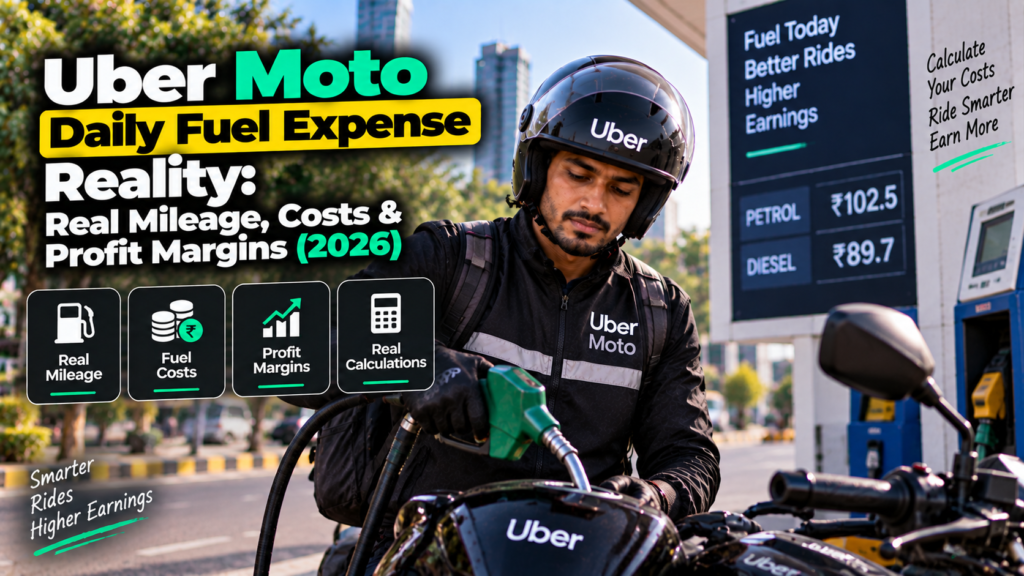
For millions of two-wheeler bike taxi captains across India, daily gross revenue displays on smartphone screens can often paint an overly optimistic financial picture. Ambitious vehicle owners evaluating delivery partner vacancies and ride-hailing gigs must factor in rising petrol prices and stop-and-go metro congestion. Analyzing the uber moto daily fuel expense reality reveals how vehicle engine capacity, deadhead kilometers, tyre pressures, and maintenance schedules directly impact your real net profit in 2026.
Operating a commercial bike taxi is fundamentally different from personal commuting. Carrying pillion passengers of varying weights, idling at red traffic signals, navigating uphill flyovers, and traversing unpaved arterial roads significantly drops your motorcycle’s real-world fuel economy below manufacturer claims.
This data-driven financial breakdown analyzes actual on-road fuel consumption across popular bike segments, calculates daily fuel cost percentages, exposes hidden ‘deadhead’ mileage drain, and outlines technical tuning strategies to preserve your daily earnings.
Gaining complete mastery over your daily fuel budget ensures you retain maximum cash in hand after every shift.
The Fuel Efficiency Gap: Lab Claims vs Commercial Pillion Reality
According to fuel economy benchmarking standards set by the Bureau of Energy Efficiency (BEE), two-wheelers tested under idealized laboratory test cycles report fuel efficiencies between 65 km/l and 85 km/l. However, commercial passenger operations tell a very different story.
In real-world metro riding conditions—carrying adult passengers weighing 65 to 85 kg, enduring frequent clutch slipping, rapid throttle bursts to beat traffic signals, and continuous GPS smartphone charging—real fuel economy drops by 25% to 35%.
A 110cc commuter motorcycle rated at 65 km/l in laboratory tests delivers an actual commercial mileage of 45 to 50 km/l on active Uber Moto duty. A 125cc commuter delivers approximately 40 to 45 km/l, while heavier 150cc to 160cc sport motorcycles drop to 32 to 38 km/l.
With petrol prices averaging between ₹95 and ₹105 per litre across Indian states, calculating your exact fuel cost per kilometer is the foundation of gig profitability.
Comprehensive Daily Fuel Cost & Earnings Matrix Across Bike Segments
The economic comparison table below outlines realistic fuel expenses, daily mileage, and net profit margins across common motorcycle engine categories completing a standard 120 km daily shift in 2026:
| Motorcycle Category & Model | Real City Mileage (Pillion) | Daily Petrol Consumed (120 km) | Daily Fuel Cost (@ ₹100/L) | Gross Earnings (120 km) | Fuel Cost % of Revenue |
| 100cc Commuter (HF Deluxe / Splendor) | 55 km/litre | 2.18 Litres | ₹218 | ₹1,250 | 17.4% (Highest Margin) |
| 110cc City Bike (Honda Shine 100 / Platina) | 50 km/litre | 2.40 Litres | ₹240 | ₹1,250 | 19.2% (Optimal Balance) |
| 125cc Executive (Glamour / Pulsar 125) | 42 km/litre | 2.85 Litres | ₹285 | ₹1,250 | 22.8% (Moderate Margin) |
| 150cc–160cc Sport (Apache / Pulsar 150) | 35 km/litre | 3.42 Litres | ₹342 | ₹1,250 | 27.4% (Heavy Fuel Drain) |
| 110cc Automatic Scooter (Activa / Jupiter) | 38 km/litre | 3.15 Litres | ₹315 | ₹1,250 | 25.2% (CVT Transmission Loss) |
Discover high-paying food and grocery delivery partner vacancies with flexible hours and weekly direct bank transfers. Explore verified gig jobs in your city today.
The Danger of ‘Deadhead’ Kilometers: The Hidden Fuel Thief
The biggest destroyer of daily profits is not high fuel prices alone, but unpaid deadhead kilometers—the distance driven without an active passenger on the pillion seat:
• Reaching Distant Pickups: Accepting a ride ping located 4 kilometers away for a trip that only pays for 3 kilometers results in severe fuel loss.
• Empty Return Trips: Dropping a passenger in a remote residential or industrial suburb and driving back 10 to 15 kilometers with no return fare burns expensive petrol for zero revenue.
• Cruising Aimlessly: Wandering through city streets hoping for a ride ping burns fuel needlessly. Top captains park in strategic demand clusters near metro exits and wait with engines switched off.
5 Mechanical Tuning Secrets to Boost Real-World Mileage by 15%
Implementing proactive maintenance practices can save between ₹1,500 and ₹2,500 in monthly petrol bills:
• Maintain Cold Tyre Pressures (Weekly): Carrying pillion passengers requires slightly higher rear tyre pressure (typically 36 to 38 PSI) compared to solo riding (30 to 32 PSI). Underinflated tyres increase rolling resistance and spike fuel consumption by up to 8%.
• Clean Spark Plugs and Air Filter: In dusty Indian cities, air filters clog within 2,500 km, choking the engine’s air intake and causing rich, fuel-wasting combustion. Clean or replace filters regularly.
• Chain Tension & Lubrication: A dry, loose motorcycle chain wastes engine torque. Clean and lubricate the drive chain every 500 km using specialized chain lube or heavy gear oil.
• Smooth Throttle & Coasting: Avoid aggressive full-throttle accelerations between red lights. Anticipating traffic stops and coasting in gear saves significant fuel over 120 km of daily driving.
Electric Two-Wheeler (EV) vs Petrol Bike Taxi Economics
With the proliferation of commercial EV scooters and battery swapping networks across Indian metros, running costs are undergoing a massive transformation:
• Petrol two-wheelers cost approximately ₹2.00 to ₹2.80 per kilometer in fuel alone.
• Battery-swapped electric scooters cost between ₹0.80 and ₹1.20 per kilometer, slashing daily running expenses by over 50%.
• Captains completing high daily mileage (140+ km) should seriously evaluate transitioning to leased EV fleets to maximize net take-home profits.
When assessing true vehicle operating expenses, bike taxi captains must also budget for consumable wear and tear alongside petrol bills. For every 1,000 kilometers of city passenger duty, captains incur approximately ₹120 in tyre tread wear, ₹130 in brake shoe abrasion, and ₹150 in semi-synthetic engine oil breakdown.
Moreover, adopting modern digital fuel tracking apps (or maintaining a simple odometer mileage logbook) enables captains to detect engine tuning degradations early. A sudden drop of 4 to 5 km/l often signals carbon buildup on throttle bodies or a failing spark plug, allowing timely servicing before excessive petrol is wasted.
Transitioning to commercial electric two-wheelers with monthly battery-swapping subscriptions also locks in fixed operational expenses, insulating gig workers from global crude oil inflation and municipal fuel cess hikes.
Frequently Asked Questions (FAQs)
How much does an Uber Moto driver spend on petrol daily in India?
On average, a full-time Uber Moto captain driving 100 to 130 km per day spends between ₹220 and ₹340 daily on petrol, depending on their motorcycle engine capacity (100cc vs 150cc) and city traffic conditions.
What is the best motorcycle for Uber Moto with maximum mileage?
100cc to 110cc commuter motorcycles such as the Hero Splendor Plus, Bajaj Platina 110, and Honda Shine 100 deliver the highest real-world city mileage (48 to 55 km/l with pillion) and lowest maintenance costs.
Are automatic gearless scooters good for Uber Moto driving?
While scooters like the Honda Activa or TVS Jupiter offer great footboard storage and ease of riding, their Continuous Variable Transmission (CVT) yields lower mileage (35 to 40 km/l) compared to geared bikes, resulting in higher daily fuel bills.
What percentage of daily Uber Moto earnings goes into fuel?
Fuel expenses typically consume between 18% and 28% of a captain’s gross daily earnings. High-mileage 100cc bikes keep fuel costs under 20%, whereas 150cc bikes consume over 27% of gross revenue.
How can I reduce deadhead fuel mileage on Uber Moto?
Reduce deadhead kilometers by declining pickups farther than 2.5 km away, using the ‘Set Destination’ feature when heading home, and parking near transit hubs instead of constantly cruising.
Unlock higher earnings, flexible delivery hours, and verified shift bonuses across top platforms in India. Explore verified gig jobs in your city today.
Conclusion
In summary, understanding the uber moto daily fuel expense reality separates struggling drivers from profitable commercial operators. By choosing fuel-efficient commuter bikes, eliminating empty deadhead runs, and maintaining optimal tyre pressures, you can protect your hard-earned margins and maximize your take-home gig income.

