Bike taxis have established themselves in 2026 as India’s most affordable and agile urban transit solution. For two-wheeler owners seeking flexible daily income, driving as a bike captain offers immediate cash flow without the burden of food packing or heavy grocery crates. When entering this mobility sector, the ultimate comparison boils down to uber moto vs rapido rider income—which platform generates higher ride volume, superior per-kilometer payouts, and greater net monthly profits?
Rapido built its brand as India’s dedicated two-wheeler mobility pioneer, establishing deep penetration across metro hubs and Tier-2/Tier-3 towns. Conversely, Uber Moto leverages Uber’s massive global passenger ecosystem, allowing captains to capture seamless multi-modal bookings and premium airport/corporate commutes.
In this detailed 2026 head-to-head bike taxi benchmark, we evaluate real ride fare structures, commission percentages, daily trip counts, surge mechanics, and captain payout policies to help you maximize your two-wheeler earnings.
Fare Structures & Platform Commission Models
How passenger fares translate into captain earnings:
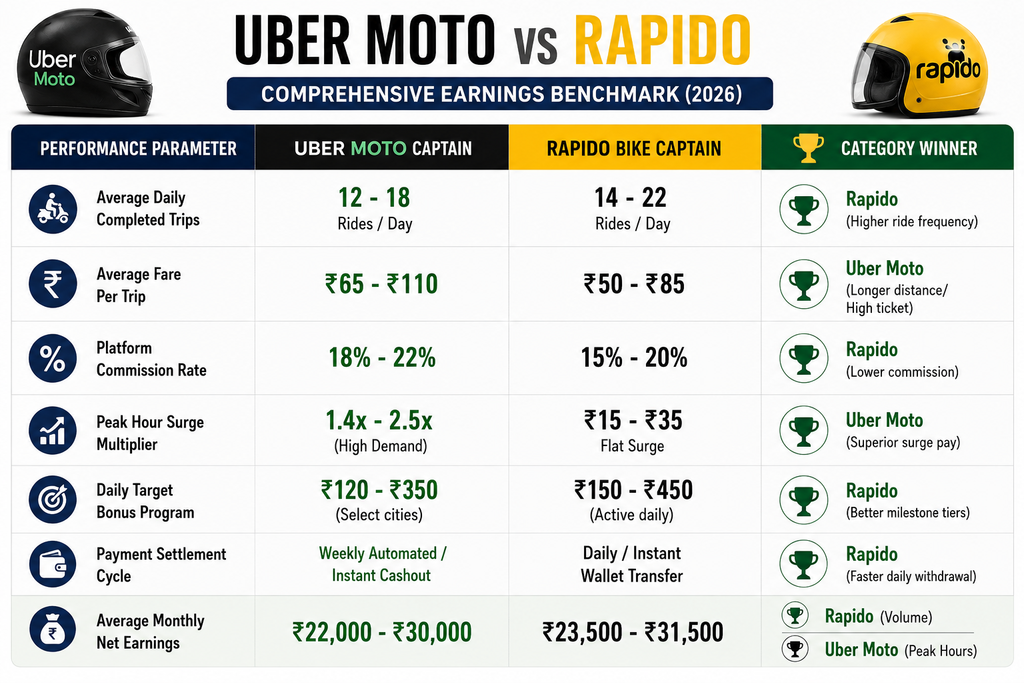
- Rapido Captain Compensation: Operates on a transparent base-plus-distance model. Captains earn ₹25–₹35 base fare for the first 2 km, followed by ₹6.50–₹9.00 per km. Platform commission averages 15%–20%, often offset by daily trip target bonuses.
- Uber Moto Dynamic Pricing: Uses dynamic algorithmic pricing linked to real-time traffic and passenger demand. Base rates average ₹25–₹32 with ₹6.00–₹8.50 per km, featuring strong surge multipliers (1.3x to 2.2x) during rush hours.
Uber Moto vs Rapido: Comprehensive Earnings Benchmark (2026)
> Discover high-paying bike taxi captain and delivery roles with instant cashouts and flexible shifts. Explore verified two-wheeler openings in your city today.
Ride Volume & Hotspot Dynamics Across Indian Cities
Ride availability varies significantly based on urban geography:
Metro & IT Hubs (Bangalore, Hyderabad, Pune, Delhi NCR): Uber Moto generates heavy corporate commute bookings during morning (8:30 AM–11:00 AM) and evening (5:30 PM–8:30 PM) office peaks, yielding higher fares per trip.
Tier-2 & Tier-3 Cities (Jaipur, Lucknow, Indore, Patna): Rapido holds commanding market share, delivering non-stop short-distance intra-city rides throughout the day with minimal waiting time.
Operating Overhead: Fuel Consumption & Maintenance
Managing daily two-wheeler operating expenses:
- Daily Distance: Bike captains travel 80–120 km per day across diverse urban road conditions.
- Fuel Cost Management: Maintaining steady 45–50 km/h cruising speeds and avoiding harsh acceleration yields 50–55 km/L on standard 110cc commuter bikes, keeping daily fuel expenses under ₹220.
- Tire & Brake Care: Frequent passenger carrying accelerates brake shoe wear; budget ₹500 monthly for periodic maintenance.
Compliance & Safety Standards for Bike Captains
Under commercial passenger transit guidelines from the Ministry of Road Transport and Highways (MoRTH):
- Both captain and pillion passenger must wear ISI-certified helmets at all times.
- Two-wheelers must carry active third-party commercial insurance covering pillion riders.
- Maintaining a 4.7+ customer rating ensures consistent high-priority algorithmic dispatching.
Frequently Asked Questions (FAQs)
Can I drive for both Uber Moto and Rapido at the same time?
Yes! Most experienced bike captains keep both apps active, accepting whichever platform broadcasts the closest passenger with the highest surge multiplier.
Do I need a commercial yellow number plate for bike taxi jobs?
State regulations vary. Some states (like Telangana and Karnataka) allow private plates under EV/aggregator guidelines, while others require commercial registration. Check in-app local hub notices.
Which app offers faster daily earnings withdrawal?
Rapido allows captains to withdraw earnings daily directly to their UPI ID, while Uber Moto offers instant flexi-cashouts alongside standard weekly direct bank deposits.
How much petrol is consumed during bike taxi driving?
Driving 80–110 km daily across city traffic consumes approximately 1.8 to 2.4 liters of petrol, costing ₹180 to ₹250 per day on standard 110cc commuter bikes.
What should I do if a passenger refuses to wear a helmet?
For your safety and to prevent traffic challans, politely explain that helmets are mandatory under traffic law. If they refuse, cancel the trip using the ‘Passenger Safety’ tag.
> Turn your two-wheeler into a daily earning machine with top-rated mobility and delivery networks. Sign up as a verified partner and hit the road today.
Conclusion
In the 2026 bike taxi arena, Rapido wins on overall daily ride volume and instant cashouts, making it unbeatable for consistent all-day riding. Meanwhile, Uber Moto excels during high-demand corporate peak hours with lucrative surge pricing. Using both platforms smartly will maximize your daily income.

