
If your income runs on a calendar, a festival, a wedding season, a harvest, a festive-hiring contract, you already know the hardest stretch isn’t the busy months. It’s the ones right after, when the season ends and the money stops with it. Seasonal worker delivery partner income exists to close exactly that gap: a way to keep earning between your festival, wedding, harvest, or contract seasons, instead of waiting months for the calendar to turn back in your favor.
This hub covers four groups who lose income the same way, year after year: festival-season vendors, wedding-season event staff, agricultural off-season migrant laborers, and festive-hiring contract workers. Whichever one describes you, the underlying problem is identical, and so is the fix.
Why Seasonal Income Has a Structural Gap, Not Just a Slow Month
A festival stall, a wedding-season catering crew, or a festive-hiring warehouse contract all share the same design flaw: the work exists only when demand spikes, and disappears completely once it passes. That’s not a personal failure to plan better. It’s how seasonal economies are built: vendors set up around Diwali or Durga Puja, event staff cluster around the wedding calendar, and festive contract hiring runs for exactly as long as a retailer’s peak-order window lasts.
The problem is that rent, food, and family expenses don’t pause for the off-season the way your income does. Delivery work is structurally different: it isn’t tied to any single festival, wedding date, or hiring window. As long as the platform is active in your city, you can log in and earn, on whatever hours you have free between seasons.
The Four Seasonal Worker Segments This Guide Covers
Festival-Season Vendors
If you run a stall, sell sweets, decorations, clothing, or festive goods around Diwali, Durga Puja, Eid, or wedding-season fairs, your income likely concentrates into a 2–3 month window and then drops sharply. See our dedicated guide: Festival Vendor Season Over? Apply as a Delivery Partner Between Seasons.
Wedding-Season Event Staff
Caterers, decorators, tent and lighting crews, and event drivers all see the bulk of their bookings cluster into India’s wedding seasons (roughly November–February and April–July), with long quiet stretches between. See: Wedding Season Staff Off-Duty? Start Earning as a Delivery Partner Today.
Agricultural Off-Season Migrant Laborers
Farm laborers who move to nearby cities during the gap between sowing and harvest cycles face a specific, predictable income gap tied to the crop calendar rather than city life in general. This is narrower than moving to a city permanently. See our dedicated guide: Agricultural Off-Season? How Rural Migrants Can Apply as Delivery Partners in the City. If you’ve relocated to a city for good rather than for a seasonal gap, our broader migrant worker delivery job guide covers that case in full.
Festive-Hiring Contract Workers
Retailers, warehouses, and event companies hire temporary staff for festive rushes, then let those contracts lapse the moment the season ends, often with no notice and no next assignment lined up. See: Laid Off After Festive-Season Contract Work? Apply as a Delivery Partner This Week.
How Much Can You Earn as a Delivery Partner Between Seasons?
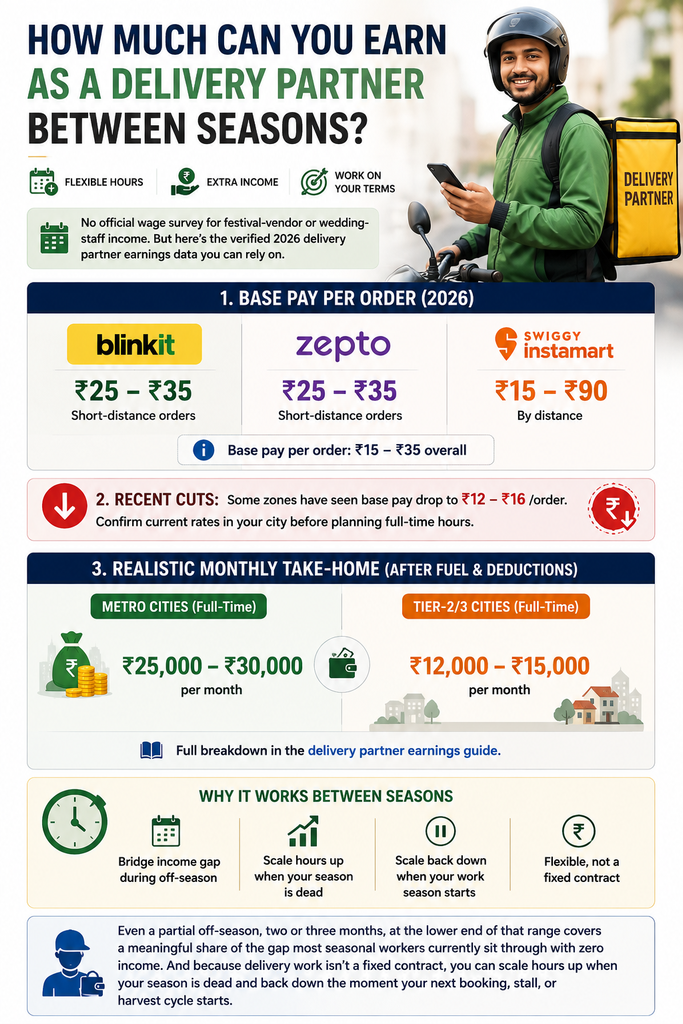
There’s no official wage survey for festival-vendor or wedding-staff income, so we won’t invent one. What we can point you to is verified 2026 delivery-partner earnings data, the same figures used across this site:
- Base pay per order: ₹15–35, with Blinkit and Zepto typically ₹25–35 for short-distance orders and Swiggy Instamart ranging ₹15–90 by distance. See current Blinkit and Zepto rate cards.
- Recent cuts: some zones have seen base pay drop to ₹12–16/order. Confirm current rates in your city before planning full-time hours.
- Realistic monthly take-home: ₹25,000–30,000 in metro cities for full-time riders, and ₹12,000–15,000 in Tier-2/3 cities after fuel and deductions. Full breakdown in the delivery partner earnings guide.
Even a partial off-season, two or three months, at the lower end of that range covers a meaningful share of the gap most seasonal workers currently sit through with zero income. And because delivery work isn’t a fixed contract, you can scale hours up when your season is dead and back down the moment your next booking, stall, or harvest cycle starts.
Season vs. Off-Season: What the Income Gap Actually Looks Like
| Segment | Typical peak season | Typical off-season length | Off-season income today |
|---|---|---|---|
| Festival vendors | 2–3 months around major festivals | 8–9 months | Often little to none |
| Wedding-season event staff | 2 windows, roughly Nov–Feb and Apr–Jul | Remaining months between windows | Sporadic, booking-dependent |
| Agricultural off-season migrants | Sowing/harvest windows (crop-dependent) | Weeks to a few months between cycles | Often none without city work |
| Festive-hiring contract workers | 1–2 months around major retail/festive rush | Rest of the year, unless rehired | None once contract lapses |
These durations describe general seasonal patterns, not a formal wage survey. Every vendor, crew, and contract cycle differs. The point isn’t the exact month count; it’s that the gap is real and recurring.
What You Need to Start During Your Off-Season
- A valid driving license (two-wheeler category), or check for cycle-delivery zones in your city if you don’t have one yet
- Aadhaar card
- PAN card
- A bank account in your own name for payouts
- Your own two-wheeler, or confirmation of a rental/partner-vehicle scheme in your city
None of this depends on which season you’re between, or how long you plan to stay before your next one starts.
Government Safety Net for Seasonal & Gig Workers
Seasonal income gaps are exactly the situation India’s gig- and unorganized-worker welfare schemes are meant to soften. Register on the government’s e-Shram portal (register.eshram.gov.in) to access social security benefits for unorganized and gig workers, including accident insurance coverage, and to build a portable worker ID that stays valid across seasons and states. Delivery partners can also access PMSBY (accident insurance), PMJJBY (life insurance), and Ayushman Bharat (healthcare coverage). See the full government schemes for delivery partners rundown and our broader gig worker welfare schemes in India explainer.
Not the Right Fit? See the Other Pillars
This hub focuses on income that vanishes between seasons. If your situation is different:
- Coming from a fixed-wage retail, warehouse, hotel, or construction job instead? See the Blue-Collar to Delivery Partner Career Switch Hub.
- Already doing informal delivery-adjacent work (chowkidar, courier, milk delivery)? See the Already Doing Delivery Work? Pillar B Hub.
- Stuck in a high-stress office or BPO job instead? See the Escape the Desk: BPO to Delivery Job Switch Hub.
- Starting from zero experience: a student, returning to work, retired, or new to the city? See the Who Can Become a Delivery Partner in 2026? Eligibility Hub.
Frequently Asked Questions
Is delivery work actually reliable enough to fill a whole off-season?
It won’t replace peak-season income for most vendors or event staff, but it’s active work that pays per order rather than zero income while you wait for your next season. Most riders treat it as a bridge, not a permanent replacement for their main trade.
Do I have to give up my stall, catering business, or farm work to try this?
No. You can register and work delivery hours around your existing commitments, then scale down or pause once your season picks back up. There’s no fixed contract locking you into full-time hours.
What if my off-season is only a few weeks, not months?
Even a short gap is worth registering for, since setup takes about 3 days and there’s no minimum commitment period. Many seasonal workers keep their delivery registration active year-round and simply work fewer hours during their peak season.
I’m a farm laborer between crop cycles, not a permanent city migrant. Does this hub apply to me?
Yes, and specifically our agricultural off-season guide is written for exactly that case. If you’ve moved to the city permanently rather than seasonally, our broader migrant worker guide is the better fit.
How fast can I actually start earning once my season ends?
Verification typically completes within 24–48 hours of applying, and most applicants are active on the road within 3 days, fast enough to start earning before the next season begins.
Ready to Bridge Your Off-Season?
Whether you’re a festival vendor packing up your stall, a wedding-season caterer between bookings, a farm laborer waiting on the next harvest, or a contract worker whose festive hiring just ended, the math is the same: your season has a gap, and delivery work fills it. Start Earning Today!