If you’re comparing delivery job salary Mumbai numbers against chowkidar or local courier pay, the honest 2026 picture looks different here than in most other Indian cities: Mumbai is the country’s most expensive place to live, and none of these three jobs, chowkidar, courier, or delivery partner, comfortably clears that cost on the low end of its range. What changes the math is that delivery pay is per order, not fixed, so more active hours translate directly into more income in a way a fixed wage never does.
Chowkidar & Courier Salaries in Mumbai: The Local Numbers
Watchmen and chowkidars working outside formal security agencies in Mumbai, independent building or society guards paid largely in cash, earn roughly ₹17,000-34,000/month, with the exact figure depending heavily on whether they’re attached to a private security agency, a housing society, or an informal arrangement directly with a building (ERI SalaryExpert, “Watchman Salary in Mumbai,” 2026 data). Entry-level agency guards with one to three years of experience start closer to ₹27,300/month, while senior guards with eight or more years can reach ₹38,400/month. For the national baseline comparison, see Chowkidar vs Security Guard vs Delivery Partner: Full Salary Comparison 2026.
Traditional, non-platform couriers and parcel delivery workers in Mumbai earn roughly ₹15,000-27,000/month. Salary.com’s 2025 dataset puts the Mumbai average at ₹27,190/month, while live JobHai and Quikr listings through mid-2026 show many entry-level roles starting at just ₹10,000-13,000/month basic pay, rising toward ₹25,000-30,000/month for established couriers, sometimes with a fuel allowance added on top. Full national comparison: Local Courier Boy vs Zomato/Swiggy/Blinkit Partner: Salary Comparison 2026.
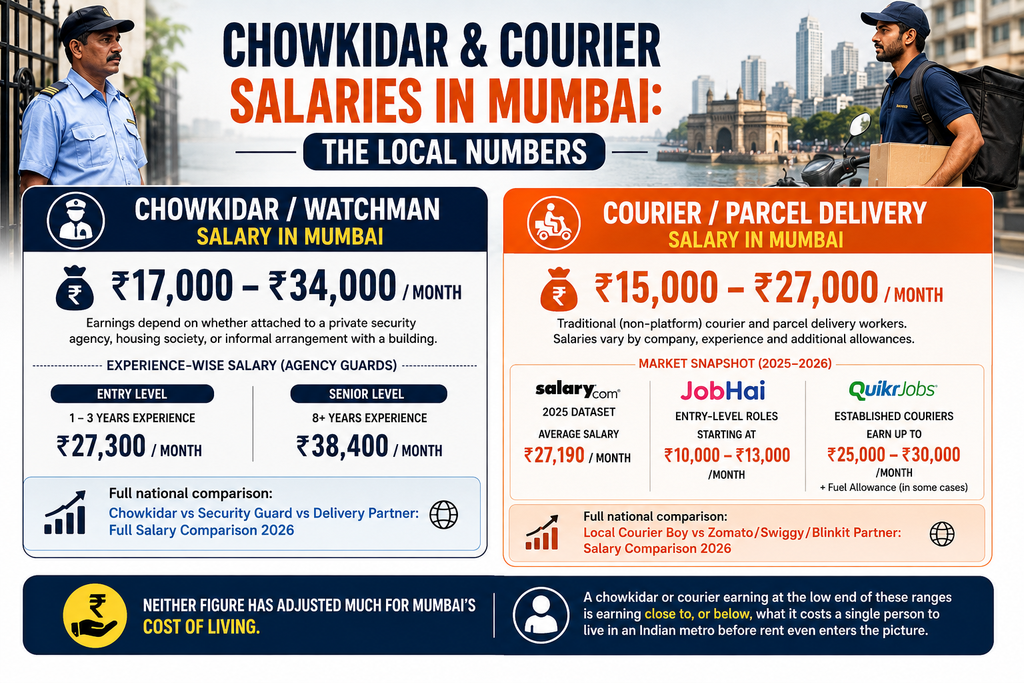
Neither figure has adjusted much for Mumbai’s cost of living. A chowkidar or courier earning at the low end of these ranges is earning close to, or below, what it costs a single person to live in an Indian metro before rent even enters the picture.
Delivery Partner Salary in Mumbai: What You Actually Earn
Delivery partner pay in Mumbai runs on the same per-order structure used across platforms nationally, with a few numbers specific to this city and its dense delivery zones:
- Base pay per order: Zepto pays roughly ₹25-35 per order depending on the city; Swiggy Instamart pays ₹15-90 per order based on distance and time; Blinkit uses a distance-based, per-packet model with its exact rate undisclosed (pickmywork.com, 21 April 2026 data).
- Realistic take-home: cross-source data agrees on a similar number. TeamLease Services (via niftytrader.in) puts full-time metro delivery partner earnings at ₹20,000-30,000/month gross, and pickmywork.com narrows this specifically for metro partners to ₹25,000-30,000/month after fuel and maintenance costs.
- Be cautious with advertised numbers. Some listings advertise ₹40,000-60,000/month, and individual Andheri and Mira Road postings for Zepto and Swiggy specifically claim “up to” ₹35,000-70,000/month. Treat these as advertiser-stated ceilings, not typical take-home; pickmywork.com explicitly flags this gap between advertised maximums and what partners actually earn.
- Where hiring concentrates: JobHai’s live listings through June-August 2026 show delivery hiring clustered in Andheri (East and West), Mira Bhayandar/Mira Road, and Nallasopara. See our locality-specific coverage for delivery jobs in Andheri East and delivery jobs in Mira Road.
Check current platform-specific rates before committing full-time hours: Blinkit per-order rate card, Zepto per-order rate card, and the full delivery partner earnings breakdown.
Side-by-Side: Mumbai Salary Comparison (2026)
| Chowkidar/Watchman | Traditional Courier | Delivery Partner (full-time) | Delivery Partner (advertised ceiling) | |
|---|---|---|---|---|
| Monthly pay | ₹17,000-34,000 | ₹15,000-27,000 | ₹25,000-30,000 (after costs) | Up to ₹35,000-70,000 (advertiser-stated) |
| Pay structure | Fixed/cash, agency-dependent | Low fixed + small incentive | Per order | Per order, high-volume |
| Source | ERI SalaryExpert, 2026 | salary.com 2025, JobHai 2026 | pickmywork.com/TeamLease, 2026 | JobHai live listings, Jun-Aug 2026 |
| Reliability | Verified estimate, wide variance | Verified estimate | Verified, cross-source consensus | Advertiser claim, not a verified average |
Even at the verified, conservative end, full-time delivery partner income in Mumbai matches or clears both chowkidar and courier pay, and unlike those two, it has no fixed ceiling tied to a shift or a contractor’s schedule.
Why Mumbai’s Cost of Living Changes the Math
Mumbai is India’s most expensive city to live in, in both 2025 and 2026 rankings (Zee News, citing Mercer/Numbeo-based data). Its cost-of-living index sits at 100, the highest in the country, compared with 57 in Bangalore, 50 in Gurgaon, 47 in Delhi, and 43 in Navi Mumbai, meaning everyday costs in Mumbai run roughly double what they do in most other major Indian cities.
That context matters for every figure in this comparison. A national, Numbeo-derived estimate puts a single person’s monthly cost of living in India, excluding rent, at roughly ₹27,300/month. Chowkidar pay at the low end (₹17,000/month) and courier pay at the low end (₹15,000/month) both sit below that baseline, before rent is even added. Rent itself is a separate problem in Mumbai specifically: a 1BHK in a central area runs around ₹65,000/month, against roughly ₹10,000/month for the same size flat in a smaller city like Lucknow.
None of the three jobs compared here comfortably clears Mumbai’s cost of living at the low end of their range. What separates delivery work is the lever it gives you: because pay is per order rather than fixed, putting in more active hours has a direct, immediate effect on your monthly total. A chowkidar or courier job doesn’t offer that same option.
What About Job Security in Mumbai? Maharashtra’s New Rules
Maharashtra issued the Gig and Platform Workers Rights and Protection Bill, 2026 on 3 July 2026, establishing worker registration, platform obligations, a state welfare board, and a dispute-resolution mechanism, funded in part by aggregator contributions (TeamLease RegTech). A separate, still-proposed amendment to the state’s 2025 Bike-Taxi Rules, reported in August 2026, would bring Swiggy, Zomato, and Zepto delivery riders under the same regulatory framework as bike-taxis for the first time: an EV fleet mandate, GPS tracking, mandatory insurance, and a 2% welfare levy on trip or order fare (Medianama, August 2026). It isn’t yet clear whether that levy would apply directly to delivery-partner payouts, since delivery platforms don’t structure pay around fixed “ride fares” the way bike-taxi apps do, so treat this as a proposal still in motion. See our coverage: Maharashtra proposes sweeping EV mandate & 2% welfare fee for Swiggy, Zomato & Zepto delivery partners.
Regardless of how that proposal lands, standard e-Shram registration is available now and worth doing immediately: see our full walkthrough on the e-Shram portal for gig workers. For the complete Pillar B picture across informal and delivery-adjacent work, see the Already Doing Delivery Work? hub.
Frequently Asked Questions
Is delivery partner pay actually higher in Mumbai than chowkidar or courier pay?
Yes, at the verified, conservative end. Full-time delivery partners in Mumbai typically clear ₹25,000-30,000/month after fuel and maintenance costs, above chowkidar pay (₹17,000-34,000/month) and traditional courier pay (₹15,000-27,000/month) at their respective low ends, and delivery pay has no fixed ceiling.
How does Mumbai’s cost of living affect these numbers?
Mumbai’s cost-of-living index is the highest in India, roughly double that of Bangalore or Delhi. A single person’s baseline monthly cost, excluding rent, runs around ₹27,300 nationally, and several of the wages compared here sit close to or below that figure at their low end, so the real difference between jobs is the ability to earn more through additional hours, which only delivery work offers directly.
What is the Maharashtra Gig and Platform Workers Rights and Protection Bill, 2026?
It’s a state law issued 3 July 2026 covering worker registration, platform obligations, a welfare board, and dispute resolution for gig and platform workers, with aggregator-funded social security. A separate proposed rule change would add EV, GPS, insurance, and a 2% welfare levy requirement specifically for bike-taxi and possibly delivery platforms, though the delivery-specific application of that levy isn’t confirmed yet.
Where in Mumbai does delivery hiring concentrate?
JobHai’s live listings through mid-2026 show hiring clustered in Andheri (East and West), Mira Bhayandar/Mira Road, and Nallasopara, where order density tends to be higher.
Do chowkidars and couriers in Mumbai earn more than the national average because of the cost of living?
Not proportionally. While Mumbai-specific sourcing shows somewhat higher figures than some national comparisons, informal chowkidar and courier pay hasn’t scaled with Mumbai’s cost of living, which runs roughly double the national metro average.
Ready to See Your Own Mumbai Numbers?
Start Earning Today! and find out what you’d actually earn in your Mumbai zone. Verification typically takes 24-48 hours.