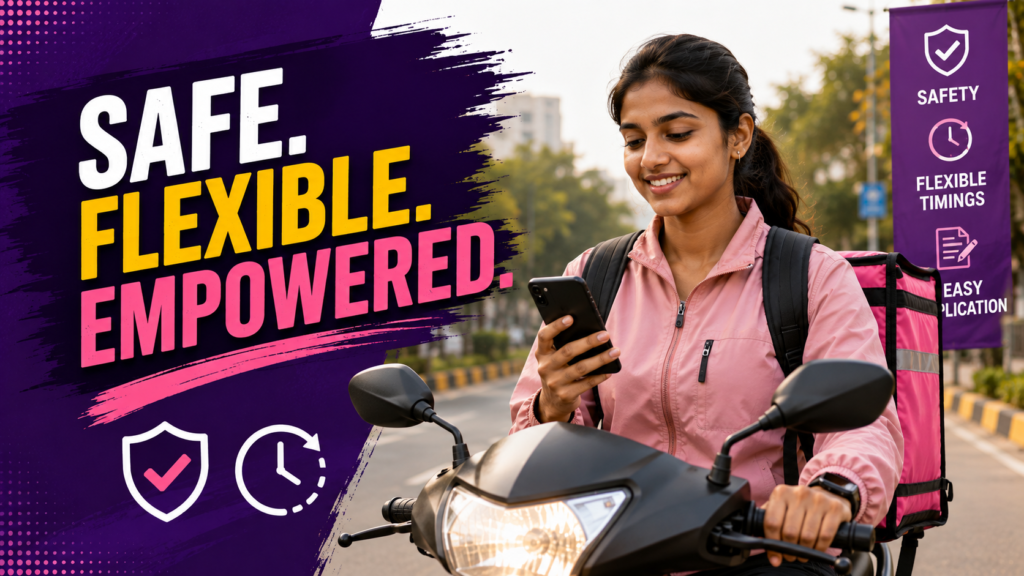
If you’re exploring a women delivery job — apply in 2026 is more straightforward than most people assume: the eligibility rules are identical for everyone, and you control your own hours and, in most apps, your preferred delivery zones. Women currently make up roughly 28% of India’s gig workforce, and that share is growing as more platforms compete for reliable riders.
This guide covers what to expect honestly — including safety considerations — rather than glossing over them, plus exactly how to apply.
Is Delivery Work a Realistic Option for Women Re-Entering the Workforce?
A career break for marriage, childbirth, or family caregiving often means restarting from zero in the traditional job market — explaining a gap, competing with continuously-employed candidates, accepting a lower starting role. Delivery work sidesteps all of that: there’s no interview panel judging your resume gap, and the eligibility bar (age, license, documents) is identical regardless of your work history.
For the full new-entrant eligibility breakdown, see our pillar guide: Who Can Become a Delivery Partner in 2026? Complete Eligibility Guide.
What About Safety? An Honest Look
This is the most common — and fair — hesitation. Here’s what’s genuinely true as of 2026:
- You set your own hours. Nothing forces you into late-night shifts. Most women riders build a daytime-heavy schedule and adjust based on comfort.
- Zone and order visibility. Most delivery apps show you the pickup/drop details before you accept an order, so you can decline anything that feels off — a level of control a fixed job rarely gives you.
- In-app safety features. Standard features across major platforms include in-app support/SOS access and ratings-based order allocation — treat these as your baseline safety toolkit, not a guarantee.
- No verified women-specific program found. We searched specifically for dedicated women-only safety programs or mandated night-timing restrictions from major platforms and found no confirmed, platform-published initiative as of this writing. Don’t take marketing claims at face value — ask directly about current safety features when you apply, and start with daytime zones until you’re comfortable with your area.
- General road and weather safety also matters regardless of gender — see our monsoon safety tips for delivery partners for practical precautions.
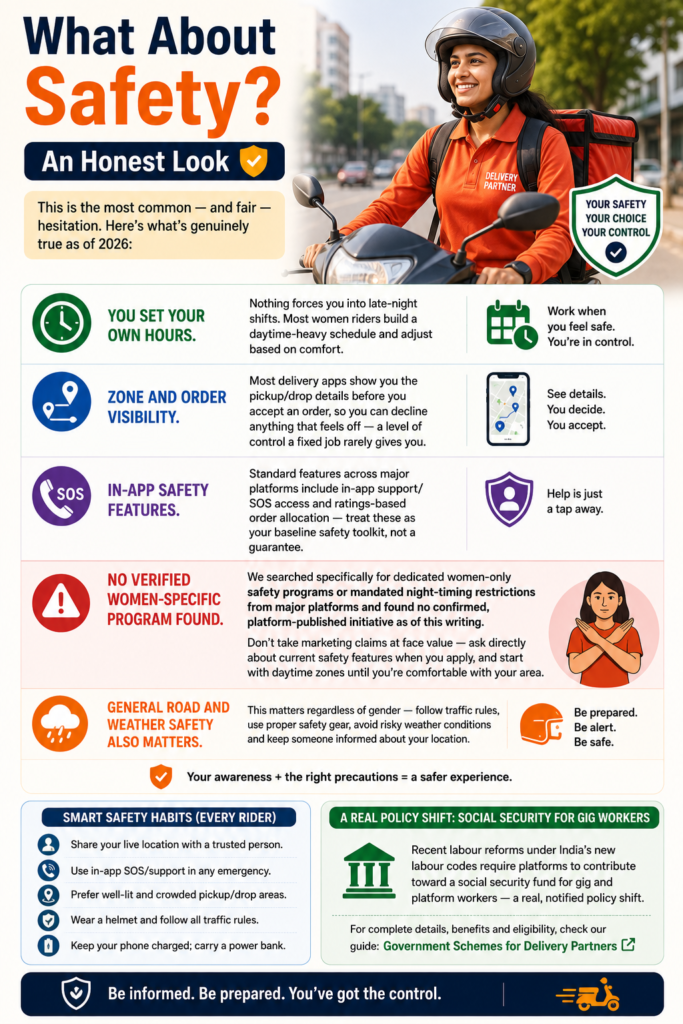
For broader context: recent labour reforms under India’s new labour codes require platforms to contribute toward a social security fund for gig and platform workers — a real, notified policy shift covered in our government schemes for delivery partners guide.
Practical Safety Tips for New Women Riders
Beyond what any platform provides, a few practical habits help regardless of which app you’re using:
- Start with familiar neighborhoods. Building comfort in areas you already know well before expanding your zone reduces uncertainty in the first few weeks.
- Share your live location with a family member or friend during shifts using your phone’s built-in location-sharing, independent of any in-app feature.
- Keep your phone charged and visible — a dead phone mid-shift removes your access to support features exactly when you might need them.
- Trust your own read on a situation. If an order or location feels off before you accept it, most apps let you decline without penalty to your rating for occasional declines.
- Connect with other women riders in your city where possible — informal local networks are often the fastest way to learn which zones and timings other women have found comfortable.
None of this replaces a platform-level safety commitment, but it’s a realistic starting toolkit while formal programs, if any, continue to develop.
How Much Can Women Delivery Partners Earn?
Earnings follow the same structure as any delivery partner — base pay per order, scaling with hours worked:
- Base pay: ₹15–35 per order depending on platform and distance — see current Swiggy and Blinkit payout pages.
- Full-time (metro): ₹25,000–30,000/month.
- Full-time (Tier-2/3): ₹12,000–15,000/month.
- Part-time / self-set hours: earnings scale roughly with active hours — see the full delivery partner earnings breakdown for what drives the higher end of the range.
Step-by-Step: How to Apply
- Check eligibility. You need to be 18+, hold a valid driving license, and have Aadhaar, PAN, and a bank account in your own name.
- Decide your preferred hours and zones. Daytime shifts and familiar neighborhoods are a common starting choice for new women riders.
- Apply online. Submit your application through Alpha Reach’s delivery partner sign-up — no resume, no interview.
- Get verified. Document checks typically complete within 24–48 hours.
- Start on your terms. Log in during hours and zones you’re comfortable with, and adjust as you build confidence.
Frequently Asked Questions
Is delivery work safe for women in 2026?
It carries the same general road and public-safety considerations as any independent, on-the-road work. You control your hours and can generally see order/zone details before accepting — start with daytime zones you know well and use your own judgement, the same way you would for any self-directed work.
Do women get different pay or eligibility rules?
No — eligibility (18+, valid license, documents) and base pay per order are the same for everyone, regardless of gender.
Can I choose to only work daytime hours?
Yes, in most apps you set your own login hours and can build a schedule that avoids late nights entirely.
Is there a dedicated women’s safety program on delivery apps?
We found no confirmed, platform-published women-specific safety program as of this writing. Ask directly about current in-app safety features (SOS, support access) when you apply, and rely on general safety practices in the meantime.
How much can a woman re-entering the workforce realistically earn?
The same range as any new rider: roughly ₹25,000–30,000/month full-time in metros, or proportionally less for part-time hours — see the earnings breakdown for details.
Ready to Apply on Your Own Terms?
Apply to become a delivery partner and set hours and zones that work for you. For the complete eligibility picture, see our Who Can Become a Delivery Partner in 2026 hub.
For general safety and legal support resources, the National Commission for Women and the national Women Helpline (181) are official government resources available to all women in India, independent of any specific employer or platform.