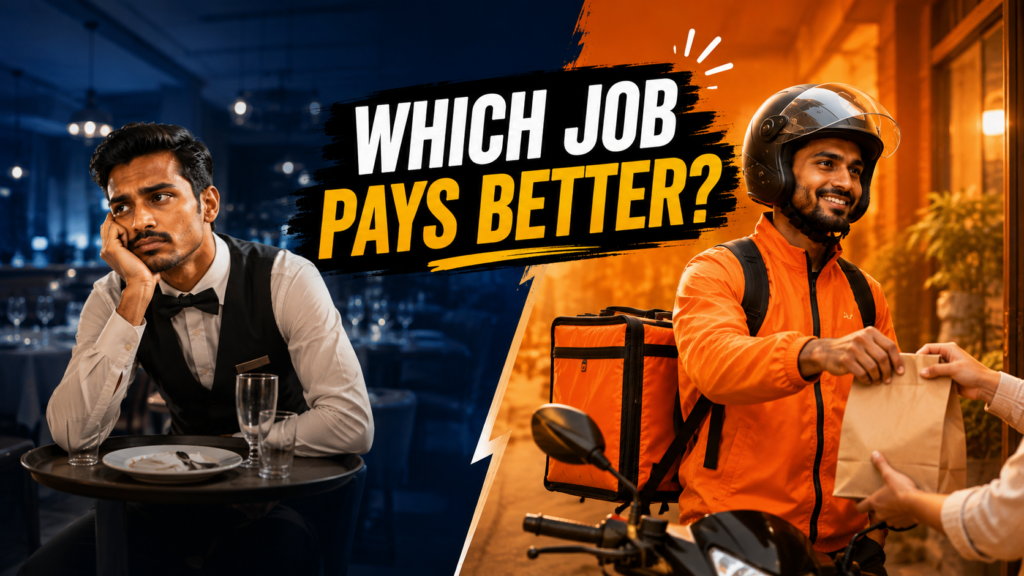
Comparing waiter job vs delivery job salary numbers comes down to more than the base pay slip: waiters earn ₹14,000–17,000/month plus variable tips, but lose control over their schedule to split shifts and late closing hours. Delivery partners can clear ₹25,000–30,000/month in metros — on hours they set themselves.
Here’s the full 2026 comparison.
Waiter/Hotel Staff Salary in 2026: What You Actually Earn
Waiters and hotel service staff earn roughly ₹13,900–17,000/month in base pay (Indeed, 2026 data), with tips and service charge adding 30–100% more in fine dining and 5-star establishments — but that upside is inconsistent and depends entirely on footfall, season, and management’s tip-pooling policy.
The trade-off for whatever tips bring in: split shifts (lunch service, a break, then dinner service), mandatory presence through the restaurant’s busiest and latest hours, and standing through a full shift with little downtime.
Delivery Partner Salary in 2026: What You Actually Earn
Delivery partner pay is per-order, not per-shift. Current base pay runs ₹15–35 per order depending on platform and distance, and realistic full-time take-home lands at ₹25,000–30,000/month in metro cities and ₹12,000–15,000/month in Tier-2/3 cities after fuel and deductions — see current Zomato and Swiggy rates, or the full delivery partner earnings breakdown.
If you’re already working in food service, this is the most natural switch of any blue-collar segment — you understand meal-time demand patterns, customer expectations, and how tips and ratings both reward good service.
Side-by-Side: Waiter/Hotel Staff vs Delivery Partner (2026)
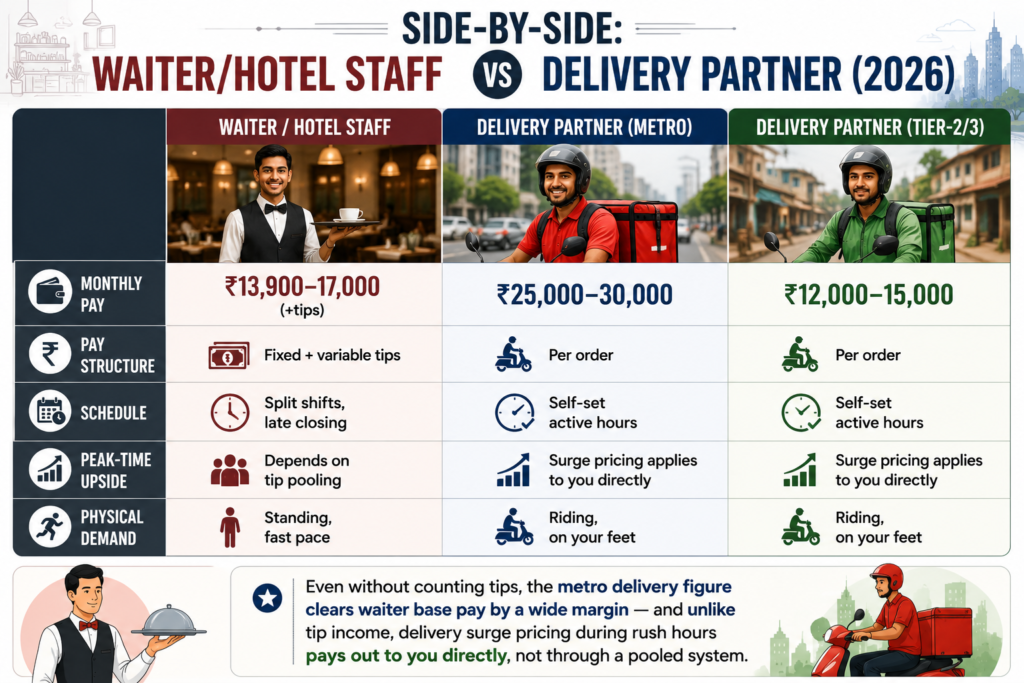
Even without counting tips, the metro delivery figure clears waiter base pay by a wide margin — and unlike tip income, delivery surge pricing during rush hours pays out to you directly, not through a pooled system.
The Tips Math: What Would You Need to Match Delivery Income?
To match a metro delivery partner’s ₹25,000–30,000/month on a ₹15,000 base salary, you’d need ₹10,000–15,000/month in tips alone — roughly ₹330–500/day if you work every day, or more if your restaurant closes one day a week. In a high-footfall fine-dining spot during festival season, that’s achievable. In a mid-range restaurant on a slow month, it usually isn’t.
Delivery partner surge pricing works on a similar principle — you earn more during rush windows — but it applies consistently to every partner on the road, not just whoever gets the best tables that shift.
Which Job Should You Choose?
Stay in hospitality if: you’re at a high-tip-volume establishment where your actual take-home (base + tips) already competes with delivery income, or you’re on a path toward a supervisory or management role.
Switch to delivery if: your base pay plus tips still falls short, split shifts are wearing you down, or you want your schedule back under your own control.
For the full step-by-step move, see our detailed guide: No More Split Shifts: How Hotel & Restaurant Staff Are Switching to Delivery Jobs. And if construction work is more your background than hospitality, see the Construction Labour vs Delivery Partner: Daily Wage vs Daily Earning 2026 instead.
What About Job Security and Benefits?
Hotel jobs vary widely on formal benefits — some offer PF and ESI, many smaller establishments don’t. Gig work doesn’t come with a traditional appointment letter either, but you’re not without options: register on the government’s e-Shram portal (register.eshram.gov.in) for accident insurance and other unorganized-worker social security benefits, and see our full rundown of government schemes for delivery partners.
For the complete Pillar overview — including retail and warehouse comparisons — see the Blue-Collar to Delivery Partner Career Switch Hub, which also links to the Retail Sales Job and Warehouse Worker comparisons.
Frequently Asked Questions
Do delivery partners really earn more than waiters?
In metro cities, base delivery pay of ₹25,000–30,000/month clears typical waiter base pay of ₹13,900–17,000/month even before tips are counted. High-tip establishments can narrow or close that gap, but delivery income still scales with hours rather than depending on footfall and tip pooling.
Will I lose out by giving up tip income?
Tips are inconsistent — tied to season, footfall, and management policy. Delivery surge pricing during meal-time rushes functions similarly (extra pay during peak demand) but goes directly to you per order, not through a shared pool.
Is restaurant experience useful for delivery work?
Yes — food-service staff already understand delivery time windows, order accuracy expectations, and handling customer complaints calmly, all of which directly affect delivery partner ratings and incentive eligibility.
Can I try delivery part-time before quitting my hotel job?
Yes — many hospitality staff start with off-shift delivery hours (before lunch service or after dinner close) for 1–2 weeks to validate real local earnings before switching fully.
Ready to Trade Split Shifts for Set Hours?
Apply to become a delivery partner and get verified within 24–48 hours.