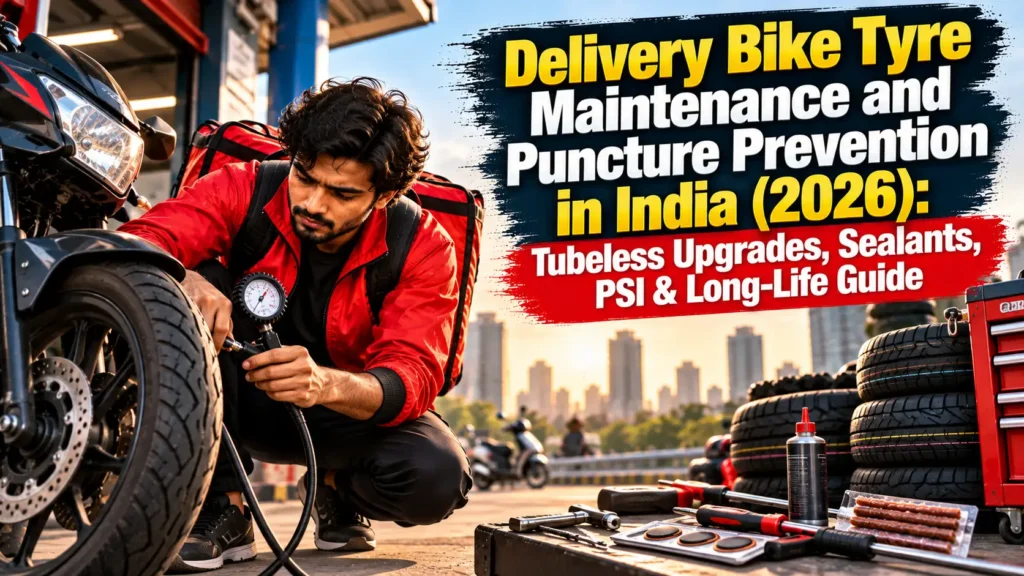
In modern India’s relentless last-mile logistics and quick-commerce delivery sector, mastering delivery bike tyre maintenance and puncture prevention is the single most critical practical skill for guaranteeing zero shift downtime. When a delivery partner covers between 80 and 120 kilometers daily fulfilling time-sensitive orders for Zomato, Swiggy, Blinkit, Zepto, and Shadowfax, their motorcycle tyres endure severe friction against boiling summer tarmac, broken glass bottles near residential dumpsters, razor-sharp construction debris, and deep waterlogged potholes. Suffering a sudden flat tyre during a peak dinner rush or in the middle of a 10-minute grocery delivery does not merely cost ₹150 for a roadside puncture fix; it results in order cancellations, algorithm dispatch penalties, missed milestone incentives, and hours of lost earning time. In 2026, professional delivery executives treat tyre care as an essential operational discipline, investing in puncture prevention technologies that guarantee continuous, uninterrupted road uptime. If you are keeping your vehicle in top condition and seeking high-paying delivery partner vacancies across top logistics platforms, you can explore verified delivery partner jobs on AlphaReach to locate certified hiring hubs in your city today.
The operational difference between tube-type tyres and modern tubeless systems under heavy commercial load is night and day. Traditional tube-type tyres suffer catastrophic instantaneous deflation when pierced by a nail, causing dangerous loss of vehicle control and forcing riders to physically push a heavy laden motorcycle to a repair garage. In contrast, tubeless tyres retain air pressure for hours or days after a puncture, allowing riders to complete their active customer drops safely and perform a 5-minute DIY plug repair at their convenience. Furthermore, pairing tubeless tyres with preventative liquid anti-puncture sealants provides automated, instant sealing of tread punctures on the fly, virtually eliminating flat tyres entirely.
Under commercial vehicle safety regulations and tyre manufacturing quality standards governed by the Bureau of Indian Standards (BIS), two-wheeler tyres sold in India must satisfy rigorous burst pressure, endurance testing, and minimum tread wear indicator (TWI) standards. In this comprehensive 2026 tyre maintenance handbook, we analyze tube-type versus tubeless economics, review preventative liquid sealants, specify exact cold tyre pressures for heavy delivery cargo, outline DIY roadside puncture repair techniques, and share proven methods to extract 40,000+ kilometers of reliable service from every tyre set.
The 5 Greatest Tyre Hazards on the Daily Delivery Beat
Commercial delivery tyres face unique mechanical and environmental stresses that civilian commuters rarely encounter:
- Construction Screws, Nails & Binding Wire: Delivering to newly developing suburban apartment complexes exposes tyres to sharp construction debris and binding wire that puncture tread grooves easily.
- Extreme Rear Axle Weight from 15 to 25 kg Delivery Bags: Carrying heavy parcel crates or thermal food backpacks places intense downward pressure on the rear tyre, causing severe sidewall flexing and accelerated tread wear.
- Scorching Summer Tarmac Temperatures (50°C+): Prolonged daytime riding on sun-baked asphalt increases internal air pressure and accelerates tread compound degradation.
- Hidden Potholes and Sharp Stone Bruising: Striking sharp-edged potholes at speed under heavy load can cut tyre sidewalls or bend the inner wheel rim, causing instant bead pressure loss.
- Roadside Broken Glass & Metal Debris near Market Dumps: Commercial food pickup zones near crowded markets often have broken glass bottles and metal scraps strewn across service lanes.
Tubeless vs. Tube-Type Tyres: Commercial Comparison Matrix (2026)
Upgrading to tubeless tyres is the single most important mechanical investment for any delivery bike. The comparative matrix below outlines performance, safety, and downtime metrics:
| Tyre Technology | Deflation Speed on Puncture | Roadside Repair Method | Downtime per Puncture | Typical Replacement Cost (₹) | Delivery Suitability Rating |
| Modern Tubeless Tyre (Alloy Wheel) | Gradual / Slow leak over 24-48 hrs | 5-Minute DIY Rubber Strip Plug | 3 to 5 Minutes (Zero Wheel Removal) | ₹1,400 – ₹1,800 (Rear) | 10/10 (Absolute Gold Standard) |
| Traditional Tube-Type Tyre (Spoke Wheel) | Instant / Catastrophic blow-down | Complex tube patch or tube change | 30 to 45 Minutes (Wheel Removal Required) | ₹1,100 (Tyre) + ₹350 (Tube) | 4/10 (High Breakdown Risk) |
| Tubeless with Liquid Anti-Puncture Sealant | Zero deflation (Auto-seals in 2 secs) | Automated internal liquid sealing | 0 Minutes (Zero Downtime) | ₹1,600 (Tyre) + ₹300 (Sealant) | 10/10 (Bulletproof Fleet Protection) |
| Commercial Heavy-Duty Cargo Tyre | Ultra-durable 6-ply nylon construction | 5-Minute DIY Rubber Strip Plug | 3 to 5 Minutes | ₹1,600 – ₹2,100 | 9/10 (Engineered for Heavy Loads) |
★ High-Paying Delivery Fleet Opportunities: Are you seeking high-paying delivery partner jobs with competitive weekly earnings, fuel distance allowances, same-day onboarding, and flexible shifts? explore verified delivery partner jobs on AlphaReach to discover immediate vacancies across top quick-commerce dark stores, food delivery platforms, and courier hubs in your city today.
Anti-Puncture Liquid Sealants: How They Work & Why Fleet Riders Use Them
Preventative liquid tyre sealants (such as formulations from formula-tested brands like Formula X or Slime) provide an invisible layer of automatic puncture protection:
- How Liquid Sealant Operates: Approximately 250 to 350 ml of liquid polymer sealant containing Kevlar micro-fibers is injected directly through the tyre valve stem into the tubeless tyre cavity before riding.
- Centrifugal Coating: As the motorcycle rolls, centrifugal force spreads the liquid evenly across the entire inner crown of the tyre tread.
- Instant 2-Second Automatic Sealing: When a nail or screw penetrates the tyre tread, escaping air pressure forces the liquid sealant into the puncture hole, instantly forming an airtight polymer plug that permanently seals holes up to 4 to 6 mm without the rider even noticing.
- Cost vs. ROI: A ₹500 to ₹700 bottle of sealant treats both tyres and lasts for 12 to 18 months, completely preventing 5 to 8 roadside punctures and saving hours of lost delivery shifts.
Cold Tyre Pressure Science: The Ideal PSI Formula for Delivery Cargo
Maintaining correct tyre pressure directly impacts braking safety, puncture resistance, and fuel economy:
- Front Tyre Pressure (Steering & Braking Stability): Maintain strictly 24 to 26 PSI in the front tyre. Under-inflation causes heavy, sluggish steering in traffic; over-inflation causes harsh handlebar vibrations.
- Rear Tyre Pressure Under Delivery Cargo: The standard single-rider recommendation (28 PSI) is dangerously inadequate when carrying heavy delivery loads. For commercial delivery work carrying a 15 to 20 kg rear bag, maintain 34 to 36 PSI in the rear tyre to prevent sidewall pinching against pothole edges.
- Check Only When Cold: Always check tyre pressure in the morning before starting your shift, or after the bike has been parked for at least 2 hours. Checking tyres after a fast 20 km ride gives artificially elevated readings due to heat expansion.
Top 5 Roadside Tyre Rules Every Delivery Executive Must Follow
Follow these five practical habits to protect your tyres and avoid garage towing bills:
- Carry an Onboard Tubeless Repair Kit & Mini Hand Pump: A compact ₹150 repair kit containing reamer tools, rubber sticky strips, and rubber cement allows you to fix any nail puncture anywhere in 5 minutes without calling a mechanic.
- Inspect Tyre Treads for Embedded Glass Shards Every Sunday: Run a gloved hand over the tyre tread once a week to locate and pry out embedded metal wire or glass chips before they work deeper into the rubber carcass.
- Replace Tyres When Tread Reaches the Tread Wear Indicator (TWI): Modern tyres have small raised rubber bars inside the tread grooves marked by ‘TWI’ on the sidewall. When the tread wears flush with this bar (below 1.6 mm depth), replace the tyre immediately to prevent wet-weather skidding.
- Avoid Riding on the Extreme Shoulder of Roads: The far outer dirt edge of highways and flyovers is where sharp nails, wire debris, and glass gather. Ride in the clean wheel tracks of traffic.
- Use Metal Valve Stem Caps: Plastic valve caps crack easily. Threaded metal valve caps with inner rubber O-rings prevent high-speed centrifugal valve core leakage and keep mud out of the valve pin.
★ Maximize Your Delivery Earnings Today: Ready to maximize your delivery income, optimize your vehicle running costs, and achieve financial independence with top platform fleets? apply as a verified delivery partner on AlphaReach to access fast onboarding, guaranteed shift schedules, and priority route dispatches today.
Frequently Asked Questions (FAQs)
What is the best tyre pressure for a delivery bike carrying heavy bags?
For a commuter delivery bike carrying a 15 to 20 kg rear delivery bag, the ideal cold tyre pressure is 25 PSI in the front tyre and 34 to 36 PSI in the rear tyre. Running the rear tyre at 34-36 PSI prevents sidewall pinching over potholes, reduces puncture risk, and improves fuel economy by 3 to 5 km/l.
Can I convert spoke wheels to tubeless tyres for delivery work?
Converting traditional spoked wheels to tubeless tyres requires specialized airtight sealing tape or converting to alloy wheels. For commercial delivery work, swapping spoke wheels for a pair of durable aftermarket alloy wheels (costing ₹4,500 to ₹6,000 second-hand or new) is the most reliable way to enjoy true, safe tubeless performance.
Does liquid anti-puncture tyre sealant really work for motorcycles?
Yes, high-quality anti-puncture liquid sealants (like Formula X or Slime) work exceptionally well in tubeless motorcycle tyres. When a nail punctures the tread, the liquid is forced into the hole by air pressure, instantly sealing punctures up to 4 to 6 mm without you having to stop your delivery shift.
How many kilometers does a delivery bike rear tyre typically last?
Under heavy commercial delivery use (covering 2,500 km monthly), a quality commuter rear tyre (from brands like MRF, CEAT, or TVS Eurogrip) typically lasts between 25,000 and 35,000 kilometers (roughly 10 to 14 months). Front tyres last significantly longer, typically between 40,000 and 50,000 kilometers.
What should I do if my tubeless tyre gets a nail puncture during a delivery order?
Do not pull the nail out immediately! A tubeless tyre will retain air pressure for hours with the nail in place. Complete your active customer delivery safely, then park at a tea stall or petrol station. Use your onboard tubeless repair kit to pull the nail, ream the hole, insert a rubber sticky plug strip, pump air, and resume your shift in under 5 minutes.
Conclusion
Proactive delivery bike tyre maintenance and puncture prevention in 2026 is an indispensable pillar of a profitable gig logistics career. In an industry where punctuality dictates platform ratings and weekly incentive bonuses, a single preventable flat tyre can derail an entire day’s earnings and cause immense physical and financial frustration.
By investing in robust tubeless tyres, injecting preventative liquid sealants, maintaining cold inflation pressures rigorously, and carrying a compact DIY plug kit, you transform your two-wheeler into an unstoppable commercial workhorse. Protect your tyres, ride with total confidence, and keep your delivery wheels rolling toward maximum daily profits.