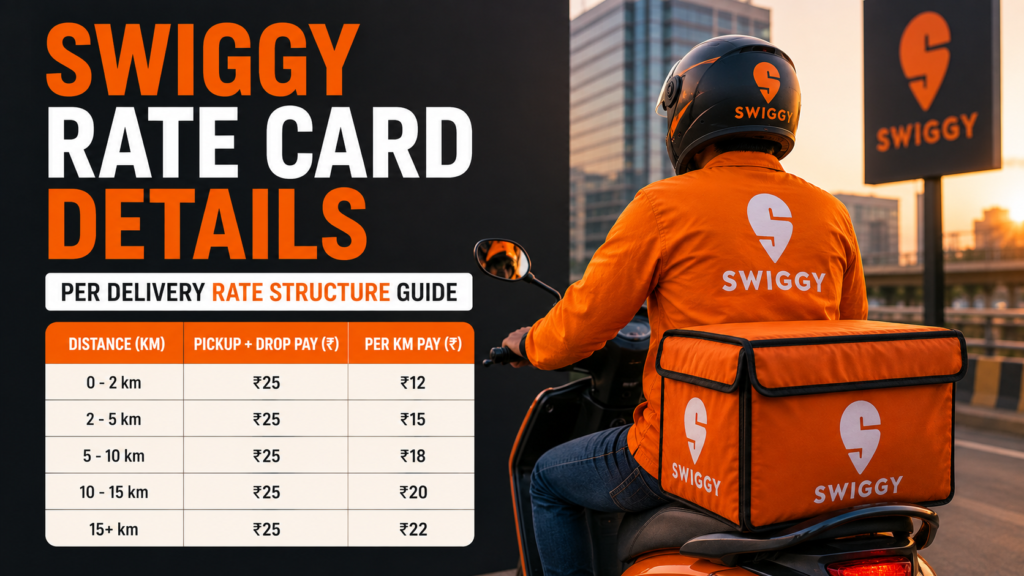
When you sign up as a Swiggy Delivery Partner, your earnings are entirely dictated by the Swiggy rate card. Unlike a fixed monthly salary, gig work relies on a per-task payout system. Swiggy’s rate structure is designed to be fair, compensating you for distance, effort, and time. However, to a new rider, the various components of the payout can seem confusing. In this detailed guide, we will break down the Swiggy per-delivery rate structure so you know exactly how every rupee is earned.
Component 1: The Base Order Pay
Every order on Swiggy starts with a Base Order Pay. This is a fixed amount promised to the rider for executing the delivery within a standard distance.
- Depending on the city and the specific zone classification (high demand vs. low demand), the base pay ranges from ₹15 to ₹30.
- This amount is guaranteed even if the delivery is just a few hundred meters away. It essentially compensates you for the time spent waiting at the restaurant and handing over the parcel.
Component 2: Distance Pay and Touchpoints
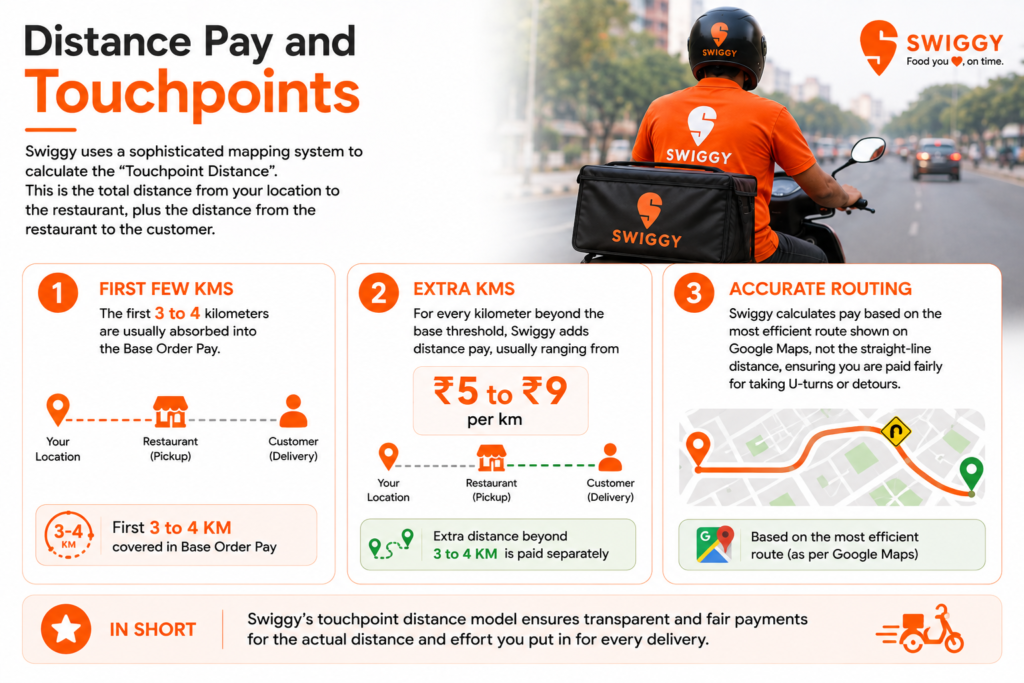
Swiggy uses a sophisticated mapping system to calculate the “Touchpoint Distance.” This is the total distance from your location to the restaurant, plus the distance from the restaurant to the customer.
- First Few KMs: The first 3 to 4 kilometers are usually absorbed into the Base Order Pay.
- Extra KMs: For every kilometer beyond the base threshold, Swiggy adds distance pay, usually ranging from ₹5 to ₹9 per km.
- Accurate Routing: Swiggy calculates pay based on the most efficient route shown on Google Maps, not the straight-line distance, ensuring you are paid fairly for taking U-turns or detours.
Component 3: Time and Wait Compensation
One of the biggest frustrations for delivery partners is waiting at a restaurant while the food is being prepared. Swiggy’s rate card includes a Wait Time Pay feature.
- If you wait at a restaurant beyond a standard grace period (usually 10-15 minutes), Swiggy automatically adds a small per-minute compensation (e.g., ₹1 to ₹2 per minute) to your final payout. This ensures that a slow restaurant doesn’t completely ruin your hourly earning rate.
Component 4: Surges and Performance Incentives
To boost the standard per-delivery rate, Swiggy uses dynamic pricing:
- High-Demand Surges: Extra ₹15 to ₹25 per order during festive days, cricket matches, or heavy rain.
- Milestone Bonuses: Completing 10, 15, or 20 orders a day triggers flat cash bonuses (e.g., extra ₹150 for 15 orders), which drastically increases your average per-delivery rate when calculated at the end of the day.
Final Words
The Swiggy rate card details reveal a highly structured payout system that rewards hard work, patience, and strategic riding. By understanding the per-delivery rate structure, you realize that long-distance orders, while time-consuming, pay significantly better due to the distance matrix. Moreover, wait time compensation ensures you aren’t financially penalized for restaurant delays. To maximize your Swiggy earnings, memorize how your local zone’s rate card works, chase the daily milestone bonuses, and never log out during peak surge hours.

