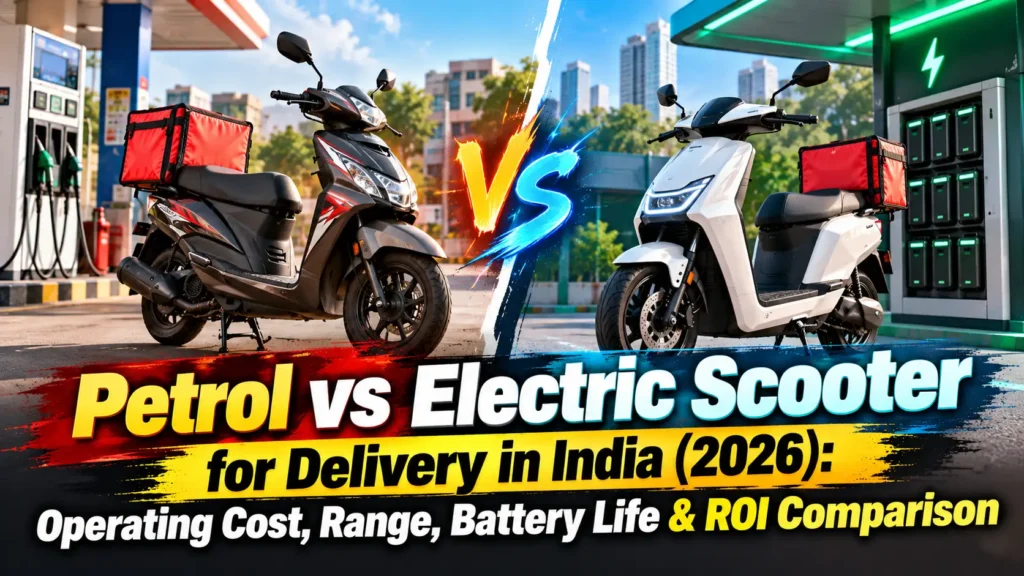
In modern India’s rapidly expanding hyper-local delivery and quick-commerce market, deciding between a petrol vs electric scooter for delivery is the most vital financial decision an aspiring delivery partner must evaluate. With fuel prices persisting near ₹100 per liter across Indian metropolitan centers, conventional petrol two-wheelers consume between ₹3,800 and ₹5,500 every month in fuel and engine upkeep. On the opposing side, commercial electric two-wheelers (EVs) operate at an energy cost of just ₹0.25 to ₹0.35 per kilometer, slashing monthly charging expenditure to under ₹750 to ₹950 for the exact same delivery workload. In 2026, leading delivery aggregators like Zomato, Swiggy, Blinkit, and Zepto actively encourage the green transition by partnering with battery-swapping networks and offering green delivery incentives. If you are preparing your vehicle and seeking high-paying delivery partner vacancies across top logistics platforms, you can explore verified delivery partner jobs on AlphaReach to locate certified hiring hubs near you.
Evaluating petrol against electric mobility requires examining more than just fuel costs. Petrol two-wheelers—like the Honda Activa, Hero Splendor, or Bajaj Platina—offer unmatched operational freedom: instantaneous 2-minute refuelling at any of India’s 75,000+ petrol stations, zero range anxiety during unforeseen long-distance drops, and massive nationwide mechanics networks with ultra-cheap spare parts. Conversely, electric scooters require planned overnight home charging or active subscriptions to commercial battery swapping hubs, but reward owners with near-zero engine maintenance, whisper-quiet operation, and lower daily physical riding fatigue.
In accordance with vehicle emissions, transport guidelines, and clean energy transition frameworks monitored by the Bureau of Energy Efficiency (BEE), commercial delivery fleets in Tier-1 cities are under increasing regulatory mandates to decarbonize last-mile transport. In this comprehensive 2026 head-to-head comparison guide, we analyze the structural economics of petrol vs. electric delivery scooters, contrast monthly running expenses, evaluate range reliability and battery degradation, and help you determine the optimal vehicle choice based on your daily delivery patterns.
The 5 Core Dimensions: Petrol vs. Electric Scooter for Delivery
Delivery partners must weigh five critical operational factors when comparing petrol and electric platforms:
- Fuel & Energy Expenditure per Kilometer: Petrol scooters (at 48 km/l) cost roughly ₹2.08 per kilometer; commuter petrol bikes (at 68 km/l) cost ~₹1.47 per km. Electric scooters consume roughly 2.5 to 3.5 kWh per 100 km, costing approximately ₹0.25 to ₹0.35 per km when charged at domestic rates.
- Refueling Speed vs. Charging Downtime: A petrol vehicle refills its entire tank in under 2 minutes at any petrol bunk. A fixed-battery EV requires 4 to 6 hours of home charging, whereas a battery-swapping EV swaps in 60 seconds at an automated swap kiosk.
- Routine Servicing & Spare Parts Overhead: Petrol engines require engine oil changes every 3,000 km, air filter replacements, spark plug checks, and drive belt/chain servicing. EVs have zero engine oil, zero filters, and zero exhaust systems, limiting service to brake pads and tires.
- Initial Upfront Cost vs. Resale Valuation: A basic petrol commuter motorcycle costs ₹65,000 to ₹78,000 ex-showroom with high resale value after 4 years. A high-range commercial EV costs ₹85,000 to ₹1,15,000, but enjoys government subsidies and lower GST (5% vs. 28% for petrol).
- Long-Distance Route Flexibility: Petrol vehicles allow unlimited, spontaneous inter-city or suburban deliveries with zero route planning. Fixed-battery EVs require careful route budgeting to avoid being stranded with a depleted battery in unfamiliar suburban zones.
Head-to-Head Comparison Matrix: Petrol vs. Electric Scooter (2026)
To evaluate the true economic reality over a 26-day monthly delivery schedule (covering 2,340 km monthly), consider the comprehensive benchmark matrix below:
| Operational Parameter | 100cc Petrol Commuter Bike | 110cc Petrol Automatic Scooter | Fixed-Battery Electric Scooter | Battery-Swapping Electric EV |
| Energy / Fuel Cost per km | ₹1.45 – ₹1.55 / km | ₹1.95 – ₹2.15 / km | ₹0.25 – ₹0.35 / km | ₹0.70 – ₹0.90 / km (Swap Fee) |
| Monthly Fuel / Power Cost (2,340 km) | ₹3,400 – ₹3,650 | ₹4,600 – ₹5,000 | ₹600 – ₹820 | ₹1,650 – ₹2,100 |
| Monthly Maintenance / Service (₹) | ₹350 – ₹450 | ₹400 – ₹550 | ₹100 – ₹150 | ₹100 – ₹150 (Fleet-Managed) |
| Total Monthly Running Cost (₹) | ₹3,750 – ₹4,100 | ₹5,000 – ₹5,550 | ₹700 – ₹970 | ₹1,750 – ₹2,250 |
| Refuel / Turnaround Time | 2 Minutes (Any Petrol Bunk) | 2 Minutes (Any Petrol Bunk) | 4.5 to 6.5 Hours (Overnight) | 60 Seconds (Swap Station) |
| Effective Daily Operational Range | Unlimited (400+ km tank) | Unlimited (220+ km tank) | 85 – 120 km per charge | Unlimited (Continuous Swaps) |
★ High-Paying Delivery Fleet Opportunities: Are you seeking high-paying delivery partner jobs with competitive weekly earnings, fuel distance allowances, same-day onboarding, and flexible shifts? explore verified delivery partner jobs on AlphaReach to discover immediate vacancies across top quick-commerce dark stores, food delivery platforms, and courier hubs in your city today.
3-Year Total Cost of Ownership (TCO) & Net Savings Calculation
Calculating the 3-year financial footprint reveals the dramatic long-term savings of electric mobility across 75,000 kilometers of commercial delivery work:
- Scenario A: 110cc Petrol Scooter (Honda Activa):
- Purchase Price: ₹85,000.
- Total Petrol Cost (75,000 km at 48 km/l and ₹100/L): ₹1,56,250.
- Total Maintenance (25 services + belt replacements): ₹16,500.
- Total 3-Year Expenditure: ₹2,57,750.
- Scenario B: Fixed-Battery Electric Scooter (TVS iQube / Ola S1X):
- Purchase Price (after state EV subsidies): ₹95,000.
- Total Electricity Cost (75,000 km at ₹0.30/km): ₹22,500.
- Total Maintenance (Brake pads, tire wear, general checks): ₹4,500.
- Total 3-Year Expenditure: ₹1,22,000.
- Net 3-Year Difference: Riding the electric scooter saves an astounding ₹1,35,750 in cash over 3 years—averaging more than ₹3,750 in extra monthly net savings!
When Does Petrol Still Make Sense in 2026?
Despite the clear economic advantages of EVs, petrol vehicles remain the superior choice in specific operational scenarios:
- Living in Rented Accommodation Without Ground-Floor Charging: If you reside in a 3rd-floor apartment without a designated parking bay or access to an external 15A charging socket, charging a fixed-battery EV becomes logistically impossible unless you opt for a removable battery or battery swap subscription.
- Long-Distance Suburban & Inter-City Courier Beats: If your delivery routes frequently take you 30 to 50 km outside the municipal city limits into rural industrial corridors where EV charging infrastructure is non-existent, a petrol motorcycle remains the only safe, reliable vehicle.
- Extreme Budget Constraints (Under ₹30,000 Capital): If you have limited upfront capital and cannot qualify for vehicle financing, purchasing a reliable second-hand Hero Splendor for ₹25,000 lets you start earning immediately without commercial debt.
Top 5 Recommendations for Making the Right Choice
Follow these actionable guidelines to pick the optimal delivery vehicle for your unique profile:
- If You Ride 60 to 90 km Daily in City Zones: Choose a Fixed-Battery EV (Ola S1X, TVS iQube, Ather Rizta). Charge overnight at home to enjoy the absolute lowest running cost (₹0.30/km).
- If You Ride 120+ km Daily in Metro Hubs: Choose a Battery-Swapping EV (Zypp Electric, Battery Smart compatible models) to eliminate midday charging delays and maximize peak delivery hours.
- If You Handle E-Commerce Long-Distance Pincodes: Choose a 100cc-110cc Petrol Commuter Bike (Bajaj Platina 110, Hero Splendor Plus) for exceptional 70 km/l range and total geographical freedom.
- If You Prioritize Maximum Physical Comfort in Crowded Markets: Choose a Petrol Scooter with an External Fuel Lid (TVS Jupiter 110) if home charging is unavailable.
- Test Ride with Full Delivery Load: Before committing, test ride both vehicles while carrying a fully weighted delivery backpack to experience real-world handling, braking, and hill-climbing power.
★ Maximize Your Delivery Earnings Today: Ready to maximize your delivery income, optimize your vehicle running costs, and achieve financial independence with top platform fleets? apply as a verified delivery partner on AlphaReach to access fast onboarding, guaranteed shift schedules, and priority route dispatches today.
Frequently Asked Questions (FAQs)
Is an electric scooter really cheaper to run than a petrol motorcycle for delivery?
Yes, significantly cheaper. An electric scooter costs approximately ₹0.25 to ₹0.35 per kilometer when charged at domestic electricity rates, compared to ₹1.45 to ₹1.55 per kilometer for a 100cc petrol commuter bike, and ₹2.00+ per kilometer for a petrol scooter. Over an average month of 2,400 km, an EV rider saves between ₹2,600 and ₹4,200 purely in energy expenses.
What is the biggest operational drawback of an electric delivery scooter?
The biggest drawback of a fixed-battery electric scooter is range limitation and charging downtime. If you run out of charge during a busy evening dinner surge, a fixed-battery EV requires 3 to 5 hours to recharge, causing you to lose prime delivery hours. This limitation is effectively solved by utilizing commercial battery-swapping networks that swap batteries in 60 seconds.
How many years does an electric scooter battery last under commercial delivery use?
A high-quality lithium-ion (NMC/LFP) battery pack in modern electric scooters lasts between 1,500 and 2,000 charge cycles, which equates to roughly 1,00,000 to 1,40,000 kilometers of driving. For a full-time delivery executive riding 2,500 km per month, the battery pack will reliably last between 3.5 and 5 years before experiencing noticeable range degradation.
Can I use an electric scooter in heavy monsoon rains without water damage?
Yes. Modern commercial electric scooters feature IP67-rated water and dust-resistant electric motors and battery enclosures. This means the battery and critical electronics are completely sealed against heavy rain downpours and can safely navigate waterlogged roads up to standing water depths of 150 to 200 mm without short-circuiting.
Are delivery platforms paying extra incentives for using electric vehicles?
Yes. Leading aggregators like Zomato, Swiggy, and Blinkit offer ‘Green Fleet’ incentives and prioritize EV riders for dense, short-distance grocery batches. Platforms also partner with EV fleet companies to offer subsidized vehicle leases and discounted battery swap coupons to active delivery partners.
Conclusion
The battle between petrol vs electric scooter for delivery in 2026 clearly tilts toward electric mobility for the vast majority of urban hyper-local delivery executives. With monthly running cost savings exceeding ₹3,500 and the rapid expansion of 60-second battery-swapping infrastructure across Tier-1 and Tier-2 Indian cities, electric scooters provide an unbeatable return on investment that directly elevates your standard of living.
However, if you operate long-distance courier routes across distant suburban fringes or lack access to reliable ground-floor charging, a proven 100cc petrol commuter bike like the Bajaj Platina or Hero Splendor remains a reliable, high-mileage workhorse. Assess your daily mileage, evaluate your residential charging access, and choose the platform that delivers the highest net income into your pocket.