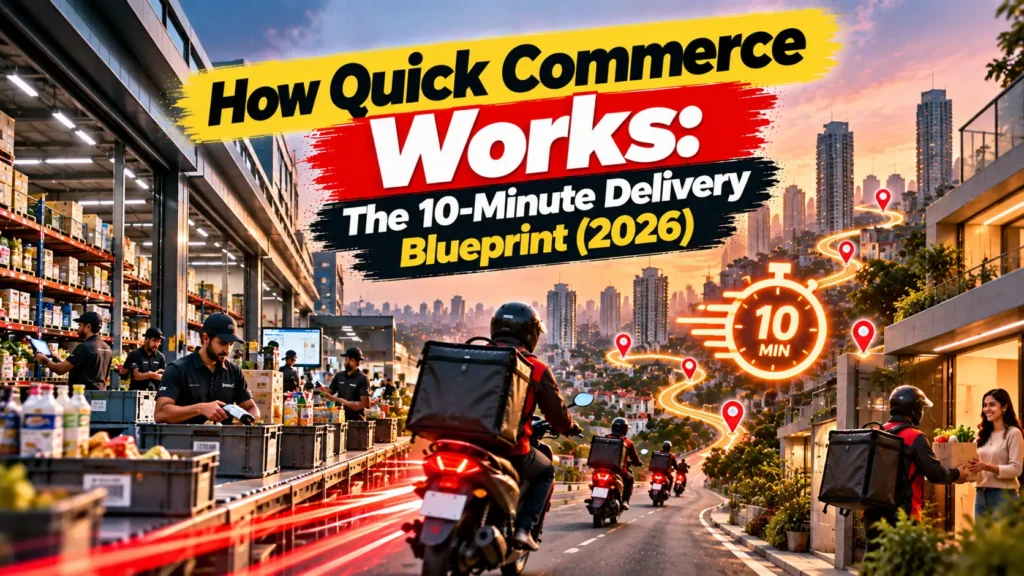
The rapid rise of quick commerce in India—promising and delivering everything from fresh coriander and milk to electronics, festive apparel, and stationery in ten to fifteen minutes—has disrupted global retail conventions. What international critics initially dismissed as a financially unviable pandemic-era novelty has matured in India into a multi-billion-dollar commercial juggernaut reshaping consumer habits. Yet, having how quick commerce works explained through an operational lens reveals that ten-minute delivery is neither magic nor reckless speeding on the road; rather, it is a masterclass in hyper-local real estate topology, predictive data science, warehouse ergonomics, and millimeter-precise fleet dispatching. If you want to capitalize on this high-growth sector by building a lucrative delivery or operations career, you can explore verified quick commerce jobs on AlphaReach to discover immediate-joining openings across leading platforms today.
To understand quick commerce (or q-commerce), one must unlearn traditional e-commerce logistics principles. Traditional e-commerce relies on massive, centralized warehouses located outside municipal limits that ship parcels over 24 to 72 hours via multi-modal line-haul networks. In stark contrast, quick commerce collapses the entire supply chain into dense, decentralized networks of micro-fulfillment centers (dark stores) embedded deep within urban residential neighborhoods.
Furthermore, quick commerce in India is expanding far beyond emergency grocery essentials into high-margin consumer electronics, beauty cosmetics, festive merchandise, and pharmaceutical supplies. In this definitive 2026 operational deep dive, we deconstruct the four mechanical pillars of 10-minute delivery, analyze dark store picking workflows, evaluate unit economics profitability, and examine the safety protocols that govern frontline operations.
The 4 Pillars of 10-Minute Delivery: Why Speed is an Engineering Feat
A persistent consumer misconception is that quick-commerce delivery partners achieve 10-minute turnarounds by speeding recklessly through traffic. In operational reality, road transit accounts for only a fraction of the total fulfillment timeline, and riders travel at normal urban speeds of 15 to 25 km/h. The secret to 10-minute delivery lies in four synchronized operational pillars:
Pillar 1: Micro-Radius Dark Store Topology. Quick-commerce operators position dark stores within a tight 1.5 to 2.5-kilometer radius of target residential catchments. At an average speed of 20 km/h, covering 1.5 kilometers takes between 4 and 6 minutes on a two-wheeler, making rapid transit naturally achievable without exceeding legal speed limits.
Pillar 2: Curated High-Velocity SKU Density. Dark stores do not stock 50,000 items; they carry 2,500 to 4,500 high-frequency, essential SKUs selected by machine learning algorithms that analyze local neighborhood purchasing patterns.
Pillar 3: 90-Second In-Store Picking and Packing. The entire warehouse process—from digital order ping to sealed bag handover—is engineered to execute in under two minutes through ergonomic aisle layouts and barcode scanning.
Pillar 4: Predictive Algorithmic Dispatch. AI engines dispatch nearby delivery partners who are already returning to the hub, timing their arrival exactly with the completion of packaging for zero idle handover lag. Innovation in this sector is supported under technological entrepreneurship programs guided by Startup India (DPIIT), which fosters digital supply chain innovation and logistics tech startups across India.
Comparative Breakdown: Traditional E-Commerce vs. Quick Commerce
Contrasting quick commerce with legacy e-commerce clarifies the radical operational, infrastructural, and economic shifts that define the 10-minute model.
The analytical table below compares the foundational operating parameters of traditional e-commerce against modern quick commerce in the Indian market:
| Operating Parameter | Traditional E-Commerce (Amazon/Flipkart) | Quick Commerce (Blinkit/Zepto/Instamart) | Underlying Operational Rationale |
| Delivery Speed | 24 – 72 Hours (or Next-Day) | 10 – 15 Minutes (Instant) | Quick commerce serves immediate, unplanned needs |
| Warehouse Footprint | Mega-DCs (100,000 – 500,000 sq.ft) | Dark Stores (2,500 – 4,000 sq.ft) | Dark stores prioritize urban neighborhood proximity |
| Delivery Radius | City-wide / Inter-State (15–50+ km) | Hyper-local Micro-Radius (1.5–2.5 km) | Short distances guarantee rapid, predictable transit |
| In-Store Fulfillment Time | 2 to 6 Hours (Batch picking) | 90 to 120 Seconds (Single-order pick) | Dark stores optimize for instant per-order velocity |
| Fleet Model | Dedicated delivery vans / Hub 3PL | Dense crowdsourced 2-wheeler gig fleet | Two-wheelers navigate urban traffic without delays |
| Product Catalog (SKUs) | Millions of products across categories | 3,000 – 6,000 High-velocity essentials | Curated selection eliminates picking clutter |
Fascinated by the rapid growth of quick commerce and want to join India’s top 10-minute delivery networks? Explore verified dark store, picking, and delivery partner vacancies: explore verified quick commerce jobs on AlphaReach and apply today.
Inside the Dark Store: Warehouse Ergonomics and Algorithmic Picking
The dark store is the beating heart of quick commerce. Spanning between 2,500 and 4,000 square feet, a dark store is closed to retail walk-ins and engineered exclusively for fulfillment speed.
Aisle layouts are designed based on spatial velocity mapping. The highest-demand SKUs—such as milk, curd, bread, eggs, and popular snack packs—are located within five paces of the central packing tables. Intermediate shelves hold cooking staples and packaged goods, while slow-moving personal care items occupy deeper perimeter shelving.
When an order is received, a dedicated warehouse picker’s handheld device vibrates, highlighting the optimal walking sequence through the aisles. The picker scans each item’s barcode, verifying batch codes and expiry dates. The packed goods are placed in a tamper-evident bag, sealed with an adhesive barcode sticker, and handed to the outbound dispatch rider at the staging counter—all in under 90 seconds.
The Unit Economics: How Quick Commerce Reaches Profitability
The central debate surrounding quick commerce has always focused on its path to sustainable profitability. Skeptics argued that delivering small-value orders like a carton of milk or a packet of chips for free could never generate positive contribution margins. However, Indian quick-commerce operators have unlocked profitability through three strategic levers.
First is Order Density and Rider Utilization. When a dark store achieves 1,500 to 2,500 daily orders within its 2-kilometer radius, riders complete three to four deliveries per hour with minimal deadhead transit, lowering fulfillment costs per order to between Rs. 35 and Rs. 45.
Second is Expanding Average Order Value (AOV) and High-Margin Non-Grocery SKUs. Platforms have expanded catalogs beyond low-margin produce to include high-margin consumer electronics (chargers, headphones), beauty cosmetics, apparel, toys, and small home appliances, elevating AOVs from Rs. 350 to over Rs. 600.
Third is Multi-Stream Monetization. Beyond customer delivery fees and handling charges, quick-commerce platforms generate high-margin revenue from In-App Brand Advertising, sponsored product search placements, and brand promotional fees, transforming dark stores into profitable retail profit centers.
Rider Safety, Algorithms, and Operational Ethics
A crucial operational question is whether 10-minute delivery compromises frontline rider road safety. Platforms emphasize that delivery partner dispatch algorithms do not penalize riders for traffic delays or delivery times exceeding 10 minutes.
The 10-minute delivery commitment is built entirely on warehouse picking speed (under 2 minutes) and short geographic proximity (1.5 to 2 km). Even if a rider travels at a safe, leisurely speed of 18 km/h, covering 1.5 kilometers requires only 5 minutes on the road, leaving ample buffer for parking and doorstep handover without any need for speeding or red-light violations.
Furthermore, platforms enforce strict road safety protocols: requiring riders to wear certified helmets, providing comprehensive group accident insurance, and automatically expanding delivery turnaround times or shrinking delivery radii during heavy monsoon rains or poor road conditions to prioritize rider well-being.
Earn Rs. 22,000 to Rs. 38,000+ monthly in quick commerce! Enjoy short delivery distances (<2.5 km), high order density, flexible shifts, and weekly bank payouts. apply directly through AlphaReach now.
Frequently Asked Questions (FAQs)
How is 10-minute delivery physically possible without speeding?
Quick commerce achieves 10-minute delivery through hyper-local dark stores located within a 1.5 to 2 km radius, 90-second warehouse picking, and algorithm-assisted dispatch. At normal urban speeds of 18-20 km/h, covering 1.5 km takes just 5 minutes on road.
What is a quick commerce dark store?
A dark store is a compact, closed-to-the-public mini-warehouse of 2,500 to 4,000 square feet located inside residential neighborhoods, engineered specifically for rapid online grocery and FMCG picking.
How does quick commerce make money?
Quick commerce platforms earn through retail product margins, customer delivery and handling fees, surge fees, and high-margin in-app brand advertising and sponsored product placements.
Do delivery riders face penalties if they deliver after 10 minutes?
No. Leading platforms have stated that delivery riders do not see delivery countdown timers on their partner apps and face zero penalties or deductions for late deliveries caused by traffic or safety considerations.
How many items does a quick commerce dark store stock?
A typical quick commerce dark store stocks between 3,000 and 5,000 high-velocity SKUs, carefully curated by machine learning algorithms based on local neighborhood demand.
Conclusion
Quick commerce in India has evolved from an ambitious experiment into an indispensable pillar of modern retail, fundamentally transforming how urban consumers access daily essentials through technological and infrastructural innovation.
By fusing neighborhood dark store networks, ergonomic warehouse picking, and sustainable electric fleets, quick commerce represents the vanguard of retail evolution, creating hundreds of thousands of dignified jobs and setting global benchmarks for operational excellence.