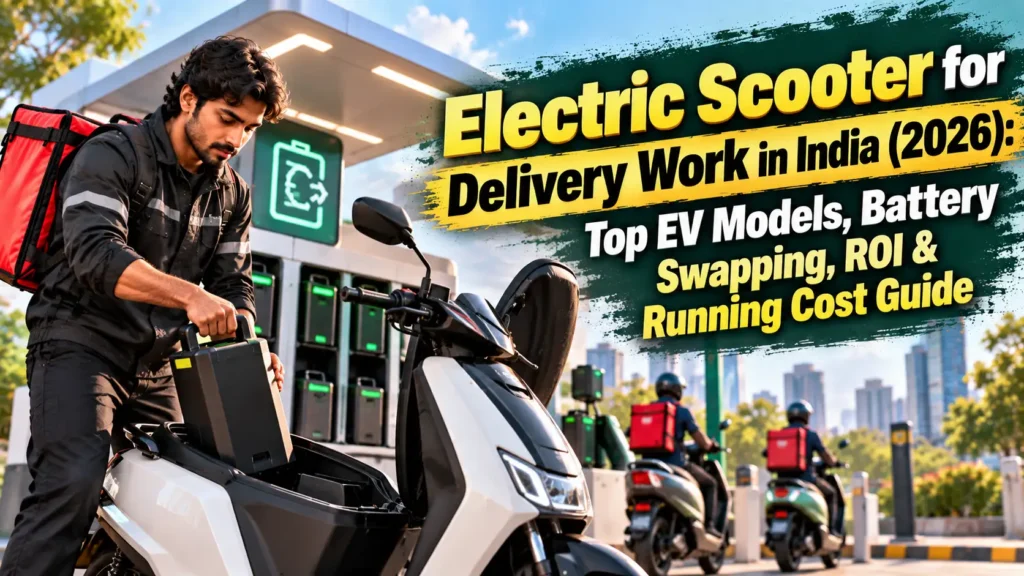
In modern India’s rapidly electrifying hyper-local logistics ecosystem, adopting an electric scooter for delivery work has emerged as the most transformative financial upgrade a delivery partner can make. With petrol prices hovering around ₹100 per liter across major metropolitan centers, conventional fuel costs consume between ₹3,500 and ₹5,500 of a delivery executive’s monthly earnings. In stark contrast, commercial electric two-wheelers (EVs) operate at an astounding energy cost of just ₹0.25 to ₹0.35 per kilometer—translating to a total monthly charging expenditure of under ₹700 to ₹900 for the exact same delivery mileage. In 2026, leading quick-commerce and food delivery giants like Zepto, Blinkit, Swiggy, and Zomato are aggressively transitioning their delivery fleets toward green mobility, offering preferential order dispatching, dedicated EV charging stations, and green delivery incentives to EV partners. If you are eager to maximize your net earnings through electric delivery mobility, you can explore verified delivery partner jobs on AlphaReach to connect with hiring hubs in your city today.
The economics of electric delivery scooters extend far beyond direct fuel savings. Commercial EVs feature significantly fewer moving components than internal combustion engines: there are zero engine oil changes, zero spark plugs, zero air filters, zero carburetors, and zero exhaust systems to service. This drastic mechanical simplification virtually eliminates routine servicing bills, saving riders an additional ₹4,000 to ₹6,000 annually in maintenance overhead. Furthermore, the advent of standardized 60-second battery swapping networks operated by players like Battery Smart, Sun Mobility, and Yuma Energy has completely eliminated range anxiety, enabling delivery riders to swap depleted batteries for fully charged packs in under a minute and stay on the road all day.
Under national clean energy initiatives and electric vehicle adoption frameworks spearheaded by the Bureau of Energy Efficiency (BEE), central and state governments offer substantial subsidies, reduced GST rates (5%), and road tax exemptions for commercial electric two-wheelers. In this comprehensive 2026 EV evaluation handbook, we analyze the top production electric scooters dominating Indian delivery fleets, compare battery charging versus battery swapping economics, calculate real-world monthly ROI, and share vital battery health management techniques to ensure long-term operational success.
The 5 Revolutionary Advantages of Electric Delivery Scooters
Transitioning from petrol to electric power delivers five immediate operational advantages for delivery executives:
- 80% Reduction in Daily Running Costs: While a petrol bike costs approximately ₹1.40 to ₹1.60 per kilometer to operate, an electric scooter consumes roughly ₹0.25 to ₹0.35 per kilometer in electricity, instantly saving ₹100 to ₹150 every single shift.
- 60-Second Battery Swapping Speed: With modern battery swap networks, riders do not need to wait 3 to 4 hours for home charging. Simply pull up to an automated kiosk, scan a QR code, swap batteries in 60 seconds, and resume accepting high-paying delivery pings.
- Instant Electric Torque for Heavy City Loads: Electric hub and mid-drive motors deliver 100% of their peak torque instantly from 0 RPM, making uphill flyover climbs with heavy 20 kg grocery totes effortless without engine strain.
- Near-Zero Routine Maintenance Downtime: With zero engine oil, spark plugs, or drive belts to service, EV maintenance is largely limited to inspecting brake pads and tire pressures, virtually eliminating garage visits.
- Platform Green Delivery Incentives: Major aggregators reward EV delivery partners with extra per-order sustainability bonuses (₹2 to ₹5 extra per drop) and preferential allocation for short-range grocery batches.
Comparative Analysis: Top 5 Electric Delivery Scooters in India (2026)
India’s commercial EV market features both fixed-battery consumer scooters and dedicated battery-swapping commercial models. The matrix below benchmarks the top five electric delivery scooters:
| Electric Scooter Model | Battery Type / Capacity | Real-World Delivery Range (km) | Charging / Swap Time | Price Range / Lease (₹) | Primary Operational Advantage |
| Ola S1X (3 kWh / 4 kWh) | Fixed Lithium-ion (3-4 kWh) | 95 – 130 km | 4.5 – 6.5 Hours (Home/Fast) | ₹79,000 – ₹99,000 | Long single-charge range, fast top speed (90 km/h), modern app telemetry |
| TVS iQube (3.4 kWh) | Fixed Lithium-ion (3.4 kWh) | 85 – 100 km | 4.5 Hours (Home Plug) | ₹95,000 – ₹1,15,000 | Legendary build quality, reliable IP67 battery enclosure, smooth throttle modulation |
| Zypp Electric Cargo | Swappable Battery (Dual) | 65 – 75 km per swap | 60 Seconds (Swap Station) | ₹150 – ₹200 / Day (Rental) | Zero upfront purchase cost, unlimited daily range via battery swapping |
| Yulu DeX | Swappable LFP Pack | 55 – 60 km per swap | 60 Seconds (Yulu Hub) | ₹130 – ₹170 / Day (Rental) | No driving licence required (under 25 km/h), ultra-cheap daily rental |
| Ather Rizta (2.9 kWh / 3.7 kWh) | Fixed Deep-Storage Pack | 90 – 125 km | 4.5 – 6.0 Hours | ₹1,09,000 – ₹1,35,000 | Massive 34L under-seat storage, cavernous flat floorboard, ultra-durable chassis |
★ High-Paying Delivery Fleet Opportunities: Are you seeking high-paying delivery partner jobs with competitive weekly earnings, fuel distance allowances, same-day onboarding, and flexible shifts? explore verified delivery partner jobs on AlphaReach to discover immediate vacancies across top quick-commerce dark stores, food delivery platforms, and courier hubs in your city today.
Battery Swapping vs. Fixed Home Charging: Which Model Wins for Delivery?
Delivery partners must choose between two distinct EV operational models based on their daily mileage:
- Fixed-Battery Home Charging Model (Best for 60 to 90 km Daily Riders):
- You purchase or finance the scooter (e.g., Ola S1X or TVS iQube) and charge it overnight at home from a standard 15A three-pin plug.
- Cost per full charge is approximately ₹25 to ₹35 for a 3 kWh battery (yielding 90 to 100 km real-world range).
- Perfect for part-time riders or single-shift daytime workers who can recharge overnight without mid-day interruptions.
- Battery Swapping Subscription Model (Best for 100 to 180 km Full-Time Riders):
- You purchase a swap-compatible EV (or rent one from fleets like Zypp) without buying the expensive battery pack.
- You subscribe to a battery swapping network (e.g., Battery Smart) paying ~₹60 to ₹80 per battery swap.
- Provides unlimited daily operational range: swap batteries during a 2-minute tea break and continue delivering through peak lunch and dinner rushes.
Real-World ROI Math: Petrol Bike vs. Electric Scooter Over 12 Months
To understand the transformative financial return of switching to an electric delivery scooter, consider a full-time rider covering 90 km daily across 300 working days (27,000 km annually):
- Annual Petrol Motorcycle Expenses (at 65 km/l and ₹100/liter):
- Fuel Consumed: 415.4 liters = ₹41,540.
- Routine Maintenance (9 oil changes + services): ₹4,500.
- Total Annual Running Cost: ₹46,040.
- Annual Electric Scooter Expenses (Home Charged at ₹0.30/km):
- Electricity Consumed: 27,000 km x ₹0.30 = ₹8,100.
- Routine Maintenance (Brake pads, tire care): ₹1,200.
- Total Annual Running Cost: ₹9,300.
- Net Annual Savings: ₹46,040 – ₹9,300 = ₹36,740 saved in cash every single year! In less than two years, the savings alone pay for the entire purchase cost of the electric scooter.
Top 5 Battery Care Rules to Preserve Long-Term EV Life
To ensure your electric scooter battery maintains strong range and avoids thermal degradation over years of heavy use, follow these rules:
- Avoid Charging Immediately After Heavy Rides in Summer: Riding hard on scorching 42°C summer afternoons raises internal battery cell temperatures. Let the scooter rest in the shade for 20 minutes before plugging it in to charge.
- Maintain Battery State-of-Charge (SoC) Between 20% and 90%: Deep discharging down to 0% stresses lithium-ion chemistry. Plug in when battery levels drop to 20% to maximize cell cycle longevity.
- Use Slow Home AC Charging Whenever Feasible: While public DC fast chargers are great for emergency top-ups, daily slow AC charging generates far less heat and prolongs battery lifespan.
- Park in Shaded Locations During Afternoon Shift Breaks: Avoid leaving your electric scooter baking under direct sunlight in unshaded parking lots for hours, which elevates pack temperatures.
- Keep Tire Pressures Strictly Monitored: EV range drops by up to 10% when tires are under-inflated. Check tire pressures weekly to maximize kilometers per kilowatt-hour.
★ Maximize Your Delivery Earnings Today: Ready to maximize your delivery income, optimize your vehicle running costs, and achieve financial independence with top platform fleets? apply as a verified delivery partner on AlphaReach to access fast onboarding, guaranteed shift schedules, and priority route dispatches today.
Frequently Asked Questions (FAQs)
How much money can a delivery rider save per month by switching to an electric scooter?
A delivery rider covering 80 to 100 km per day typically saves between ₹2,800 and ₹4,000 per month by switching from a petrol motorcycle to an electric scooter. Over a full year, this translates to ₹33,000 to ₹48,000 in direct bank savings due to an 80% reduction in fuel costs and near-zero engine maintenance expenses.
Is the range of an electric scooter enough for a full-time 8 to 10-hour delivery shift?
Yes. Modern electric scooters like the Ola S1X (4 kWh) deliver 115 to 130 km of real-world delivery range on a single charge, which is fully sufficient for an 8-hour shift. For riders covering 150+ km daily, battery-swapping networks (like Battery Smart or Zypp) allow instant battery changes in under 60 seconds, providing unlimited daily range.
What happens if an electric delivery scooter runs out of battery mid-shift?
Most modern EVs provide precise digital state-of-charge (SoC) meters and enter an ‘Eco Limp Mode’ when battery levels drop below 10%, limiting speed to 25 km/h to allow you to reach a nearby charging station. Riders can also use platform app maps to locate public fast-charging points or battery swapping kiosks within 1 to 2 km.
Can I rent an electric scooter for delivery work without paying a huge down payment?
Yes. Commercial EV mobility providers like Zypp Electric, Yulu, and Euler Motors offer flexible daily and weekly commercial EV rental plans ranging from ₹130 to ₹220 per day. These subscription rentals include vehicle maintenance, battery swapping access, and insurance, allowing beginners to start delivery work with zero upfront purchase capital.
How long do electric scooter batteries last before needing replacement?
High-quality lithium-ion (NMC and LFP) battery packs used in modern electric scooters like TVS iQube, Ather, and Ola are rated for 1,500 to 2,000 full charge cycles, which translates to approximately 1,20,000 to 1,50,000 operational kilometers (or 4 to 6 years of commercial delivery use) before capacity drops below 75%.
Conclusion
Operating an electric scooter for delivery work in 2026 is no longer an experimental alternative—it is the most profitable, forward-looking operational choice in the Indian logistics industry. By slashing your daily energy expenditure by 80% and eliminating expensive engine repair bills, an electric scooter directly converts operating waste into substantial personal savings.
Whether you choose a fixed-battery scooter like the Ola S1X or TVS iQube for predictable suburban shifts, or leverage commercial battery swapping for non-stop metro deliveries, embracing electric mobility secures your financial edge. In the fast-evolving gig economy, going electric is the smartest vehicle upgrade you will ever make.