
Priya’s story is a BPO employee delivery partner story built around a pattern that keeps surfacing in real reporting on India’s gig economy: call-centre staff citing low pay, job insecurity, and the night shift’s toll on health as reasons for leaving — sometimes for delivery work, sometimes finding gig income isn’t quite the upgrade they hoped for. As with our other real-story pieces, “Priya” is an illustrative composite, not a verified account of one named individual — but the pressures she weighs are drawn from real cases and published research, cited below.
Note on this story: “Priya” represents a common pattern among BPO agents, not a specific verified person. Her salary figures come from our BPO Job vs Delivery Partner Salary comparison; the pressures in her story are grounded in a real documented case and peer-reviewed research, cited inline.
The Starting Point: A Fixed Desk, a Rotating Night Roster
Priya worked an international-process BPO role for just over two years, earning in the typical ₹18,000–25,000/month range for international/voice processes — solid pay by entry-level standards, but tied to a rotating night shift set months in advance by an operations manager. Average handle time targets, call-quality audits, and mandatory login/logout tracking shaped every hour of her day, whether or not the shift itself was busy.
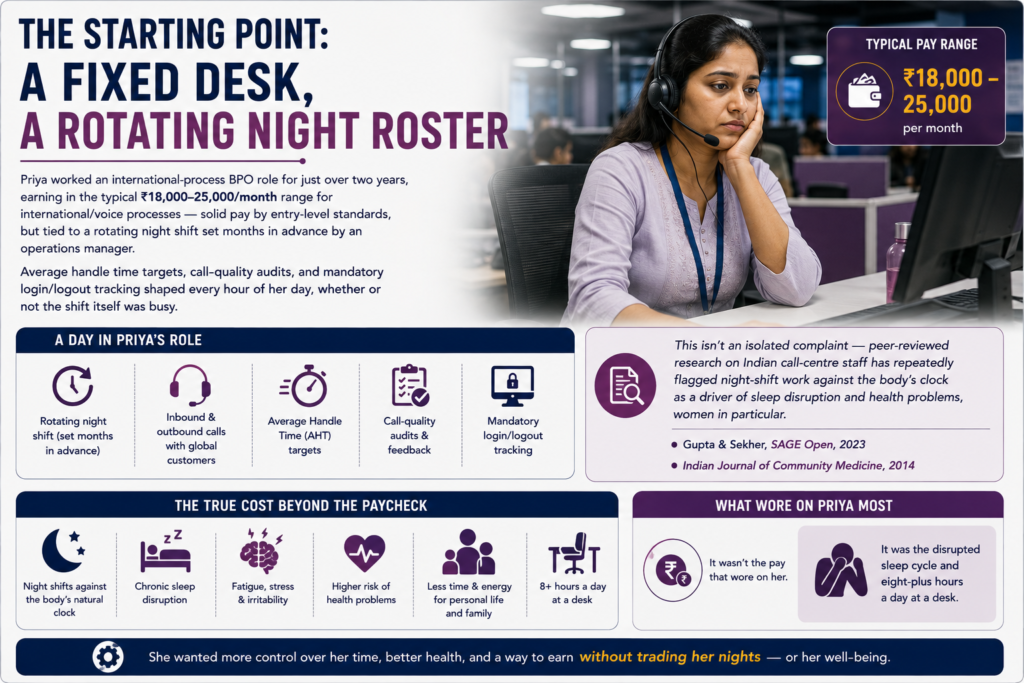
This isn’t an isolated complaint — peer-reviewed research on Indian call-centre staff has repeatedly flagged night-shift work against the body’s clock as a driver of sleep disruption and health problems, women in particular (Gupta & Sekher, SAGE Open, 2023; Indian Journal of Community Medicine, 2014). For Priya, it wasn’t the pay that wore on her most — it was the disrupted sleep cycle and eight-plus hours a day at a desk.
Why This Trade-Off Resonates With BPO Staff
The core pitch for Pillar C — BPO and back-office workers — isn’t primarily about income upside, though that exists too. It’s about trading KPI stress and a fixed night roster for open hours and physical activity. Delivery partner pay runs ₹15–35 per order depending on platform and distance, with some zones recently cut to ₹12–16/order — worth checking current Zepto rates for your city. For Priya, the appeal wasn’t just matching her BPO pay — it was that no supervisor’s dashboard would decide her schedule anymore.
That trade-off works out for some, and disappoints others. Kunal, 26, quit a call centre after three years over low pay and job insecurity and has delivered for Blinkit for six months — but told Newslaundry the switch hasn’t been the upgrade he expected: “It is not that there is a future here either. Even the money is not better” (Newslaundry, December 2025). Gig pay varies by platform, city, and hours logged — why this story sticks to the sourced BPO Job vs Delivery Partner Salary range rather than marketing claims.
The Transition: Testing Delivery Hours Around a BPO Shift
A common pattern among BPO staff who switch well is testing delivery work during off-shift daytime hours for a week or two before deciding to leave the BPO job entirely — validating real local earnings in a specific city zone first, rather than resigning on a guess.
Once validated, moving to full-time delivery hours puts realistic take-home at ₹25,000–30,000/month in metro cities (see the delivery partner earnings breakdown) — comfortably clearing entry-to-mid BPO pay of ₹15,000–25,000/month, and landing close to what 2+ years’ BPO experience would pay, but without the mandatory night shift.
What Actually Changed
- Schedule control: A roster set by an operations manager became self-set login hours — Priya chose daytime and evening peak windows and skipped night hours entirely.
- Health impact: Rotating night shifts gave way to a schedule she controlled — the change that research on BPO night-shift work suggests matters most for long-term wellbeing, ahead of the pay difference itself.
- Pay structure: Fixed monthly salary regardless of call volume became per-order pay tied to active hours and completed orders.
- What didn’t change immediately: Formal-sector EPF from a BPO job stays in your account even after leaving — it doesn’t disappear. As a gig worker, registering on the e-Shram portal (register.eshram.gov.in) gives access to separate unorganized-worker social security schemes, including accident and life insurance.
Is This the Right Trade-Off for Every BPO Employee?
Not necessarily — and Kunal’s account is a reminder that it isn’t automatic. Someone on a clear promotion track toward team lead, or who values a fixed paycheck and company-provided health insurance over schedule flexibility, may reasonably stick with BPO work — especially against experienced BPO pay of ₹25,000–35,000/month, where the income gap narrows. The honest picture: for entry-to-mid BPO staff dealing with mandatory night shifts and limited growth, delivery work offers a real, sourced income match or improvement plus schedule control — not a guaranteed windfall, and outcomes depend heavily on city, platform, and hours logged.
For the full numbers, see BPO Job vs Delivery Partner Salary: Which Pays More in 2026?, or the broader BPO to Delivery Job Switch Hub covering data-entry comparisons and night-shift-specific pain points too.
Frequently Asked Questions
Is this a real, verified individual’s story?
No — “Priya” is an illustrative, representative profile, not a verified account of a specific named person. The pressures in her story are grounded in real reporting, including a former call-centre employee’s documented move to gig delivery work (Newslaundry, 2025), and peer-reviewed research on night-shift health effects among Indian call-centre staff. Real accounts also show outcomes vary — some riders report gig pay falling short of expectations, which is why this article sticks to sourced salary ranges rather than platform marketing figures.
Do most BPO staff quit immediately, or test delivery work first?
Most who switch well test delivery hours part-time around their existing shift for 1–2 weeks before deciding to leave the BPO job, to validate real local earnings first.
Will I lose my EPF if I switch from a BPO job?
No. Formal-sector EPF from your current employer stays in your account even after you leave. As a gig worker, e-Shram registration provides separate unorganized-worker benefits.
Can delivery work really let me avoid night shifts completely?
Yes — unlike a BPO roster set by an operations manager, delivery partners choose their own login hours and can work daytime and evening peak windows only.
How does delivery pay compare to experienced BPO pay?
Metro delivery take-home (₹25,000–30,000/month) clears entry-to-mid BPO pay comfortably and closely matches 2+ years’ experienced BPO pay (₹25,000–35,000/month), without the mandatory night shift.
Ready to See What You’d Actually Earn?
Priya’s numbers are illustrative, but the underlying math is real and sourced. Apply to become a delivery partner and see what the switch looks like for your city and hours.