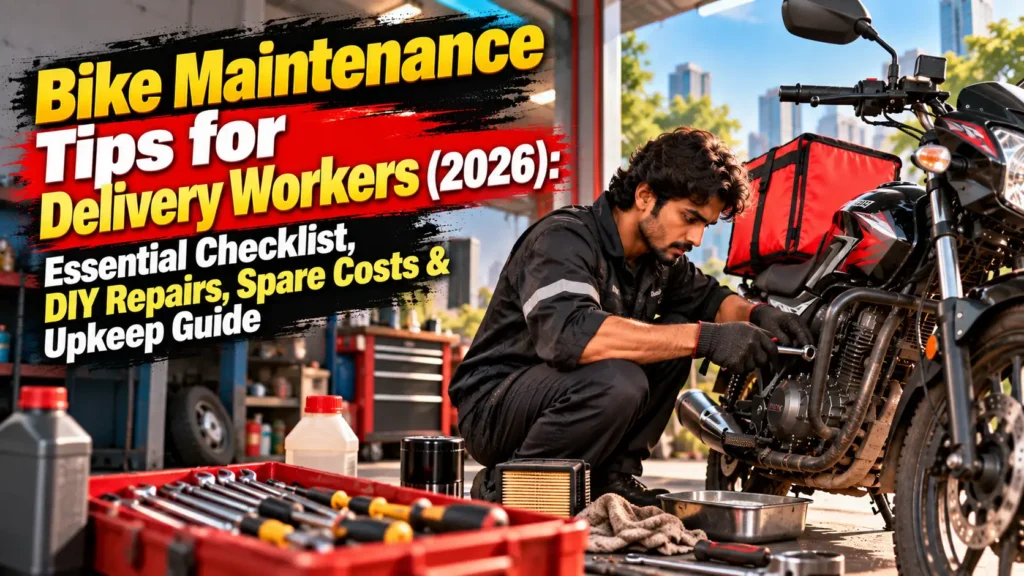
In modern India’s high-speed last-mile logistics ecosystem, practicing proactive bike maintenance tips for delivery workers is the single most effective way to protect your livelihood and avoid catastrophic repair bills. When a delivery executive logs between 2,200 and 3,200 kilometers every month fulfilling orders for Zomato, Swiggy, Zepto, Blinkit, and Shadowfax, their two-wheeler endures three to four times the mechanical wear and tear of a standard commuter motorcycle. Subjected to scorching summer pavement, torrential monsoon waterlogging, deep potholes, and continuous cargo loading, an unmaintained motorcycle will rapidly lose engine compression, burn excess petrol, and suffer sudden mid-shift mechanical failures that wipe out days of hard-earned delivery wages. In 2026, top-earning delivery professionals treat preventative maintenance not as an unwanted expense, but as essential insurance that guarantees 100% shift uptime and maximum daily earnings. If you are keeping your vehicle in top condition and looking for high-paying delivery partner opportunities, you can explore verified delivery partner jobs on AlphaReach to connect with hiring hubs in your area today.
The key to affordable, hassle-free motorcycle maintenance lies in disciplined consistency rather than expensive garage overhauls. Modern 100cc to 125cc commuter motorcycles from Hero MotoCorp, Bajaj Auto, and Honda are engineered with robust, simple mechanical layouts that are remarkably easy to inspect and service. A delivery rider who masters simple 5-minute daily inspections—such as verifying engine oil dipstick levels, checking tire air pressure, cleaning the air filter element, and lubricating the drive chain—can easily prevent 90% of all common roadside breakdowns. Furthermore, learning basic DIY maintenance tasks saves hundreds of rupees in mechanic labor charges every single month.
In accordance with vehicle roadworthiness and passenger safety standards regulated by the Ministry of Road Transport and Highways (MoRTH), commercial delivery two-wheelers must maintain fully functional braking systems, compliant exhaust emissions, and intact lighting systems to ensure public safety on urban roads. In this comprehensive 2026 maintenance handbook, we outline a foolproof 3-tier maintenance schedule for delivery riders, detail step-by-step DIY servicing techniques, review real-world component costs, and share insider mechanical tips to keep your motorcycle running like new for over 1,00,000 kilometers.
The 3-Tier Maintenance Schedule for High-Mileage Delivery Bikes
To ensure zero mid-shift breakdowns, delivery partners should adopt a structured 3-tier maintenance schedule:
- Tier 1: Daily 2-Minute Pre-Shift Walkaround:
- Inspect tire tread surfaces for embedded glass shards, sharp stones, or construction nails.
- Test front and rear brake lever feel (ensure levers do not bottom out against the handlebar).
- Verify that the headlight, rear tail lamp, brake light, and horn operate crisply.
- Tier 2: Weekly 10-Minute Sunday Tune-Up:
- Check engine oil level via the dipstick while the bike is parked on its center stand on level ground.
- Check cold tire pressures using a digital pressure gauge (Front 25 PSI, Rear 34-36 PSI).
- Inspect drive chain slack (adjust to standard 25 to 30 mm vertical play) and apply heavy gear oil.
- Tier 3: Monthly 30-Minute Comprehensive Service (Every 2,500 to 3,000 km):
- Drain old motor oil and refill with fresh 4T 10W-30 or 20W-40 mineral/semi-synthetic oil.
- Remove and blow clean the paper air filter element using compressed air (replace if clogged).
- Inspect front and rear brake shoes for friction lining thickness and lubricate control cables.
Essential Component Replacement Intervals & Price Benchmarks (2026)
Budgeting for routine component replacements prevents financial surprises. The benchmark matrix below details standard replacement intervals and parts costs for popular 100cc-110cc commuter bikes:
| Motorcycle Component | Recommended Replacement Interval | Genuine OEM Part Cost (₹) | Mechanic Labor Cost (₹) | Consequence of Neglect |
| 4T Engine Oil (900 ml – 1L) | Every 2,500 – 3,000 km | ₹320 – ₹400 | ₹50 – ₹100 (or DIY ₹0) | Piston seizure, cylinder scoring, complete engine failure |
| Paper Air Filter Element | Every 6,000 – 8,000 km | ₹180 – ₹260 | ₹30 – ₹50 | Choked air intake, black smoke, 5-8 km/l mileage loss |
| Drive Chain & Sprocket Kit | Every 20,000 – 25,000 km | ₹750 – ₹950 | ₹150 – ₹250 | Chain slippage, broken crankcase, dangerous rear wheel lockup |
| Front & Rear Brake Shoes | Every 8,000 – 12,000 km | ₹180 – ₹240 / pair | ₹50 – ₹80 | Weak stopping power, scored brake drums, accident risk |
| Resistor Spark Plug | Every 12,000 – 15,000 km | ₹110 – ₹150 | ₹20 – ₹30 (or DIY ₹0) | Engine misfiring, hard cold starting, poor fuel combustion |
★ High-Paying Delivery Fleet Opportunities: Are you seeking high-paying delivery partner jobs with competitive weekly earnings, fuel distance allowances, same-day onboarding, and flexible shifts? explore verified delivery partner jobs on AlphaReach to discover immediate vacancies across top quick-commerce dark stores, food delivery platforms, and courier hubs in your city today.
Step-by-Step DIY Engine Oil Change Guide for Delivery Riders
Changing your own engine oil takes just 15 minutes, saves mechanic fees, and ensures genuine oil is used:
- Warm Up the Engine: Run the motorcycle for 2 to 3 minutes to warm the oil, allowing suspended carbon and metal particles to drain out smoothly.
- Park on Center Stand on Flat Ground: Place an oil drain pan or cut plastic container directly beneath the engine’s bottom oil drain bolt.
- Remove Drain Bolt: Using a 17mm socket or ring spanner, loosen the drain bolt counterclockwise. Carefully remove the bolt and crush washer, allowing dark oil to drain completely for 5 to 7 minutes.
- Clean Oil Strainer Screen: Remove the side oil cap to wipe the wire mesh filter screen clean of any metallic debris before re-inserting.
- Reinstall Drain Bolt & Refill: Reinstall the drain bolt and washer securely (do not over-tighten). Pour in fresh 4T motorcycle oil (typically 900 ml for Hero Splendor/Platina). Check dipstick level, replace the cap, and you are ready to ride!
Monsoon & Extreme Summer Care Protocols
Extreme Indian seasons require tailored maintenance precautions:
- Monsoon Survival Rules:
- Apply waterproof grease to brake pivots, footrest hinges, and throttle cable nipples to prevent rust binding.
- Spray silicone water-dispersant (WD-40) into the ignition key barrel and handlebar switch gears to prevent electrical short-circuits.
- Clean the brake drums immediately after riding through waterlogged streets to prevent brake lining glazing.
- Summer Heat Wave Rules:
- Use slightly thicker 20W-40 viscosity oil during peak summer months (April to June) to ensure oil film strength under 45°C ambient heat.
- Inspect tire pressures weekly; hot road tarmac expands internal air pressure by 3 to 4 PSI, increasing blowout risks if over-inflated.
- Park in shaded areas during shift breaks to prevent ultraviolet degradation of rubber fuel lines and vinyl seat covers.
Top 5 Roadside Emergency Troubleshooting Hacks
Keep these quick roadside fixes in mind when unexpected trouble strikes mid-shift:
- Bike Stalls and Won’t Start? Check the Spark Plug Cap: Heavy rain often causes water to enter the rubber spark plug cap, shorting ignition current to the engine block. Remove the cap, blow it dry with your mouth, wipe with a dry cloth, and reattach firmly.
- Punctured Tubeless Tire Mid-Route? Carry a Portable Puncture Kit: A ₹150 tubeless puncture repair kit with rubber sticky strips and a mini hand pump allows you to plug a nail puncture in 5 minutes without removing the wheel.
- Snapped Clutch Cable? Shift by Rev-Matching: If your clutch cable snaps mid-traffic, push the bike forward, click into 1st gear while giving gentle throttle, and upshift smoothly without the clutch to limp to the nearest repair shop.
- Engine Chokes and Dies at High Throttle? Clear the Petrol Tank Air Vent: A blocked fuel cap breather hole creates an internal vacuum, stopping petrol flow to the injector. Open the fuel cap, listen for an air hiss, and clear the tiny vent hole with a pin.
- Dim Headlight and Weak Horn? Clean the Battery Terminals: Remove white sulfate powdery buildup from battery terminals using hot water and baking soda, and tighten the terminal screws to restore 100% electrical output.
★ Maximize Your Delivery Earnings Today: Ready to maximize your delivery income, optimize your vehicle running costs, and achieve financial independence with top platform fleets? apply as a verified delivery partner on AlphaReach to access fast onboarding, guaranteed shift schedules, and priority route dispatches today.
Frequently Asked Questions (FAQs)
How often should a delivery partner change engine oil on a commercial bike?
A delivery partner covering 80 to 100 km daily (2,400 to 3,000 km per month) should change their engine oil every 30 to 40 days (or every 2,500 to 3,000 km). Frequent oil changes are the most critical maintenance investment to prevent internal engine wear and maintain peak fuel efficiency.
What is the best engine oil grade for delivery bikes in India?
The best all-round engine oil grade for commuter delivery bikes like Hero Splendor, Bajaj Platina, and Honda Shine is a certified 4T 10W-30 or 20W-40 mineral or semi-synthetic motorcycle oil meeting API SL/SM and JASO MA2 standards. Brands like Castrol Activ, Motul, and Shell Advance are highly reliable.
Can I use regular car engine oil in my delivery motorcycle?
No, never use car engine oil in a motorcycle. Most commuter motorcycles share the same engine oil to lubricate the engine, gearbox, and wet clutch assembly. Car oils contain friction-reducing molybdenum additives that will cause your motorcycle’s wet clutch plates to slip, severely damaging the clutch.
How do I know if my motorcycle drive chain needs tightening?
Inspect the middle portion of the lower chain run between the two sprockets with your fingers. Standard free-play should be between 25 and 30 mm vertically. If the chain moves up and down by more than 40 mm, or slaps loudly against the metal chain guard when shifting gears, it must be adjusted immediately.
What essential tools should a delivery rider always carry under the seat?
Every delivery rider should carry a basic onboard toolkit containing: a spark plug spanner, a double-ended screwdriver (flat/Phillips), 10-12mm and 14-17mm open-end spanners, a tubeless tire puncture repair kit, a small bottle of chain lubricant, and a spare spark plug.
Conclusion
Consistent bike maintenance for delivery workers in 2026 is the ultimate operational discipline that guarantees long-term gig profitability. In the high-intensity logistics sector, your motorcycle is not merely transport—it is your daily income engine. Spending just 10 minutes a week on basic preventative checks eliminates unexpected breakdown downtime, preserves 65+ km/l fuel economy, and saves thousands of rupees in preventable engine repairs.
By following a disciplined maintenance schedule, changing engine oil before it degrades, lubricating your drive chain regularly, and inspecting brake wear, you protect your safety and your daily earnings. Treat your delivery motorcycle with care, and it will faithfully deliver reliable income shift after shift.