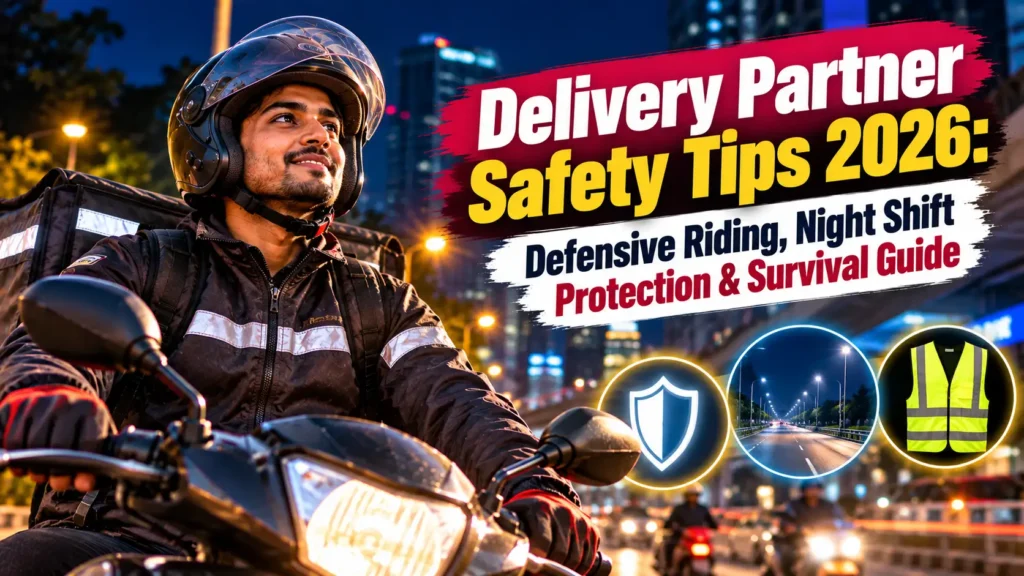
For two-wheeler delivery executives in India, every working shift involves navigating chaotic traffic gridlocks, pothole-riddled roads, reckless motorists, and unpredictable weather conditions. While achieving delivery milestone bonuses and earning high daily payouts is rewarding, your personal physical safety is infinitely more valuable than any delivery tip or customer rating. In the high-pressure environment of quick commerce and hyper-local delivery, adopting proven delivery partner safety tips is the essential discipline that ensures you return home safely to your family after every single shift.
Accident statistics from across Indian urban centers reveal that the vast majority of delivery road collisions are entirely preventable through proactive defensive riding techniques, proper safety gear, and situational awareness. Delivery couriers seeking career opportunities with supportive hub cultures and verified safety infrastructure can explore openings on delivery partner jobs. In this comprehensive safety manual, we break down critical defensive riding principles, provide a night-shift security protocol, explain how to de-escalate aggressive customer interactions, and detail essential safety gear that saves lives.
The Golden Rule: Defensive Riding in Heavy Urban Traffic
Defensive riding is the art of anticipating road hazards before they materialize, riding under the foundational assumption that other motorists cannot see you. In congested city traffic, couriers must adhere to four cardinal defensive riding principles:
- Avoid Heavy Vehicle Blind Spots: Never linger alongside the left or rear quarters of large commercial vehicles (city buses, cement mixers, multi-axle trucks). Truck drivers have massive blind spots (‘No-Zones’) where two-wheelers become completely invisible. Always pass quickly on the right with a clear horn alert, or hang back at a safe distance.
- The 3-Second Following Distance: Maintain at least a 3-second distance behind the vehicle in front. This buffer provides sufficient reaction time if an autorickshaw or cab ahead makes a sudden, unindicated stop to pick up a passenger.
- Intersection Vigilance (The Green Light Trap): Never accelerate recklessly into an intersection the microsecond the signal turns green. Red-light jumpers and speeding delivery vehicles traveling across the junction cause devastating T-bone collisions. Look left, right, and left again before entering any crossroad.
- Beware of ‘Dooring’ Near Parked Cars: When filtering past parked cars along street curbs, leave at least 1.5 meters of clearance. Careless car occupants frequently fling doors open without checking their side mirrors.
Essential Protective Gear: Beyond Just Avoiding Traffic Fines
Too many couriers treat safety equipment as a chore designed merely to avoid a ₹1,000 traffic fine. High-grade safety equipment is the only barrier separating your fragile body from concrete roadways:
- ISI-Marked Full-Face Helmets: Half-helmets or cheap novelty helmets provide virtually zero chin, jaw, or facial protection. Mandatory road safety standards certified by the Bureau of Indian Standards (BIS) under standard IS 4151 mandate that helmets withstand high-velocity structural impacts. Always fasten your chin strap securely—an unbuckled helmet flies off before your head hits the pavement.
- High-Visibility Reflective Vests: During dusk, night, and foggy winter shifts, dark clothing makes two-wheeler riders invisible to speeding cars. Wearing a fluorescent neon safety vest with certified 3M reflective tape ensures you are visible from over 200 meters away.
- Reinforced Riding Gloves: In a fall, human instinct forces your palms out to break the impact. Abrasion-resistant gloves with palm sliders and knuckle guards prevent agonizing road rash and fractured wrist bones.
- Sturdy Closed-Toe Footwear: Never operate delivery shifts in open rubber flip-flops or sandals. A simple low-speed foot-dab on uneven asphalt can shatter metatarsal bones or rip toenails. Wear rugged, ankle-height closed sneakers or work boots.
| Safety Gear Item | Mandatory Quality Standard | Primary Injury Protection | Estimated Cost |
| Full-Face Helmet | BIS Standard (IS 4151) with clear visor | Prevents traumatic brain injury & facial trauma | ₹1,200 – ₹2,500 |
| Fluorescent Reflective Vest | EN 471 / Certified 3M micro-prismatic tape | Nighttime 360-degree driver visibility | ₹250 – ₹450 |
| Abrasion Riding Gloves | Reinforced textile with palm leather padding | Prevents severe hand abrasions & wrist fractures | ₹600 – ₹1,200 |
| Closed-Toe Ankle Shoes | Rubber non-slip sole with reinforced toe cap | Shields feet from crushes & road scrapes | ₹1,000 – ₹2,000 |
| Elbow & Knee Guards | CE Level 1 / High-impact polymer guards | Protects joints from impact during low-speed falls | ₹800 – ₹1,500 |
Your safety is non-negotiable! Work with leading platforms that provide 24×7 SOS emergency support, verified insurance, and safe daytime shift options. Discover top vacancies on AlphaReach Jobs today.
Night Shift Safety Protocols: Navigating the Dark with Confidence
Operating late-night delivery shifts (11:00 PM to 4:00 AM) offers higher surge bonuses and quiet roads, but introduces unique hazards: drunk drivers, poorly lit alleys, stray dog packs, and potential security threats. Follow these non-negotiable nocturnal safety protocols:
Inspect Your Vehicle Lighting Before Leaving the Hub: Verify that your high-beam headlight, rear red taillight, and license plate lamp are functioning flawlessly. If your headlight bulb blows out, stop and replace it immediately at a 24-hour service station.
Avoid Poorly Lit Shortcuts: While your GPS navigation may suggest a dark, unpaved alley to save 90 seconds, stick strictly to well-lit, arterial main thoroughfares. Saving two minutes is never worth exposing yourself to isolated ambushes or road hazards.
Maintain Alertness Against Drunk Drivers: Late-night weekend traffic carries an elevated proportion of intoxicated drivers. Watch oncoming vehicles closely; if a car is drifting between lanes or speeding erratically, pull safely to the shoulder and let it pass.
Stay in Communication: Share your live WhatsApp location with a trusted friend, family member, or fellow delivery colleague during late-night hours.
Handling Aggressive Customers and De-Escalating Conflict
Delivery couriers occasionally face impatient, aggressive customers frustrated by restaurant preparation delays, app glitches, or cold food. Mishandling these tense encounters can lead to verbal abuse, physical altercations, and unfair account suspensions:
- Practice Calm Professional Detachment: Never retaliate verbally or match an angry customer’s raised voice. Remember that customer frustration is directed at the platform delay or food quality, not at you personally. Respond calmly: ‘Sir/Madam, I completely understand your frustration. The restaurant took longer to pack your order. Let me help you raise a ticket on the app for an instant refund.’
- Maintain Physical Distance: Stand at least two steps back from the customer doorstep. Never enter a customer’s private residence, apartment foyer, or hotel room under any circumstances—always hand over the order at the threshold doorway.
- Report Aggressive Behavior Immediately: If a customer becomes physically threatening or verbally abusive, do not argue. Hand over the package, return to your vehicle, and immediately report the incident via the partner app under ‘Customer Safety Issue’. Platforms maintain customer blacklists and will unassign you from future deliveries to that address.
Emergency SOS Response: How to Use In-App Safety Features
Every major delivery application features an integrated, one-touch Emergency SOS button prominently positioned on the active order screen. Familiarize yourself with how this technology operates before an emergency occurs:
When activated, the SOS engine immediately transmits your real-time GPS telemetry to the platform’s 24×7 Safety Command Center. Within 30 to 60 seconds, an emergency dispatcher calls your smartphone to assess the situation while simultaneously alerting local police control rooms (112) and dispatching nearby platform field assistance executives.
Never hesitate to trigger the SOS button if you suspect you are being followed, involved in a road collision, or facing physical harassment. Platforms treat SOS triggers with the highest operational priority.
Join a delivery fleet that puts your safety first! Register through AlphaReach Delivery Partner Onboarding to access high-safety zones, reflective gear kits, and comprehensive rider protections.
Frequently Asked Questions (FAQs)
What should I do if a customer becomes physically aggressive or threatens me?
Do not engage in physical or verbal conflict. Step back, maintain a safe physical distance, hand over the package, and leave the premises immediately. Once safe, trigger the in-app SOS button or call platform partner support to report the incident. Platforms will block the customer and file formal complaints if necessary.
Are half-face helmets legal and safe for delivery work?
While some basic half-helmets carry legal ISI marks, they provide zero protection for your chin, teeth, and jaw in a frontal crash. Experienced couriers strongly recommend full-face helmets certified under BIS IS 4151, which reduce the risk of fatal head trauma by over 70%.
How does the in-app SOS button work on delivery apps?
Tapping the SOS button immediately alerts the platform’s 24×7 emergency response desk with your exact live GPS coordinates. A safety executive calls you within 60 seconds while coordinating with local police control rooms (112) and ambulance networks if medical help is required.
Is it safe to do late-night delivery shifts in Indian cities?
Yes, provided you take strict safety precautions: stick to well-lit arterial roads, wear high-visibility reflective vests, ensure all vehicle lights are working, avoid dark isolated alleys, and keep your phone charged with emergency SOS numbers readily accessible.
What should I do if my two-wheeler breaks down at night during an active order?
Move your vehicle safely to the shoulder of a well-lit street. Turn on your vehicle hazard lights (or parking lights). Immediately open the delivery app, tap ‘Partner Support’, and select ‘Vehicle Breakdown’. Support will reassign the order to another nearby courier and cancel your delivery without penalty.
Conclusion
In the fast-paced world of gig logistics, no customer tip, milestone bonus, or delivery deadline is worth compromising your physical health and safety. The measure of a truly professional delivery partner is not how fast they speed through red lights, but their ability to navigate complex city streets safely, day after day, year after year.
By investing in high-grade protective gear, mastering defensive riding principles, staying alert during night shifts, and utilizing in-app emergency SOS networks, you protect your greatest asset: your life. Ride with pride, ride with care, and always make arriving home safely your number one priority.