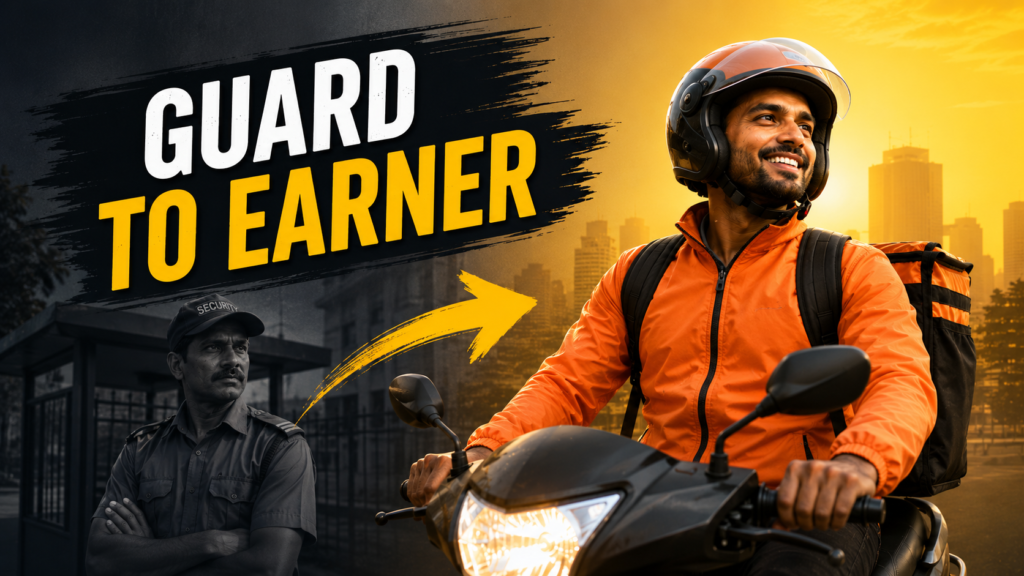
Suresh’s journey is a chowkidar delivery partner success story built around a pattern that isn’t just imagined anymore — it’s been caught on camera. In June 2026, a video of Akash Gupta, founder of EV delivery startup Zypp Electric, chatting with his own security guard went viral across Indian news outlets. The guard, earning ₹18,000/month on a 12-hour shift, told Gupta he was already planning to switch into delivery work: “12 ghante denge wahan toh Rs 1500-1600 ho jayega din ka” (“If I put in 12 hours there, I could earn ₹1,500–1,600 a day”) (Storyboard18). Gupta later posted the clip with the caption “Oops, I poached my own employee.”
Suresh isn’t that guard, and this remains an illustrative composite, not a verified account of one named individual — but the pull factor is now documented, not assumed. Every wage figure below is grounded in the sourced 2026 data already published on this site, not in the guard’s own optimistic day-rate math.
Note on this story: “Suresh” represents a common pattern among informal chowkidars, not a specific verified person. Figures come from our Chowkidar vs Security Guard vs Delivery Partner salary comparison. The one real, reported case we found — the viral Zypp Electric video — involved an agency-tier guard earning ₹18,000/month, closer to the top of the guard pay band than the informal, non-agency chowkidar pay Suresh represents, which makes his version of this switch even more compelling on paper.
The Starting Point: 12-Hour Nights, Cash Pay, No Weekly Off
Suresh worked as an informal, non-agency chowkidar for a row of shops in a mid-sized housing colony — hired directly by the shop owners, paid in cash, with no written contract. That arrangement typically pays ₹8,000–15,000/month for shifts running 10–12 hours, usually overnight, with no weekly off and no bonus for covering extra nights.
There was no path to more money without asking the shop owners directly for a raise — and no guarantee they’d say yes. Industry write-ups on guard attrition point to the same three complaints repeatedly: no overtime pay, no paid leave, and irregular scheduling that leaves little room to plan a second income (Novagems, Celayix — 2025 guard turnover data). Suresh’s situation matches that pattern closely.
Why This Switch Is Often the Most Direct One
Of the four pillars covered across this site, informal delivery-adjacent workers like chowkidars, courier boys, and milk-delivery agents tend to have the smallest behavioral gap to close. Suresh was already outdoors for long stretches, already used to irregular hours, already comfortable navigating his neighborhood on foot or bike. What was missing wasn’t stamina — it was a pay structure that rewarded it, which is exactly the calculation the Zypp guard made out loud on camera: roughly ₹600 for a 12-hour security shift versus a shot at ₹1,500+ for the same 12 hours on delivery.
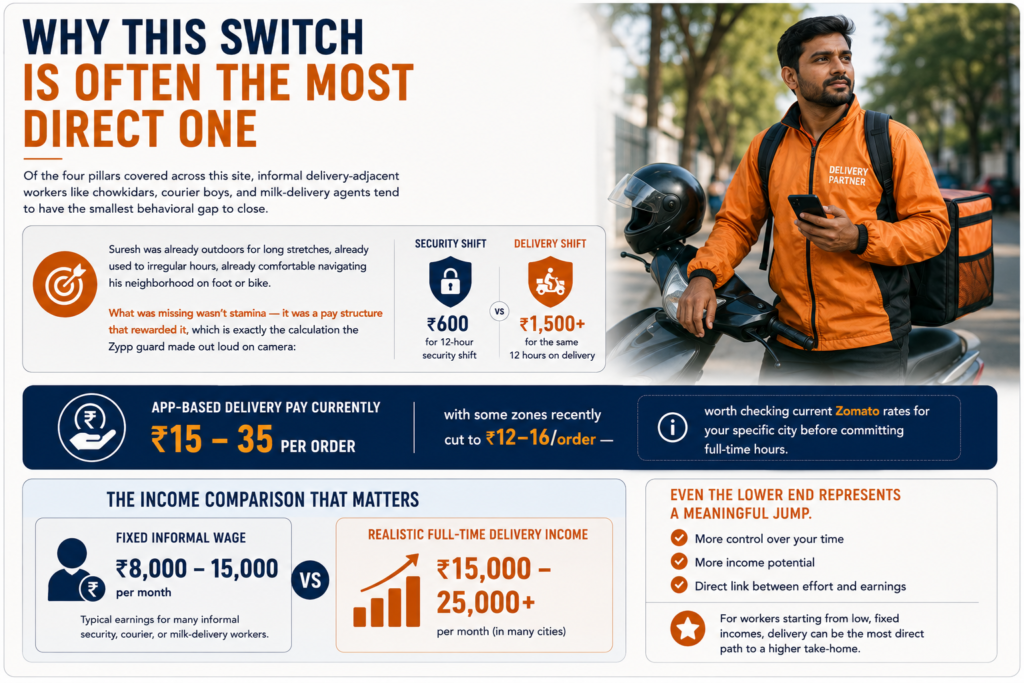
App-based delivery pay currently runs ₹15–35 per order, with some zones recently cut to ₹12–16/order — worth checking current Zomato rates for your specific city before committing full-time hours. For someone earning ₹8,000–15,000/month on a fixed informal wage, even the lower end of realistic full-time delivery income represents a meaningful jump.
The Transition: Testing Hours Around an Existing Shift
Many chowkidars who make this move don’t quit their post immediately — a common approach is testing delivery work during off-duty daylight hours or on days off, for a week or two, before deciding whether to switch fully. The Zypp guard’s own plan followed the same shape: buy a vehicle first, then move into delivery, rather than quitting security work on the spot. That period lets a rider validate real local earnings in their specific zone rather than going on a single day’s day-rate math.
Once validated, moving to full-time delivery hours puts realistic take-home in the ₹25,000–30,000/month range in metro cities (see the delivery partner earnings breakdown for how riders build toward the higher end) — which is where a “₹30,000+” outcome comes from for a chowkidar starting near ₹8,000–10,000/month in an informal post, in a strong-demand metro zone, working consistent full-time hours.
What Actually Changed
- Pay structure: Fixed, informal, cash-in-hand pay became per-order pay with no ceiling tied to a shop owner’s discretion.
- Hours: 10–12 hour fixed night shifts became self-set hours, chosen around demand peaks rather than a single post’s schedule.
- Benefits access: Most informal chowkidar postings offer no contract, no PF, no insurance. Riders in this position typically register on the government’s e-Shram portal (register.eshram.gov.in) for accident insurance and other unorganized-worker social security benefits.
- What stayed the same: The outdoor, route-based, physically active nature of the work — the core skill set carried over almost entirely.
Is ₹30,000+ Realistic for Every Chowkidar?
Not automatically — and this is where Suresh’s story deliberately parts ways with the viral video. The Zypp guard’s own math (₹1,500–1,600/day, or ₹40,000–50,000+/month) was a self-reported, un-audited projection made in a 90-second clip, not a confirmed outcome. The sourced range on this site is more conservative: ₹25,000–30,000/month at the higher end of the metro delivery range, and that assumes full-time hours, a strong-demand city zone, and consistency over weeks, not days. In Tier-2/3 cities, realistic take-home is closer to ₹12,000–15,000/month — still a real improvement over most informal chowkidar pay, but not a tripling. The honest picture: delivery income scales with hours and city demand, and Suresh’s outcome represents a strong but plausible case within the sourced range, not the best-case number a guard might do in his head on camera.
For the full numbers and a step-by-step switch guide, see Chowkidar vs Security Guard vs Delivery Partner: Full Salary Comparison 2026 and the broader Pillar B hub covering newspaper, milk, petrol pump, and courier comparisons.
Frequently Asked Questions
Is this a real, verified individual’s story?
“Suresh” is an illustrative, representative profile, not a verified account of a specific named person. The pull factor behind it is real and documented, though: in June 2026, a viral video showed Zypp Electric founder Akash Gupta discussing this exact switch with his own security guard, who was earning ₹18,000/month and actively planning to move into delivery work (Storyboard18). Suresh’s specific numbers come from this site’s sourced chowkidar and delivery wage data, not from that video.
Is ₹30,000/month a typical outcome or a best case?
It’s toward the higher end of the sourced metro delivery range, achievable with full-time hours in a strong-demand zone — not the more optimistic per-day math a guard or chowkidar might do on the spot. Tier-2/3 realistic take-home is closer to ₹12,000–15,000/month.
Do I need a security license to become a delivery partner?
No. Delivery partner registration only requires a valid two-wheeler driving license, Aadhaar, PAN, and a bank account — no PSARA or security-specific licensing.
Can I test delivery work while still doing chowkidar duty?
Yes — many informal workers test delivery hours during off-duty time for 1–2 weeks before switching fully, to validate real local earnings first.
What happens to my job security if I switch?
Most informal chowkidar postings already have no written contract or benefits. Delivery work adds access to e-Shram registration and accident insurance most informal jobs don’t offer.
Ready to See What You’d Actually Earn?
Suresh’s numbers are illustrative, but the underlying math is real and sourced. Apply to become a delivery partner and find out what the switch looks like in your city.