
For a call center employee delivery job switch, the trigger is rarely the pay alone — it’s the rotational night roster, the average-handle-time target, and a call-quality scorecard that can dent your incentive even on a month where you showed up for every shift. In 2026, more call center employees are trading that structure for gig delivery work, where they set their own hours.
The Real Problem Isn’t the Job — It’s the Shift
Call center work itself isn’t inherently worse than many entry-level jobs. The structural issue is the schedule: international voice processes routinely run night shifts, and even domestic processes increasingly run 24/7 rosters for e-commerce and fintech support. Employees frequently report disrupted sleep cycles, reduced family and social time, and long-term health complaints tied to circadian disruption — issues that persist even when the pay itself is reasonable for entry-level work.
On top of the shift, agents are measured continuously: average handle time (AHT), calls per hour, first-call resolution, and randomly audited call-quality scores all feed into incentive pay. Hit every metric and your base salary still doesn’t move much — miss one consistently and your incentive shrinks, even if the miss wasn’t in your control (a difficult customer, a system outage, a spike in call volume).
What Changes When You Switch to Delivery Work
Your schedule becomes yours. Delivery demand does peak at certain times (breakfast, lunch, evening, and yes — some late-night food orders), but nothing forces you into any specific window. Many delivery partners work only daytime and evening hours and skip night shifts entirely.
No AHT, no call-quality audit. Your income depends on orders completed, not on a supervisor’s scorecard. There’s no equivalent of a “call quality deduction” — a completed order pays what the app shows, consistently.
Physical activity replaces sedentary hours. Call center work is desk-bound for the full shift. Delivery work keeps you moving, which several former agents cite as an unexpected health improvement after switching.
Pay structure flips from fixed to per-order. Entry-to-mid call center pay runs ₹15,000–25,000/month; full-time delivery partners average ₹25,000–30,000/month in metros and ₹12,000–15,000/month in Tier-2/3 cities — see the full BPO Job vs Delivery Partner Salary comparison and delivery partner earnings breakdown.
3 Myths Call Center Employees Believe About Delivery Work
Myth: “Delivery work has no structure or stability.” Reality: You still log in, accept orders, and get paid per completed delivery — the structure is just self-directed instead of roster-assigned. Many partners build a consistent daily routine around demand peaks they choose themselves.
Myth: “I’ll lose all my benefits.” Reality: Formal EPF from your current employer stays in your account after you leave. As a gig worker, you can separately register on the e-Shram portal (register.eshram.gov.in) for unorganized-worker social security, including accident insurance — see our e-Shram portal guide.
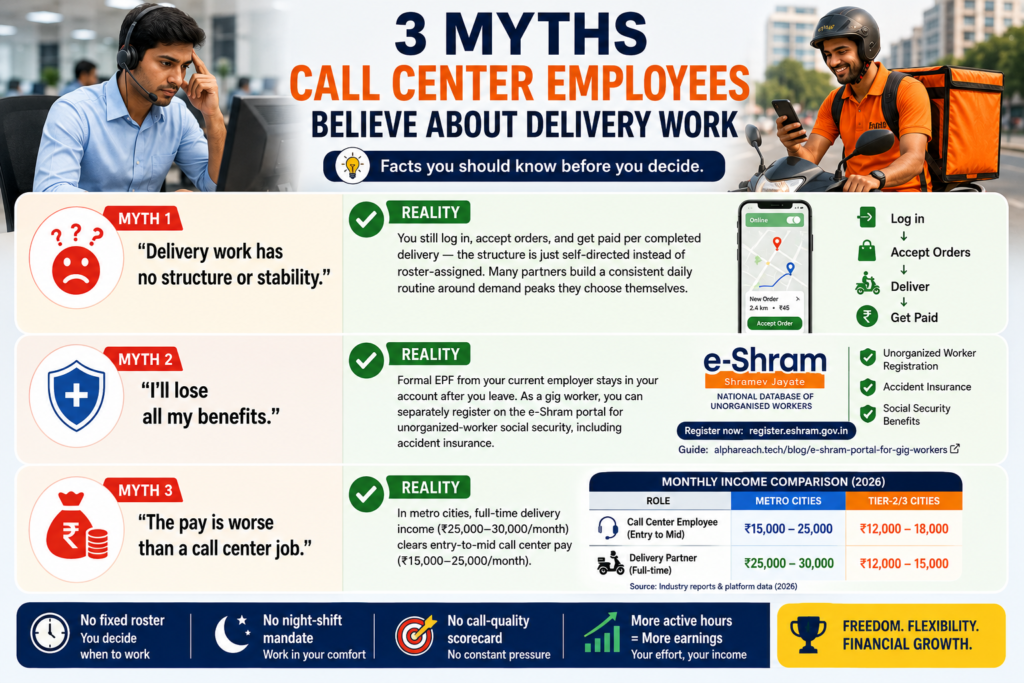
Myth: “The pay is worse than a call center job.” Reality: In metro cities, full-time delivery income (₹25,000–30,000/month) clears entry-to-mid call center pay (₹15,000–25,000/month) — see the numbers side by side in BPO Job vs Delivery Partner Salary: Which Pays More in 2026?
How to Test the Switch Without Quitting
Most call center employees who make this move successfully don’t quit on day one. They:
- Work delivery part-time first — early mornings before a night shift, or evenings after a day shift, for 1–2 weeks.
- Track real local earnings in their specific zone and city, since per-order rates vary by platform and location.
- Compare that number against take-home call center pay, factoring in fuel costs.
- Only then decide whether to give notice and switch full-time.
This is the same low-risk approach covered in more detail in our BPO to Delivery Job Switch Hub.
Frequently Asked Questions
Do delivery partners ever have to work night shifts?
No — there’s no mandatory roster. Late-night food delivery demand exists if you want to work those hours for higher earnings potential, but daytime and evening-only schedules are common and fully viable.
Will quitting my call center job for delivery hurt my resume?
Delivery partner work is gig-based, not a formal employment gap in the traditional sense — many partners treat it as a flexible bridge while exploring other options, or as a long-term income source in its own right.
How quickly can I start delivery work after leaving a call center job?
Document verification typically takes 24–48 hours, and most applicants are completing orders within 3 days of applying — see the step-by-step process in our BPO to Delivery Job Switch Hub.
Is delivery work less stressful than call center work?
Most former agents report it removes the specific stressors of AHT targets, call-quality audits, and forced night shifts — though it introduces different pressures (traffic, weather, order volume during peak hours).
Ready to Trade the Night Shift for Open Hours?
Apply to become a delivery partner and set your own schedule — verification typically takes 24–48 hours.