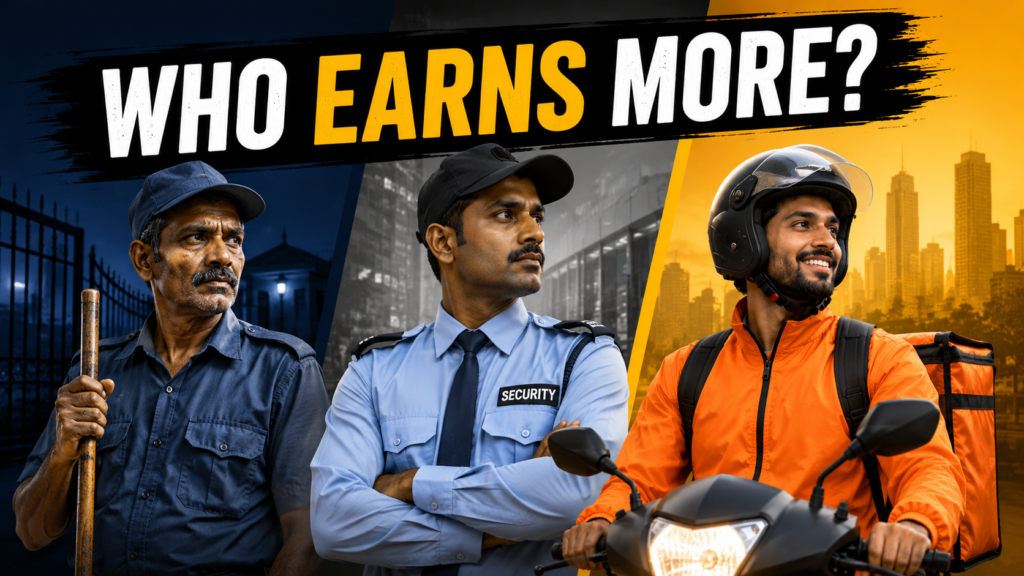
If you’re weighing chowkidar vs delivery job salary numbers, here’s the short version: informal chowkidar work pays the least of the three, agency security guard work pays a bit more but comes with its own cuts, and delivery partner income has no fixed ceiling on either.
Chowkidar (Informal, Non-Agency) Salary in 2026: What You Actually Earn
Most housing-society and shopfront chowkidars are hired directly, off the books, without an agency in between. That informal arrangement typically pays ₹8,000–15,000/month in cash, for shifts that regularly run 10–12 hours, usually overnight, with no weekly off, no leave, and no bonus for covering extra nights (Indeed, PayScale — 2026 data).
There’s effectively no ceiling to push against here because there’s also no floor protecting you — pay is whatever the society or shop owner decides, and it rarely moves without you asking directly.
Security Guard (Agency) Salary in 2026: What You Actually Earn
Agency-employed guards do somewhat better. Entry-level agency security guard pay typically runs ₹15,000–18,000/month, rising to ₹18,000–25,000/month with a few years of experience (Indeed, PayScale, SecurityForce — 2026 data). The catch: security agencies typically bill clients 40–60% above what they actually pay the guard, so a large share of the value you generate on a shift never reaches your pay slip.
Guard duty also means long, immobile shifts — 8–12 hours standing or seated at a single post, with overtime pay inconsistent between agencies.
Delivery Partner Salary in 2026: What You Actually Earn
Delivery partner pay works on a different structure — you’re paid per order, not per shift. Current base pay runs ₹15–35 per order depending on platform and distance, with Blinkit and Zepto typically at the ₹25–35 end for short-distance orders. Some zones have recently seen cuts to ₹12–16/order, so check live rates for your city before committing full-time hours — see current Blinkit and Zomato payout pages.
Realistic full-time take-home lands at ₹25,000–30,000/month in metro cities, and ₹12,000–15,000/month in Tier-2/3 cities after fuel and deductions.
Side-by-Side: Chowkidar vs Security Guard vs Delivery Partner (2026)
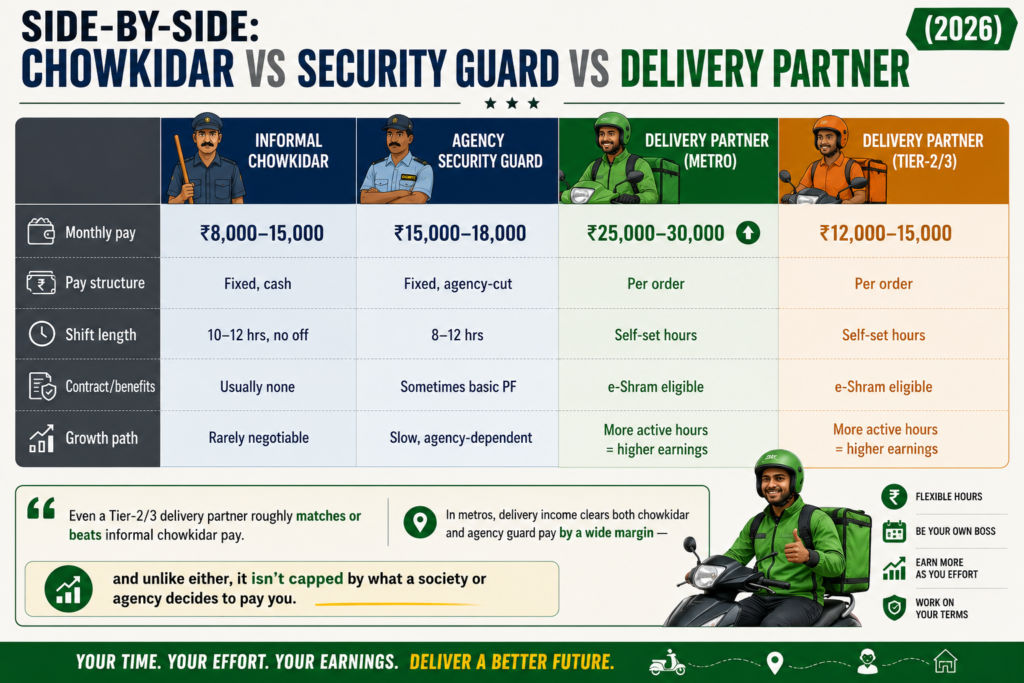
Even a Tier-2/3 delivery partner roughly matches or beats informal chowkidar pay. In metros, delivery income clears both chowkidar and agency guard pay by a wide margin — and unlike either, it isn’t capped by what a society or agency decides to pay you.
Do the Math: Take-Home After Costs
Chowkidar and guard pay is close to what lands in your hand — no fuel or vehicle cost involved. Delivery income needs one adjustment before a fair comparison:
- Fuel: Budget roughly ₹150–250/day for a two-wheeler doing full-time delivery hours.
- Vehicle wear: Servicing, tyres, and minor repairs add up faster with daily riding.
- Phone data: A stable data plan for the delivery app runs through battery and data across a full shift.
The ₹25,000–30,000/month metro and ₹12,000–15,000/month Tier-2/3 figures already account for these costs — they’re take-home estimates, not gross platform payouts.
Which Job Should You Choose?
Stick with chowkidar or guard duty if: you value a fixed daily routine at one location and don’t mind the pay ceiling, or your current post comes with accommodation or other in-kind benefits worth factoring in.
Switch to delivery if: you’re doing 10-12 hour informal shifts for under ₹15,000/month with zero benefits, you can commit to full-time active hours, and you’d rather your pay reflect your effort than a fixed post rate.
For the full step-by-step move from night-watch duty to delivery work, see our guide: From Chowkidar to Delivery Partner: Step-by-Step Guide (2026).
What About Job Security and Benefits?
Neither informal chowkidar work nor most agency guard postings come with meaningful benefits — many chowkidars have no written contract at all. Register on the government’s e-Shram portal (register.eshram.gov.in) as a delivery partner to access accident insurance and other unorganized-worker social security benefits — see our full walkthrough: e-Shram portal for gig workers, plus a rundown of other government schemes for delivery partners.
Comparing a different informal job instead? See our Newspaper & Milk Delivery Agent vs App-Based Delivery Partner: 2026 Earning Guide, or the complete Pillar B overview covering petrol pump and courier comparisons too: Already Doing Delivery Work? hub.
Frequently Asked Questions
Does delivery partner pay really beat chowkidar and security guard salary?
Yes, in most cases. Metro delivery partner take-home (₹25,000–30,000/month) clears both informal chowkidar pay (₹8,000–15,000) and agency guard pay (₹15,000–18,000) by a wide margin. Even Tier-2/3 delivery income roughly matches or beats chowkidar pay.
Is delivery work as safe as night-watch duty?
Both involve being outdoors and, in delivery’s case, on the road. Delivery partners can register on e-Shram for accident insurance coverage — a benefit most informal chowkidar postings don’t offer at all.
Do I need a security license or PSARA registration to become a delivery partner?
No. Delivery partner registration only requires a valid two-wheeler driving license, Aadhaar, PAN, and a bank account — no PSARA or security-specific licensing needed.
Can I try delivery work part-time before leaving my current post?
Yes — many chowkidars and guards test delivery work during off-duty hours or days off for 1–2 weeks before switching fully, to validate real local earnings first.
Ready to Compare Your Own Numbers?
Apply to become a delivery partner and see what you’d actually earn in your city — verification typically takes 24–48 hours.