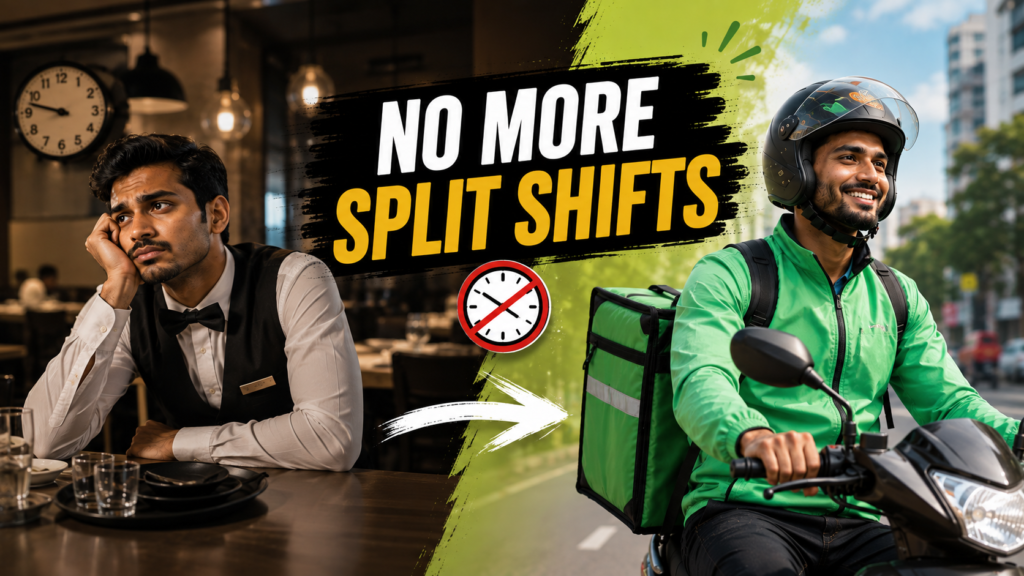
If you’re on a restaurant staff delivery job switch search, you already know the real problem isn’t the pay slip — it’s the split shift. Lunch service, a dead afternoon gap, then back for dinner until close. Delivery work runs on hours you choose, not a roster built around someone else’s meal times.
Here are the myths holding hospitality staff back from switching, and what’s actually true in 2026.
Myth 1: “Delivery Work Pays Less Than My Tips”
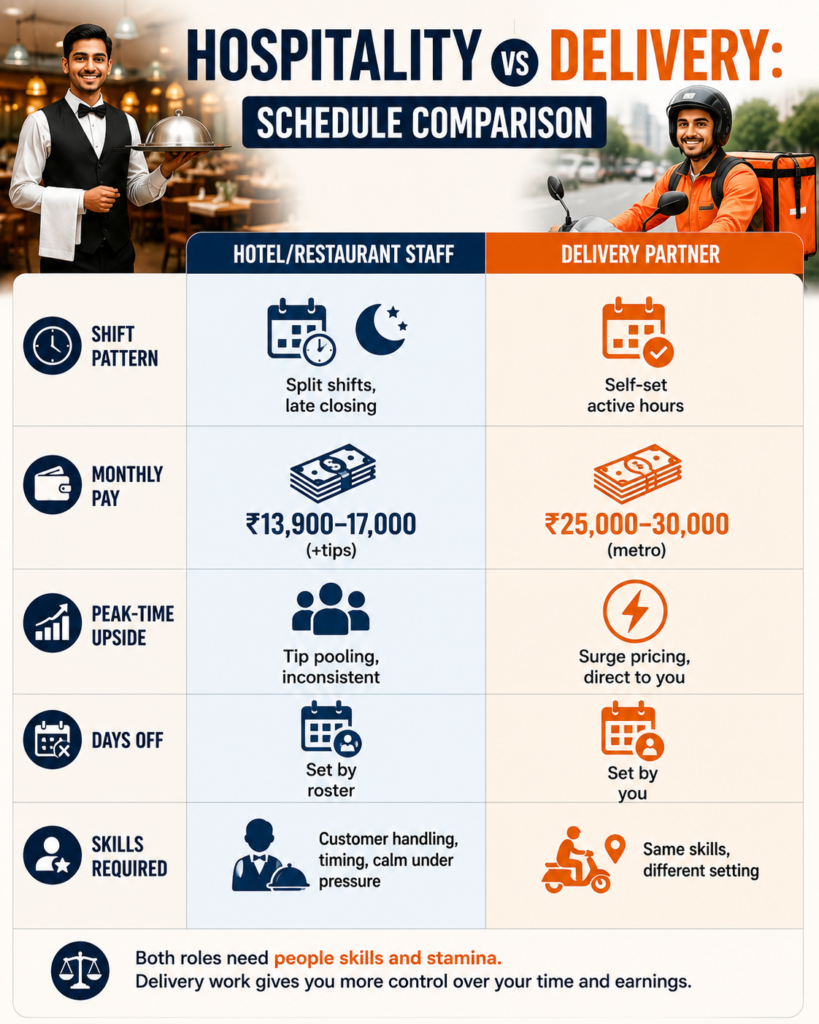
This is the myth that keeps the most hospitality staff stuck. The truth: tips are inconsistent, tied to footfall, season, and your establishment’s tip-pooling policy. To match a metro delivery partner’s ₹25,000–30,000/month on a ₹15,000 base, you’d need ₹10,000–15,000/month in tips alone — achievable in a high-footfall fine-dining spot during festival season, but rarely on a slow month in a mid-range restaurant.
Delivery surge pricing works on a similar principle — extra pay during meal-time rush windows — except it pays out to you directly per order, every time, not through a shared pool that depends on which tables you got that shift. See the full breakdown in Waiter/Hotel Staff vs Delivery Partner: Which Job Pays Better in 2026?
Myth 2: “I’ll Lose the Skills I’ve Built”
Food-service staff already understand delivery time windows, order accuracy expectations, and how to handle a frustrated customer calmly under pressure. Every one of those skills directly affects a delivery partner’s ratings and incentive eligibility — this isn’t a fresh start, it’s a lateral move into work you’re already good at.
Myth 3: “It’s a Step Down From Working in a Hotel or Restaurant”
Some hospitality staff hesitate because delivery work feels less formal than a hotel or restaurant job title. In practice, the day-to-day reality often runs the other way: no floor manager watching your every move, no dress code enforced by a supervisor, and no mandatory late closing you can’t leave until the last table pays its bill. What changes isn’t your effort or skill — it’s who controls your schedule.
Myth 4: “There’s No Structure or Security”
Hotel and restaurant jobs vary widely on formal benefits — some offer PF and ESI, many smaller establishments don’t. Gig work doesn’t come with a traditional appointment letter either, but you’re not without options: register on the government’s e-Shram portal (register.eshram.gov.in) to access accident insurance and other unorganized-worker social security benefits. See our full rundown of government schemes for delivery partners covering PMSBY, PMJJBY, and Ayushman Bharat.
The Real Pain Point: Split Shifts Aren’t Going Away in Hospitality
Restaurant and hotel scheduling is structurally built around split shifts and late closing hours — it’s not a temporary rough patch at one employer, it’s how the industry runs. That’s the piece that doesn’t change even if you find a “better” hospitality job elsewhere.
Delivery work removes that structure entirely. You set your own active hours around meal-time demand — which, notably, is exactly when your food-service instincts are sharpest anyway.
Hospitality vs Delivery: Schedule Comparison
How to Make the Switch
- Check current earnings honestly. Add up your last 3 months of base pay + tips — not your best month, your average.
- Try delivery part-time first. Off-shift hours (before lunch service or after dinner close) for 1–2 weeks give you real local earnings data.
- Compare against Zomato and Swiggy current rates in your city — see the full delivery partner earnings breakdown for what full-time riders actually take home.
- Apply once the numbers make sense for you. No resume, no interview — most applicants are verified within 24–48 hours.
For the complete Pillar A picture, including retail, warehouse, and construction comparisons, see the Blue-Collar to Delivery Partner Career Switch Hub.
Frequently Asked Questions
Will I really earn more without tips as a delivery partner?
In metro cities, base delivery pay of ₹25,000–30,000/month often clears typical waiter base pay plus average tips. High-tip establishments narrow the gap, but delivery income still scales with hours rather than depending on footfall and season.
Does delivery work actually avoid split shifts?
Yes — you choose your own active hours on the app. There’s no fixed lunch-and-dinner roster split imposed on you.
Is delivery work considered a step down from hospitality work?
No — it’s a different structure, not a lower one. Many hospitality staff find delivery work less stressful because there’s no floor manager, no tip pooling, and no mandatory late closing.
Can I try delivery work without quitting my restaurant job?
Yes — many hospitality staff run off-shift delivery hours around their existing roster for 1–2 weeks before deciding to switch fully.
What documents do I need to apply?
A valid driving license (two-wheeler category), Aadhaar, PAN, and a bank account in your own name — see the career switch hub for the full checklist.
Ready to Trade Split Shifts for Set Hours?
Apply to become a delivery partner and get verified within 24–48 hours.