If you’re comparing retail job vs delivery job salary numbers before making a move, the short answer is: it depends on where you live, but delivery partner income has a much higher ceiling — and that ceiling is the whole story for anyone stuck on a fixed retail wage.
Here’s the real 2026 breakdown, not a rounded-up estimate.
Retail Sales Job Salary in 2026: What You Actually Earn
Retail sales associates in India average ₹16,000–25,000/month (Indeed, 2026 data), with the higher end typically reserved for senior staff, metro locations, and larger-format stores. Entry-level floor staff in smaller cities often sit closer to the bottom of that range.
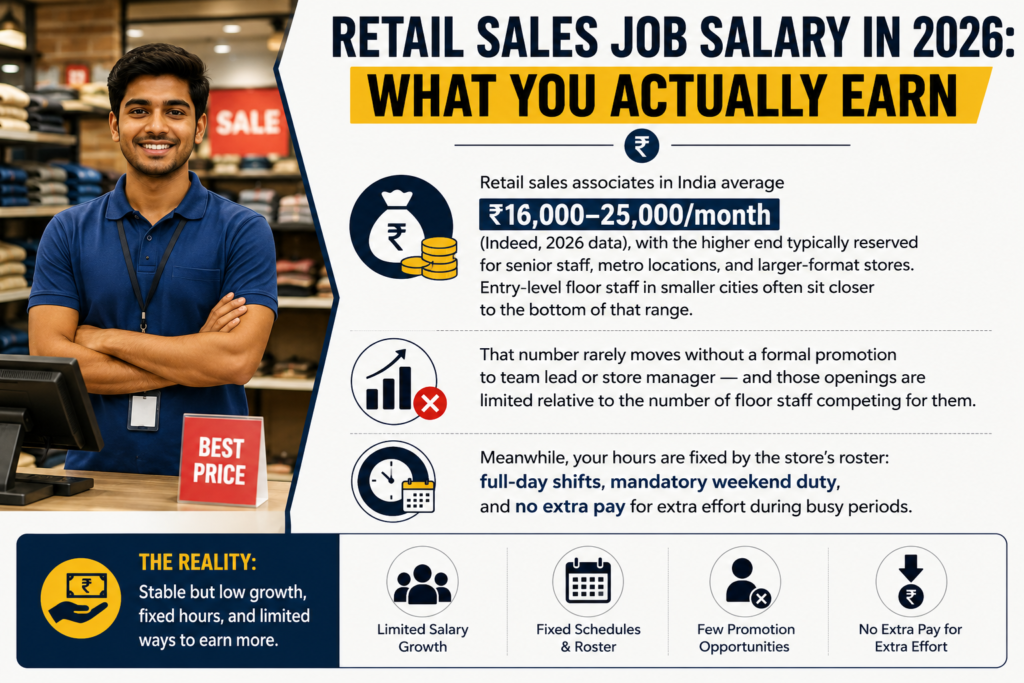
That number rarely moves without a formal promotion to team lead or store manager — and those openings are limited relative to the number of floor staff competing for them. Meanwhile, your hours are fixed by the store’s roster: full-day shifts, mandatory weekend duty, and no extra pay for extra effort during busy periods.
Delivery Partner Salary in 2026: What You Actually Earn
Delivery partner pay works on a different structure entirely — you’re paid per order, not per shift. Current base pay runs ₹15–35 per order depending on platform and distance, with Blinkit and Zepto typically at the ₹25–35 end for short-distance orders. Some zones have recently seen cuts to ₹12–16/order, so it’s worth checking live rates for your city before committing full-time hours — see current Blinkit and Zomato payout pages.
Realistic full-time take-home lands at ₹25,000–30,000/month in metro cities, and ₹12,000–15,000/month in Tier-2/3 cities after fuel and deductions. The difference from retail: there’s no ceiling built into the structure. More active hours and completed orders generally mean more income.
Side-by-Side: Retail vs Delivery Partner Salary (2026)
| Retail Sales Staff | Delivery Partner (Metro) | Delivery Partner (Tier-2/3) | |
|---|---|---|---|
| Monthly pay | ₹16,000–25,000 | ₹25,000–30,000 | ₹12,000–15,000 |
| Pay structure | Fixed monthly | Per order | Per order |
| Schedule control | Store roster | Self-set hours | Self-set hours |
| Growth path | Promotion required | More active hours | More active hours |
| Weekend/overtime pay | Usually none | Applies to all hours worked | Applies to all hours worked |
In metro cities, delivery partner income clears retail pay at both ends of the range. In smaller cities, the Tier-2/3 delivery figure sits close to entry-level retail pay — but comes without the fixed-shift trade-off, and rises directly with hours you choose to put in.
Do the Math: Take-Home After Costs
Retail’s ₹16,000–25,000/month is close to what lands in your bank account — the store covers the space, equipment, and any travel allowance. Delivery income needs one more step before you compare it fairly.
- Fuel: Budget roughly ₹150–250/day for a two-wheeler doing full-time delivery hours, more in high-traffic metros.
- Vehicle wear: Servicing, tyres, and minor repairs add up faster with daily riding — plan for periodic maintenance costs.
- Phone data: A stable data plan for the delivery app runs through battery and data quickly across a full shift.
The ₹25,000–30,000/month metro and ₹12,000–15,000/month Tier-2/3 figures cited above already account for typical fuel and deductions — they’re take-home estimates, not gross platform payouts. That’s why they’re worth comparing directly against retail’s largely cost-free wage, rather than against a platform’s advertised gross earning potential.
Which Job Should You Choose?
Stick with retail if: you value a fixed, predictable paycheck regardless of how the store performs that month, or you’re on a growth track toward a supervisory role.
Switch to delivery if: you’re capped at your current retail wage with no promotion in sight, you can commit to full-time active hours, and you’d rather your income reflect your effort than a fixed roster.
For the full step-by-step move, see our detailed guide: Retail Employee to Delivery Partner: Step-by-Step Switch Guide (2026).
What About Job Security?
Retail comes with a formal appointment letter; gig work doesn’t. That’s a real trade-off, not a myth — but it’s a manageable one. Register on the government’s e-Shram portal (register.eshram.gov.in) as a delivery partner to access accident insurance and other unorganized-worker social security benefits. Government support for gig workers has also been a recurring theme in recent Budget 2026 coverage on this blog.
For the complete Pillar overview — including warehouse, hotel staff, and construction comparisons — see the Blue-Collar to Delivery Partner Career Switch Hub.
Frequently Asked Questions
Does delivery partner pay really beat retail salary?
In metro cities, yes — ₹25,000–30,000/month for full-time delivery partners clears the typical ₹16,000–25,000/month retail range. In smaller cities the gap narrows, but delivery income still has more upside since it scales with hours worked.
Do I need experience to become a delivery partner?
No prior delivery experience is required. You’ll need a valid driving license, Aadhaar, PAN, and a bank account — see the career switch hub for the full document checklist.
Can I try delivery work part-time before quitting my retail job?
Yes — many retail staff start with early-morning or evening delivery shifts around their existing roster for 1–2 weeks to validate real local earnings before switching fully.
Is retail sales experience useful for delivery work?
Retail builds customer-facing habits (politeness, reliability, handling complaints) that transfer well to delivery work, where partner ratings affect order allocation and incentives.
Ready to Compare Your Own Numbers?
Apply to become a delivery partner and see what you’d actually earn in your city — verification typically takes 24–48 hours.