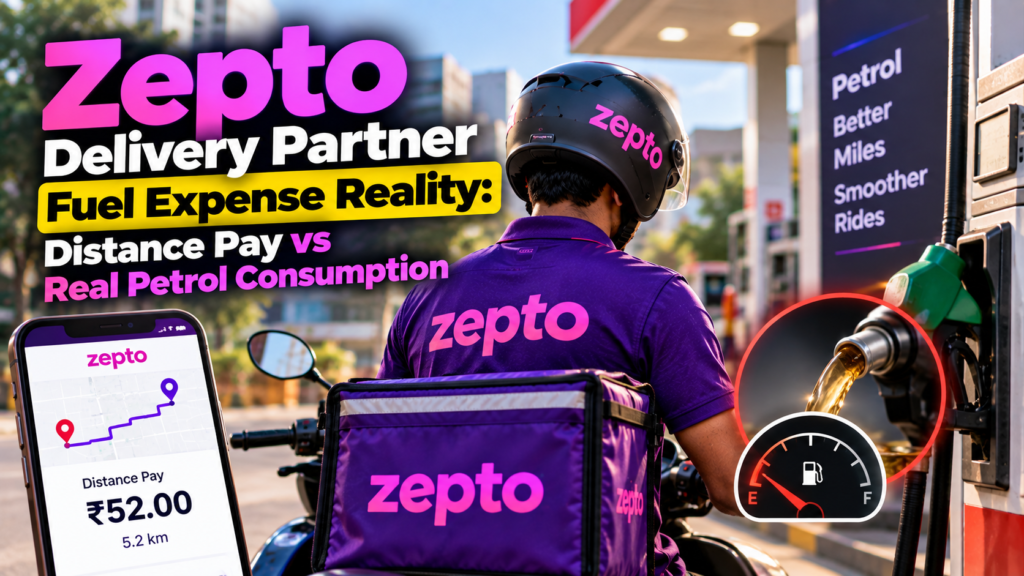
In the era of elevated petrol prices, two-wheeler gig workers must scrutinize every rupee spent on vehicle fuel to calculate true daily profit. With petrol hovering around ₹95 to ₹105 per litre across Indian metros, candidates exploring delivery partner vacancies frequently ask: does quick commerce deliver better fuel economics than traditional food delivery? Unpacking the zepto delivery partner fuel expense reality reveals how compact dark store radiuses and distance pay structures create superior profit margins in 2026.
A common assumption among new gig couriers is that all delivery platforms consume identical amounts of petrol. In reality, because Zepto delivery couriers operate within a tight 1.0 to 2.2-kilometer radius around a centralized dark store, their daily vehicle mileage is up to 50% lower than food delivery riders who traverse wide city zones.
This economic analysis breaks down Zepto’s distance pay formula, compares real-world petrol consumption between quick commerce and food delivery, examines multi-order batch profitability, and highlights fuel-saving riding techniques. Evaluating distance compensation against true vehicle running costs is the key to optimizing your daily routes and maximizing net monthly earnings.
Understanding these fuel dynamics proves why quick commerce represents the highest net-margin two-wheeler gig in urban India.
The Core Reality: Hyper-Local Radius vs Wide Food Delivery Distance
In traditional food delivery on apps like Zomato or Swiggy, couriers travel 4 to 8 kilometers per delivery, accumulating 120 to 150 kilometers of daily road travel to complete 16 to 18 orders. In contrast, quick-commerce models monitored by the Bureau of Energy Efficiency (BEE) operate within compact, dense delivery clusters.
A Zepto courier operating from an assigned dark store serves an exclusive 1.0 to 2.2 km boundary. Fulfilling 24 to 28 grocery deliveries requires covering only 50 to 70 total kilometers per shift. This 50% reduction in daily driving distance translates into massive direct fuel savings.
Zepto does not provide separate petrol reimbursement slips; instead, fuel costs are compensated through Base Distance Pay and Order Batch Surcharges. Because delivery distances are exceptionally short, the distance pay component provides a significant gross surplus over actual petrol consumed.
When calculating distance payouts, couriers must also factor in tire wear and oil degradation. Because quick commerce couriers cover half the daily mileage of long-distance riders, engine oil and tire lifespan are effectively doubled.
When calculating distance payouts, couriers must also factor in tire wear and oil degradation. Every 1,000 kilometers of aggressive city riding consumes approximately ₹120 in tire tread wear and ₹140 in engine oil degradation, which must be budgeted alongside raw fuel expenses.
Delivery couriers who transition to modern electric two-wheelers also benefit from state government EV subsidies and road tax exemptions under urban clean mobility initiatives. Many state electric vehicle policies provide direct purchase incentives of ₹5,000 to ₹10,000 for commercial gig delivery couriers.
Switching from a traditional petrol motorcycle to a commercial electric two-wheeler also shields delivery partners from volatile global crude oil price swings. While petrol prices can fluctuate unpredictably, commercial EV battery-swapping subscription rates remain fixed, giving gig workers predictable monthly vehicle operating budgets.
Fuel Economics Breakdown: Distance Pay vs Real Petrol Consumption (2026 Data)
To demonstrate the financial superiority of quick commerce fuel economics, let us examine real-world operating costs across popular delivery vehicles in Indian metros:
| Vehicle Category & Mileage | Daily KM Covered (25 Deliveries) | Daily Fuel Cost (@ ₹100/L) | Gross Distance Pay Earned | Net Daily Surplus (Pay minus Fuel) |
| 100cc Commuter Bike (60–65 km/l) | 50 – 60 km | ₹85 – ₹105 | ₹550 – ₹750 | +₹445 to +₹645 Surplus |
| 110cc–125cc Standard Bike (48–55 km/l) | 50 – 60 km | ₹100 – ₹130 | ₹550 – ₹750 | +₹420 to +₹620 Surplus |
| 110cc Gearless Scooter (38–44 km/l) | 50 – 60 km | ₹125 – ₹160 | ₹550 – ₹750 | +₹390 to +₹590 Surplus |
| Electric Scooter (EV) (~₹0.35/km) | 50 – 60 km | ₹18 – ₹22 (Electricity) | ₹550 – ₹750 | +₹528 to +₹728 Surplus |
| Bicycle / Electric Bicycle | 30 – 40 km | ₹0 (Zero Fuel Cost) | ₹450 – ₹600 | +₹450 to +₹600 Pure Profit |
Discover high-paying food and grocery delivery partner vacancies with flexible hours and weekly direct bank transfers. Explore verified gig jobs in your city today.
The Dark Store Batching Advantage: Multiple Payouts on a Single Kilometer
The primary driver of exceptional net margins on Zepto is multi-order batching. When order volume surges, dark store algorithms frequently assign two or three customer parcels destined for the same gated residential society to a single courier.
Consider a triple-batched delivery: the courier rides 1.5 kilometers to an apartment complex, drops three separate grocery parcels across Towers A, B, and C, and rides 1.5 kilometers back to the dark store. The total round trip covers just 3.0 kilometers (consuming approximately ₹5 worth of petrol on a 100cc motorcycle).
However, the courier earns base distance pay and drop fees on all three distinct customer orders—totaling ₹90 to ₹120 in gross revenue. Delivering three orders on 3.0 kilometers of travel generates an unprecedented profit margin that long-distance food delivery can never replicate.
Top 4 Strategies to Maximize Fuel Efficiency on Delivery Shifts
Implementing proactive riding and route management techniques will dramatically curb fuel consumption and boost net income:
• Switch to an Electric Two-Wheeler (EV): Transitioning to a commercial EV scooter reduces running fuel costs from ~₹2.00/km down to just ₹0.35/km. Over a month of quick-commerce delivery, an EV rider saves ₹2,500 to ₹3,500 in pure fuel overhead.
• Cut Engine While Waiting at Society Security Gates: Gated residential complexes often involve 2 to 3 minutes of security clearance. Turning off your engine during gate check-ins prevents fuel wastage.
• Maintain Tire Air Pressure Weekly: Under-inflated tires increase rolling resistance, reducing motorcycle fuel efficiency by up to 10% to 15%. Check tire pressure every Monday morning without fail.
• Ride Directly Back to Store Post-Drop: Avoid wandering around neighborhood streets looking for shade. Riding straight back to your dark store hub minimizes unpaid dead kilometers and puts you back in the dispatch queue immediately.
Long-Term Financial Modeling: Zepto Quick Commerce vs Long-Distance Food Delivery
To understand the compound financial impact of fuel economics over a full working year, let us compare a full-time courier completing 25 daily deliveries across 300 working days in 2026:
Food Delivery (130 km/day on 110cc Bike @ 50 km/l): Total annual distance: 39,000 km. Fuel consumed: 780 litres @ ₹100/L = ₹78,000. Maintenance (oil changes every 2,500 km, tires, chains): ₹10,500. Total annual vehicle overhead: ₹88,500.
Zepto Quick Commerce (55 km/day on 110cc Bike @ 50 km/l): Total annual distance: 16,500 km. Fuel consumed: 330 litres @ ₹100/L = ₹33,000. Maintenance: ₹4,800. Total annual vehicle overhead: ₹37,800.
The Quick Commerce Margin Difference: Delivering on Zepto saves ₹50,700 per year in direct vehicle expenses while delivering the exact same number of orders—money that stays directly in your family savings account.
Frequently Asked Questions (FAQs)
Does Zepto pay separate petrol allowances for delivery partners?
No. Zepto does not reimburse petrol pump receipts. Fuel costs are incorporated into the base delivery payout and distance pay components of each completed order.
Why is fuel expense lower on Zepto compared to Zomato or Swiggy?
Zepto delivery radiuses are tightly capped at 1.0 to 2.2 kilometers around a fixed dark store, whereas food delivery apps dispatch couriers across 4 to 10 km radiuses, cutting daily travel distance by more than half.
Can I deliver for Zepto on a bicycle to eliminate fuel costs entirely?
Yes. In dense metro zones, Zepto operates dedicated bicycle delivery fleets where couriers deliver orders within a 1.5 km radius with zero fuel costs and zero vehicle maintenance overhead.
Which motorcycle provides the highest profit for Zepto deliveries?
100cc commuter motorcycles (such as Hero Splendor, Bajaj Platina, or Honda Shine 100) delivering 60+ km/l and commercial electric scooters (EVs) deliver the highest net profit margins.
Does Zepto offer charging station access for electric scooter couriers?
Yes. Many Zepto dark stores partner with EV battery-swapping networks (such as Battery Smart and Sun Mobility), allowing riders to swap batteries at discounted partner rates directly at the store.
Unlock higher earnings, flexible delivery hours, and verified shift bonuses across top platforms in India. Explore verified gig jobs in your city today.
Conclusion
Understanding the zepto delivery partner fuel expense reality highlights the decisive economic edge of quick-commerce logistics. With compact delivery radiuses, high multi-order batching rates, and halved daily vehicle mileage, Zepto couriers retain significantly higher net profit margins than wide-radius delivery workers.

