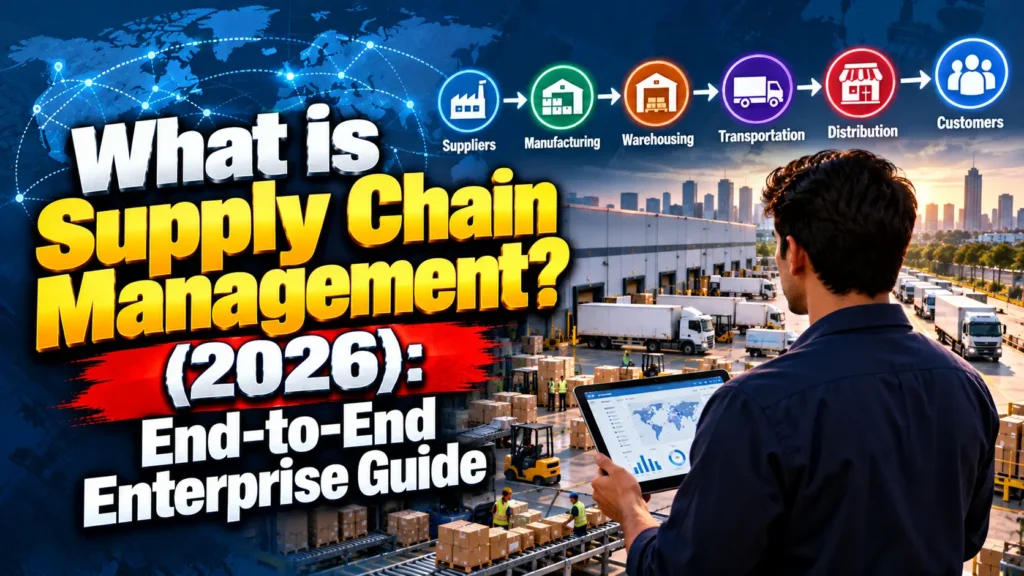
In the modern global economy, individual products no longer compete in isolation; rather, entire supply chains compete against each other. From the extraction of basic raw materials to high-tech manufacturing, warehouse fulfillment, and doorstep customer delivery, the foundational discipline governing this entire industrial web is supply chain management. For ambitious professionals, operations executives, and job seekers exploring high-paying careers in supply chain management and operations, understanding what supply chain management is and how it orchestrates global trade provides the master key to contemporary enterprise leadership.
Supply Chain Management (SCM) is the strategic, cross-functional discipline of planning, designing, executing, controlling, and monitoring the synchronized flow of materials, information, and financial capital across a network of interconnected organizations. Encompassing five foundational pillars—Plan, Source, Make, Deliver, and Return—SCM transforms disparate suppliers, factories, distribution hubs, and retail channels into a unified, high-performance commercial engine that delivers maximum customer value at minimal total cost.
Under national infrastructure modernization frameworks championed by the Logistics Division of DPIIT through the National Logistics Policy and PM Gati Shakti, optimizing supply chain competitiveness has become a paramount national economic objective. Deconstructing the foundational frameworks, technological architectures, financial impacts, and career progressions of supply chain management reveals why SCM stands as the ultimate strategic differentiator of 21st-century business.
1. Defining Supply Chain Management: Core Scope and Strategic Vision
Supply Chain Management (SCM) is the centralized, end-to-end management of the flow of goods, services, data, and finances as they move from raw material suppliers through manufacturing plants, distribution warehouses, retail networks, and into the hands of the end consumer. Its ultimate objective is delivering the right product, in the right quantity, at the right time, to the right place, in pristine condition, at the lowest total cost—a principle known across the industry as the ‘Seven Rights of Logistics.’
A critical conceptual distinction must be drawn between logistics and supply chain management. Logistics is a specialized operational subset of SCM focused specifically on the physical transportation, warehousing, and inventory handling of goods between points in the supply chain. In contrast, Supply Chain Management is the overarching strategic umbrella that integrates logistics with product design, demand forecasting, supplier procurement, manufacturing operations, customer service, and reverse recycling.
Modern SCM operates on the philosophy of network synchronization. Rather than treating suppliers, manufacturers, and distributors as independent, transactional adversaries, modern supply chain management aligns all network participants through transparent data sharing, integrated technology platforms, and shared strategic objectives, eliminating friction and maximizing collective profitability.
2. The SCOR Framework: The Five Structural Pillars of Supply Chain Management
The globally accepted operational blueprint for architecting enterprise supply chains is the Supply Chain Operations Reference (SCOR) model. Developed by global industry consortiums, the SCOR model divides the entire end-to-end supply chain into five core interconnected management processes: Plan, Source, Make, Deliver, and Return.
Each SCOR stage requires specific managerial expertise, specialized software systems, and strict key performance indicators. Harmonizing these five stages enables global enterprises to balance supply and demand dynamically, even during severe global geopolitical or economic disruptions.
The structured comparison table below breaks down the five core pillars of the SCOR framework, detailing primary business activities, deployed software systems, core KPIs, and primary operational vulnerabilities.
| SCOR Pillar | Primary Strategic Focus | Core Business Activities | Primary Enterprise Software | Key Performance Indicator (KPI) | Critical Operational Vulnerability |
| Plan | Balancing aggregate demand & supply resources | Demand forecasting, sales & ops planning (S&OP) | Advanced Planning & Scheduling (APS), Kinaxis | Forecast Accuracy Rate (>85%) | Inaccurate demand forecast causing stockouts or excess inventory |
| Source | Procurement of raw materials, parts & services | Supplier selection, contract negotiation, vendor audits | e-Procurement, SAP Ariba, Coupa | Supplier On-Time In-Full (OTIF) | Single-source supplier factory disruption or price spike |
| Make | Transforming raw inputs into finished products | Production scheduling, assembly, quality control | Manufacturing Execution System (MES), ERP | Overall Equipment Effectiveness (OEE) | Factory machinery breakdown or raw material assembly shortage |
| Deliver | Order fulfillment, warehousing & transport logistics | Warehouse pick-pack, carrier dispatch, last-mile | WMS, TMS, Route Optimization Engines | Order Fill Rate / On-Time Delivery | Port congestion, highway transit delay, or carrier capacity crunch |
| Return | Managing customer returns, repairs & recycling | Reverse logistics, warranty triage, eco-disposal | Reverse WMS, RMA portals, circular software | Return Processing Cycle Time | High return rates eroding profit margin or slow inventory restock |
★ Verified Logistics & Supply Chain Vacancies: Looking for verified delivery operations, dispatch, or logistics career opportunities? Explore open logistics and supply chain roles on AlphaReach to connect directly with leading courier networks, e-commerce fulfillment hubs, and transport enterprises in your region.
3. The Three Critical Supply Chain Flows: Material, Information, and Finance
To understand how supply chain management operates in practice, one must visualize it as three synchronized, continuous flows moving across the enterprise network: the Material Flow, the Information Flow, and the Financial Flow.
The Material Flow represents the physical movement of tangible goods—from extracted raw ores, agricultural produce, and synthetic chemicals through intermediate manufacturing components to packaged consumer products and reverse recycling. Managing material flow requires state-of-the-art warehousing infrastructure, automated material handling systems, and multimodal transport logistics.
The Information Flow represents the two-way transmission of data that guides material movements. Forward information includes customer orders, sales forecasts, advance shipping notices (ASNs), and inventory availability. Backward information includes customer delivery confirmations, tracking telemetry, and point-of-sale consumption data. Without seamless digital information flow, supply chains suffer from the destructive ‘Bullwhip Effect’—where small fluctuations in retail customer demand amplify into massive, chaotic swings in supplier manufacturing orders.
The Financial Flow represents the monetary transactions connecting network partners—including consumer payments, supplier credit terms, bills of lading financing, freight invoices, and warranty refunds. Optimizing financial flow accelerates cash-to-cash cycle times, providing enterprises with healthy liquidity to finance continued commercial growth.
4. Technological Revolution: AI, Digital Twins, and Autonomous Supply Chains
The modern supply chain management landscape is undergoing a monumental technological renaissance driven by artificial intelligence, machine learning, IoT telematics, and cloud computing. Legacy supply chains that relied on historical spreadsheets and intuition are being replaced by predictive, autonomous supply networks.
Leading enterprises deploy Digital Twins—dynamic, virtual replicas of their entire physical supply chain network powered by real-time IoT sensor telemetry. Supply chain architects can simulate complex ‘what-if’ scenarios inside the digital twin: assessing the impact of a sudden port strike, a localized semiconductor factory fire, or an unexpected spike in fuel prices, allowing organizations to execute contingency rerouting before physical disruptions materialize.
Furthermore, artificial intelligence algorithms analyze millions of disparate data variables—including macroeconomic signals, social media sentiment trends, localized weather forecasts, and historical purchasing habits—to deliver hyper-accurate predictive demand planning. Autonomous inventory replenishment systems automatically generate purchase orders, negotiate spot freight space on digital carrier exchanges, and schedule warehouse picking shifts without requiring human intervention.
5. Organizational Hierarchy, Career Paths, and Global Salary Trajectories
Supply chain management is universally recognized as one of the most intellectually rewarding, strategically vital, and financially lucrative career disciplines in modern industry. Entry-level professionals typically start as Supply Chain Analysts, Procurement Associates, Logistics Coordinators, or Material Planners, earning initial annual compensation packages between ₹3.5 Lakh and ₹6 Lakh.
With four to seven years of experience and demonstrated expertise in demand planning, S&OP modeling, and ERP platforms, professionals advance into roles such as Supply Chain Manager, Global Sourcing Lead, Inventory Planning Head, and Plant Logistics Director, commanding annual salaries ranging from ₹8 Lakh to ₹18 Lakh plus executive bonuses.
At the highest executive echelon, Chief Supply Chain Officers (CSCO) and Vice Presidents of Global Operations sit on corporate executive boards, shaping corporate strategy, steering multi-billion-dollar global procurement budgets, and driving enterprise sustainability initiatives. As global commerce continues to prize supply chain agility and resilience above all else, mastering supply chain management provides an enduring passport to corporate leadership.
★ Accelerate Your Logistics Career Today: Ready to step into high-demand delivery operations, fleet coordination, or station management? Apply through AlphaReach to access fast-track hiring, verified logistics employers, and competitive compensation packages today!
Frequently Asked Questions (FAQs)
What is the primary difference between logistics and supply chain management?
Logistics is a specialized subset of supply chain management focused specifically on the physical storage, handling, and transportation of goods from one location to another. Supply chain management (SCM) is the broader strategic discipline that encompasses logistics along with demand forecasting, supplier procurement, product manufacturing, financial management, and customer returns.
What are the five core pillars of the SCOR supply chain model?
The five structural pillars of the SCOR (Supply Chain Operations Reference) model are Plan (forecasting demand and balancing resources), Source (procuring raw materials and components), Make (manufacturing and assembly), Deliver (warehousing, order fulfillment, and transportation), and Return (reverse logistics and returns handling).
What is the ‘Bullwhip Effect’ in supply chain management?
The Bullwhip Effect is a supply chain phenomenon where small fluctuations in end-consumer retail demand create progressively larger, distorted swings in demand as orders move upstream to distributors, manufacturers, and raw material suppliers, leading to severe inventory gluts or shortages.
Why is supply chain resilience so critical for modern businesses?
Supply chain resilience is the ability of an organization to anticipate, absorb, adapt to, and recover rapidly from unexpected disruptions (such as geopolitical conflicts, natural disasters, port strikes, or pandemic shutdowns) without compromising customer delivery commitments or enterprise profitability.
What educational degrees and certifications are best for a supply chain career?
Valuable degrees include a Bachelor’s or Master’s in Supply Chain Management, Logistics, Industrial Engineering, or an MBA in Operations. Globally recognized professional certifications—such as APICS CSCP (Certified Supply Chain Professional), CPIM, and Six Sigma Green/Black Belt—significantly enhance career prospects and salary potential.
Conclusion
Supply Chain Management is the master discipline that connects human creativity, industrial engineering, and global commerce into a harmonious, value-generating reality. Far beyond moving boxes, SCM shapes how humanity produces, allocates, and consumes the resources of the modern world.
As enterprises confront an era marked by rapid technological automation, heightened geopolitical volatility, and imperative environmental sustainability goals, the demand for visionary supply chain leaders has never been greater. For ambitious professionals, embarking on a career in supply chain management provides an intellectually exhilarating and extraordinarily rewarding path to shaping the future of global industry.