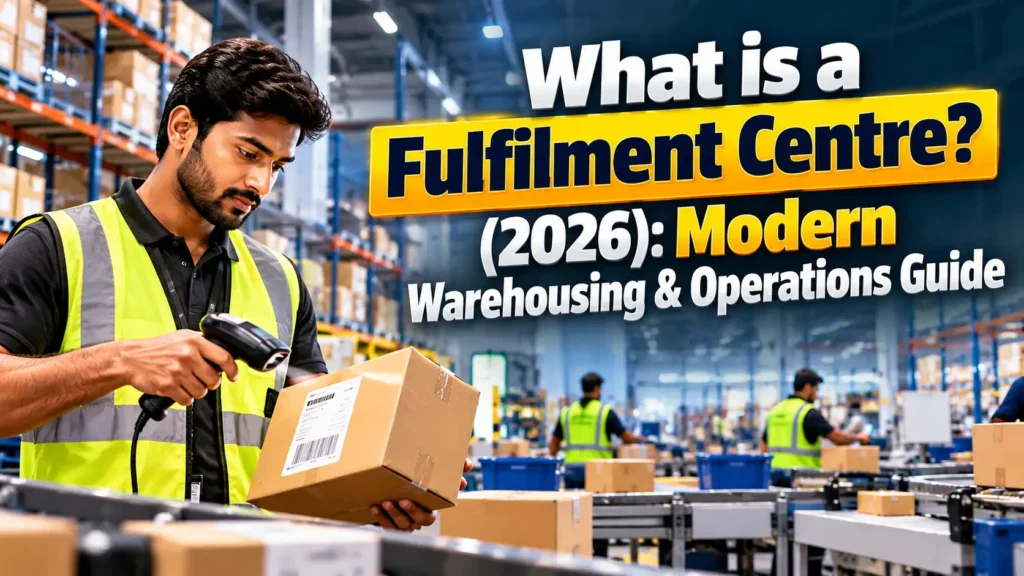
In the rapidly expanding universe of modern omni-channel retail and global e-commerce, the fulfillment center stands as the monumental operational colosseum where physical commerce is stored, orchestrated, and mobilized. For supply chain architects, warehouse inventory managers, and motivated candidates seeking high-paying careers in modern warehousing and logistics, understanding what a fulfilment centre is and how it functions provides the definitive blueprint for contemporary commercial distribution.
Often mistakenly conflated with traditional storage godowns or static bulk warehouses, a modern fulfilment centre (FC) is a high-velocity, highly automated production environment engineered specifically to execute complex individual consumer orders at scale. Spanning hundreds of thousands or even millions of square feet, fulfillment centers integrate artificial intelligence, automated guided vehicles (AGVs), sophisticated conveyor routing systems, and thousands of skilled operational associates to process tens of thousands of unique customer orders every single hour.
Under the strategic policy directives formulated by the Logistics Division of DPIIT to elevate India’s national logistics infrastructure, state-of-the-art fulfillment centers have become pivotal economic assets. By deconstructing the physical anatomy, operational workflows, technological ecosystems, and professional career ladders inside a modern fulfillment center, industry professionals can master the core mechanics of modern retail supply chains.
1. Defining the Fulfilment Centre: Beyond Traditional Warehousing
A fulfilment centre is a specialized, technology-enabled logistics facility dedicated to the complete lifecycle of customer order execution—encompassing bulk vendor receiving, quality auditing, high-density inventory slotting, real-time inventory management, item picking, precision packing, automated dimensioning, and linehaul carrier dispatch. Its defining characteristic is customer-centric agility rather than passive storage.
Traditional commercial warehouses exist primarily to hold large quantities of bulk palletized goods for manufacturers, distributors, and wholesalers over extended periods, moving entire truckloads or full pallet consignments infrequently. In sharp contrast, a fulfillment center is engineered to break down bulk pallets into individual consumer units, storing millions of disparate product SKUs and packaging custom combinations of items for direct shipment to individual residential consumers.
Fulfillment centers act as the central operational bridge between digital marketplace algorithms and the physical world. When an online customer places an order, the fulfillment center’s software infrastructure coordinates physical material handling systems within seconds to initiate picking, ensuring that promised delivery windows—ranging from same-day to standard 48-hour delivery—are consistently met with near-zero error rates.
2. Comparative Analysis: Fulfilment Centres vs. Traditional Warehouses
To truly appreciate the operational complexity of a modern fulfilment centre, one must contrast its functional design, technological sophistication, and operational velocity against traditional distribution warehouses. While conventional storage warehouses measure throughput in terms of pallet moves per week, fulfillment centers measure performance in items picked per minute and seconds elapsed per order cartonization.
Furthermore, while traditional warehouses deal primarily with predictable business-to-business (B2B) freight flows, fulfillment centers operate in an unpredictable business-to-consumer (B2C) environment characterized by volatile demand surges, seasonal holiday peaks, and intensive individual item return processing.
The detailed comparative table below delineates the structural, operational, and technological distinctions that separate modern fulfillment centers from traditional bulk storage facilities.
| Operational Dimension | Modern Fulfilment Centre (FC) | Traditional Storage Warehouse | Dark Store (Micro-FC) | Mother Hub / Sort Center | Regional Distribution Center (RDC) |
| Primary Operational Focus | Individual B2C order pick, pack & rapid dispatch | Bulk pallet storage & B2B distributor replenishment | Hyper-local 10-minute grocery micro-fulfillment | High-speed parcel sortation & linehaul cross-docking | Regional store replenishment & buffer stock holding |
| Facility Physical Footprint | 200,000 to 1,500,000+ sq ft | 20,000 to 100,000 sq ft | 2,000 to 4,500 sq ft | 50,000 to 250,000 sq ft | 100,000 to 500,000 sq ft |
| Average Inventory Dwell Time | 15 to 45 days (high turnover velocity) | 60 to 180+ days (long-term holding) | 1 to 3 days (continuous replenishment) | 4 to 12 hours (zero long-term storage) | 30 to 90 days (seasonal staging) |
| Core Material Handling Tech | Automated sorters, AGVs, pick-to-light, conveyors | Manual forklifts, hydraulic pallet jacks, hand trucks | Gravity flow racks, ring scanners, pick carts | Cross-belt sorters, telescopic dock unloaders | Narrow-aisle reach trucks, turret trucks, pallet conveyors |
| Outbound Consignment Profile | Individual custom parcels & polybags to consumers | Full pallet loads & shrink-wrapped truckloads to retail | Paper grocery bags to hyper-local delivery riders | Consolidated courier bags & gaylord container boxes | Mixed pallet shipments to retail department stores |
★ Verified Logistics & Supply Chain Vacancies: Looking for verified delivery operations, dispatch, or logistics career opportunities? Explore open logistics and supply chain roles on AlphaReach to connect directly with leading courier networks, e-commerce fulfillment hubs, and transport enterprises in your region.
3. The Architectural Anatomy and Functional Zones of a Fulfilment Centre
A world-class fulfillment center is architecturally organized into distinct, highly specialized operational zones designed to maintain seamless material flow from inbound supplier docks to outbound shipping doors. These zones include Inbound Receiving and Decant, Inventory Stow and Storage, Pick and Consolidation, Pack and Cartonization, and Outbound Shipping and Manifest.
In the Inbound Receiving zone, freight trucks unload pallets of supplier merchandise. Associates decant cartons, verify purchase orders against Advanced Shipping Notices (ASNs), inspect barcodes, and place verified units into standardized yellow inventory totes. These totes travel along automated motorized roller conveyors to the Storage Zone.
The Storage Zone may feature multi-tier mezzanine pick towers, high-bay narrow-aisle racking, or automated mobile robotic drive units (where robotic pods transport shelving towers directly to stationary human stowers). Software algorithms dictate ‘chaotic storage’—a methodology where items are stored in seemingly random bins based on available space rather than product category, maximizing storage density and minimizing worker travel time.
In the Pick and Pack zones, picking associates or automated robotic arms retrieve items according to digital pick lists. Totes converge at ergonomic packing stations equipped with touch-screen monitors, automated carton dispensers, paper void-fill machines, and digital scales. Packers scan items, place them in optimized corrugated boxes, apply shipping labels, and send packages onto high-speed sortation conveyors that divert cartons into designated carrier shipping chutes.
4. Advanced Automation and Technology Stacks Powering Fulfilment
Operating a mega-facility housing millions of individual items requires a formidable technology stack anchored by an enterprise Warehouse Management System (WMS) and a Warehouse Execution System (WES). The WMS acts as the facility’s central brain, tracking exact 3D spatial coordinates for every SKU, optimizing picker walking routes, and balancing workloads across packing lanes.
Autonomous Mobile Robots (AMRs) and Automated Guided Vehicles (AGVs) navigate facility floors using QR-code floor grids or LiDAR-based Simultaneous Localization and Mapping (SLAM) technology. These robots transport heavy inventory pods directly to ergonomic human pick stations, eliminating miles of daily walking for warehouse personnel and tripling picking productivity rates.
Automated vision inspection tunnels and dynamic in-line checkweighers audit parcels on the fly as they travel across high-speed conveyors at velocities exceeding 2.5 meters per second. Overhead optical camera arrays read shipping labels on five sides of a moving box, instantly verifying package weight against theoretical bill-of-materials calculations and shunting anomalous cartons to quality audit lanes before carrier loading.
5. Career Pathways, Organizational Structure, and In-Demand Skills
Fulfillment centers are premier engines of employment, supporting an extensive hierarchy of technical, operational, and management professionals. Entry-level roles include Fulfillment Associates, Stowers, Pickers, Packers, and Material Handlers, who gain hands-on expertise in digital inventory scanning, material handling equipment operation, and workplace safety protocols.
Skilled operational specialists advance into technical and supervisory roles, including Inventory Control and Quality Assurance (ICQA) Leads, Warehouse Safety Coordinators, Automation Maintenance Technicians, and Area Managers. ICQA specialists utilize advanced statistical sampling and cycle counting to maintain inventory record accuracy exceeding 99.9 percent across millions of storage bins.
At the executive level, Operations Managers and General Managers oversee multi-million-dollar operational budgets, labor planning models, automation capital investments, and carrier service-level agreements. With the unrelenting expansion of global e-commerce and omnichannel retail, professionals with expertise in warehouse automation, WMS configuration, and lean six sigma methodologies enjoy exceptional long-term career growth and executive mobility.
★ Accelerate Your Logistics Career Today: Ready to step into high-demand delivery operations, fleet coordination, or station management? Apply through AlphaReach to access fast-track hiring, verified logistics employers, and competitive compensation packages today!
Frequently Asked Questions (FAQs)
What is the main purpose of a fulfilment centre?
The primary purpose of a fulfilment centre is to store e-commerce inventory, receive customer orders placed online, accurately pick ordered items from storage shelves, securely pack them in protective boxes, and dispatch finished parcels to shipping carriers for delivery to individual consumers.
How is a fulfilment centre different from a regular warehouse?
A traditional warehouse stores large quantities of bulk palletized products for businesses over long periods, shipping full truckloads to distributors. A fulfilment centre focuses on high-speed retail order execution, breaking down bulk inventory to pick, pack, and ship individual items directly to residential consumers within hours of order placement.
What is ‘chaotic storage’ in an e-commerce fulfilment centre?
‘Chaotic storage’ or dynamic slotting is an inventory method where products are placed in any available shelf bin rather than grouped by category. An item’s location is recorded by scanning its barcode alongside the shelf barcode. This maximizes warehouse storage capacity, prevents bin congestion, and allows pickers to find items in nearby bins regardless of product type.
What role do robots play in modern fulfilment centres?
Robots—such as Autonomous Mobile Robots (AMRs) and automated robotic arms—transport mobile shelving pods directly to human associates, sort parcels onto outbound conveyor chutes, and palletize heavy boxes. This automation drastically reduces human walking distance, increases order processing speed, and elevates picking accuracy.
What qualifications are required to work in a fulfilment centre?
Entry-level fulfillment associate roles typically require basic 10th or 12th-standard education, physical stamina, and basic digital literacy to operate handheld barcode scanners. Supervisory, ICQA, automation engineering, and managerial positions generally require technical diplomas, degrees in logistics, supply chain, or engineering, and experience in warehouse operations.
Conclusion
A modern fulfilment centre is the physical marvel that makes modern digital commerce possible. Far from being a static storage shed, it is a high-speed, technology-driven production engine where advanced software algorithms, robotics, and skilled human craftsmanship collaborate to fulfill millions of consumer desires every day.
As e-commerce continues to reshape global consumption and supply chain resilience becomes a paramount strategic priority, the fulfillment center will remain the decisive arena of retail competition. For aspiring logistics professionals, mastering fulfillment center operations opens the doorway to fulfilling, future-proof careers in the modern global economy.