The gig economy has fundamentally transformed urban mobility across India, and the bike-taxi segment stands at the absolute forefront of this revolution. For millions of daily commuters navigating heavily congested city streets, Uber Moto offers a fast, highly affordable, and efficient way to beat the traffic. Simultaneously, it provides hundreds of thousands of individuals with a flexible, scalable source of independent income. However, operating as an independent contractor on the Uber platform requires much more than just a driving license and a motorcycle. It requires a deep understanding of the digital algorithms that govern your daily earnings.
In 2026, your financial success on the Uber app is heavily dictated by a single, highly visible digital metric: your driver star rating. While new drivers start with a perfect score, the reality of navigating chaotic roads, dealing with diverse passenger moods, and battling unpredictable weather can quickly cause that score to drop. A declining rating is a massive source of anxiety for gig workers. It can lead to a loss of platform privileges, reduced order volume, and in severe cases, complete account deactivation.
If you have experienced a sudden drop in your metrics and are actively looking for effective strategies for Raising low driver rating score, you are in the right place. This comprehensive, deep-dive guide will explain the exact mathematics behind the platform’s algorithm, explore the psychological triggers that cause passengers to leave bad reviews, and provide a proven, step-by-step blueprint for Uber Moto Driver Rating Recovery: How to Get Back to 4.8+ Stars.
How the Uber Moto Driver Rating System Actually Works
To successfully manipulate your score and push it upward, you must first understand the foundational mechanics of the Uber evaluation system.
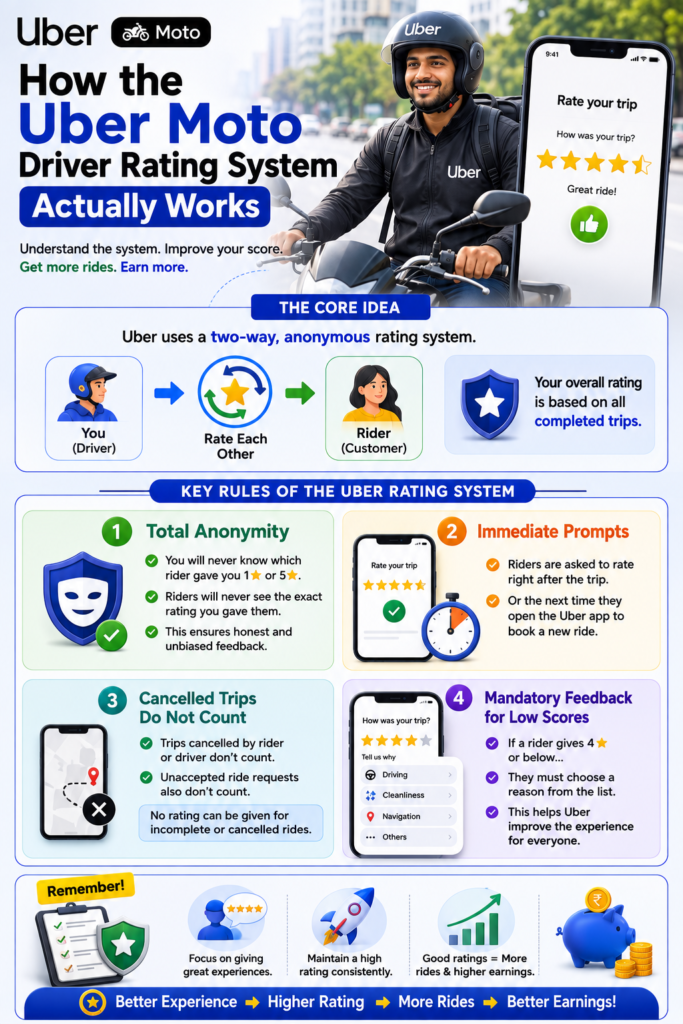
Uber operates on a two-way, anonymous rating ecosystem. At the end of every completed trip, both the driver and the rider are prompted by the application to rate each other on a scale of 1 to 5 stars, based entirely on their trip experience.
Here are the core functional rules of the rating engine:
- Total Anonymity: The rating system is completely anonymous. You will never see exactly which specific rider gave you a 1-star or 5-star review, and the rider will never see the specific rating you left for them. This is designed to promote honest, unbiased feedback without the fear of confrontation.
- Immediate Prompts: Riders are prompted to rate their most recent trip immediately after stepping off your motorcycle, or the very next time they open the Uber app to book a new ride.
- Cancelled Trips Do Not Count: If a trip is cancelled by either the rider or the driver before it is completed, or if a trip request is simply unaccepted, no rating can be given. You cannot receive a star rating for a trip that did not officially happen.
- Mandatory Feedback for Low Scores: If a rider chooses to leave a rating of 4 stars or lower, the Uber app immediately prompts them to select a specific reason for the low score (such as “Driving,” “Cleanliness,” or “Navigation”).
> Looking for more riding opportunities? Explore current driver and delivery jobs that can help you find flexible work alongside your Uber Moto routine.
The Math Behind the System: The 500-Trip Rolling Average
The most critical mathematical concept you must grasp for successful uber moto driver rating recovery is the “Rolling Average.”
Your overall driver star rating is not an average of every single trip you have ever taken since the day you joined the platform. Instead, it is strictly calculated as the average of the last 500 ratings you have received from riders.
Why the 500-Trip Rule is Your Best Friend
Many drivers panic when they receive a random 1-star rating, assuming their entire profile is ruined. Because your score is spread across 500 individual ratings, a single 1-star review from an angry or unreasonable passenger is statistically insignificant and will not dramatically break your overall average.
However, the rolling average system also means that Raising low driver rating score requires extreme patience and consistency.
Imagine your profile currently holds a 1-star rating that you received yesterday. To permanently erase that specific 1-star rating from your mathematical average, you must accumulate 500 new rated trips. Only then will the old 1-star rating be pushed out of the 500-trip calculation window.
Furthermore, not every passenger leaves a rating. If only 60% of your passengers bother to rate you, you might need to complete over 800 actual trips just to cycle out older, negative ratings. This mathematical reality means there is no overnight “hack” to fix your score. Recovery is a marathon of sustained excellent service.
Why Does a 4.8+ Driver Rating Score Matter?
You might wonder why a massive technology company cares if a driver maintains a 4.6 or a 4.9 rating, as long as the passenger gets from point A to point B. The algorithm aggressively monitors these metrics because high ratings directly correlate with customer retention. For drivers, holding a high score unlocks distinct financial and operational advantages.
1. Protection from Account Deactivation
The most pressing reason to focus on uber moto driver rating recovery is platform survival. Uber continuously monitors the fleet to ensure quality control. If a driver’s overall star rating drops below the minimum acceptable threshold for their specific city (which is often around the 4.6 mark), the account falls into the danger zone. Consistently low ratings over an extended period will trigger an automated account deactivation, permanently banning the driver from earning on the platform.
2. Unlocking Uber Pro Rewards
Uber incentivizes top-tier service through its Uber Pro rewards program. Drivers are categorized into tiers—Blue, Gold, Platinum, and Diamond. Achieving Gold, Platinum, or Diamond status unlocks massive benefits, such as priority airport rematches, extra destination filters, priority customer support, and even discounts on insurance or vehicle maintenance. To unlock and maintain these highly profitable tiers, you must maintain a high star rating (typically 4.85 or above) and keep your cancellation rate strictly below a certain threshold (usually under 4% to 10%, depending on the region).
Top Reasons Riders Leave Low Ratings on Uber Moto
Before you can fix your score, you must understand exactly why it dropped in the first place. Operating a bike-taxi presents a unique set of passenger challenges compared to driving a standard four-wheeler cab. A motorcycle is fully exposed to the elements, and the passenger is in close physical proximity to the driver.
Here are the most common psychological triggers that cause riders to leave 1-star reviews on Uber Moto:
- Aggressive Driving and Safety Fears: Safety is the absolute number one concern for a pillion rider. Weaving aggressively through heavy traffic, speeding to beat red lights, or taking dangerously sharp turns terrifies passengers. If a rider feels their life is at risk, they will immediately leave a 1-star rating, regardless of how fast you reached the destination.
- Poor Helmet Hygiene: In a post-pandemic world, personal hygiene is heavily scrutinized. A passenger’s face is completely encased in the helmet you provide. If the helmet smells of stale sweat, has a broken visor, or a wet interior, it guarantees a terrible rating.
- Uncomfortable Acceleration and Braking: A motorcycle does not have seatbelts. If you accelerate with a sudden jerk, the passenger is thrown backward. If you brake aggressively, the passenger slams into your back. A jerky, uncomfortable ride is a major source of low ratings.
- Navigation Arguments: Arguing with the passenger over the GPS route, intentionally taking a longer route to increase the fare, or demanding that the passenger guide you turn-by-turn creates immediate friction.
- Vehicle Condition: A poorly maintained motorcycle with a torn pillion seat, worn-out shock absorbers, or missing footpegs makes traversing pothole-ridden city streets a painful experience for the rider.
Proven Strategies: Uber Moto Driver Rating Recovery: How to Get Back to 4.8+ Stars
Now that we understand the math and the common pitfalls, it is time to implement a highly disciplined operational strategy. Treat your bike-taxi like an independent, professional chauffeur service. Here is your definitive blueprint for Raising low driver rating score:
1. The “Two-Helmet” Hygiene Protocol
Your most valuable asset, aside from your motorcycle, is the passenger helmet. To immediately elevate your service quality, invest in a high-quality, comfortable, and well-ventilated passenger helmet.
- Sanitization: Carry a small bottle of isopropyl alcohol spray and a microfiber cloth. Quickly wipe the inside of the helmet in front of the passenger before handing it to them. This visual demonstration of hygiene instantly earns their trust.
- Disposable Caps: Many top-rated Diamond drivers in 2026 buy cheap, disposable surgical hair caps in bulk and offer one to the passenger before they put on the helmet. This completely eliminates hygiene complaints and almost guarantees a 5-star rating.
2. Master “Defensive and Smooth” Riding
You must change your driving style when you have a passenger. You are no longer riding solo.
- Accelerate smoothly and gradually.
- Anticipate traffic signals early so you can brake softly without causing the passenger to lurch forward.
- Slow down significantly over speed bumps and potholes to protect the passenger’s spine. A smooth, boring, and safe ride is precisely what earns a 5-star review.
3. Route Confirmation is Mandatory
Never blindly follow the GPS without speaking to the rider, and never assume you know a better shortcut. The moment the passenger sits on the bike, politely ask: “Sir/Ma’am, should I follow the Uber GPS route, or do you have a preferred shortcut you would like me to take?”
By giving the passenger the power to choose, you completely eliminate complaints about “Poor Route Choice.” If they choose the GPS, they cannot blame you if there is traffic. If they choose their own route, they are responsible for it.
4. Professional Doorstep Demeanor
First impressions matter. Always wear clean clothes, maintain personal hygiene, and greet the rider politely. Say, “Good morning, Uber for [Passenger Name]?”
Ensure you have an extra, clean cloth to wipe the pillion seat if it has been raining or is dusty. Do not engage in overly personal, political, or intrusive conversations. Let the passenger dictate the level of conversation.
5. The Polite Rating Request
Because ratings are a numbers game, you need a massive volume of 5-star reviews to dilute the old 1-star reviews. At the end of a safe and smooth trip, as the passenger is handing back the helmet, politely ask for the rating.
- Say: “Thank you for riding with me! If you enjoyed the safe ride today, please take a second to give a 5-star rating on the app. It really helps me maintain my account.”
- Most satisfied passengers are happy to help a polite driver, but they simply need to be reminded.
How Uber Protects Drivers: The “Ratings Protection” System
Many drivers stress over variables that are entirely outside their control. What happens if you get stuck in a massive, unexpected traffic jam, or the Uber app crashes, and the customer blames you?
You will be relieved to know that the Uber algorithm features a robust, automated “Ratings Protection” system. The platform understands that unfair situations occur, and it actively filters out biased feedback.
If a rider leaves a rating of less than 5 stars, the algorithm will automatically exclude that rating from your 500-trip average if the root cause is determined to be beyond your control. You do not even need to call Uber support to request the removal; the system auto-removes it.
Ratings are automatically removed from your profile if they are caused by:
- Traffic Delays: Unexpected, severe traffic jams that severely alter the ETA.
- App or GPS Errors: Widespread app outages or internal Uber GPS routing failures.
- Faulty Rider Inputs: The rider drops the wrong pickup pin location on the map, leading to a delayed pickup.
- False Reports: The system identifies a rider who consistently leaves negative, biased 1-star ratings for all drivers to get free refunds. The algorithm invalidates that rider’s feedback entirely.
Because of this automated protection, you only need to focus on what you can actually control: your driving safety, your hygiene, and your customer service.
> Ready to explore another earning option? Apply as a delivery partner and discover flexible opportunities where consistent service can support your earning goals.
Frequently Asked Questions (FAQs)
Q1: How long does an uber moto driver rating recovery process take?
Because your rating is a rolling average of your last 500 rated trips, the recovery time depends entirely on your driving volume. If you drive full-time and complete 15 to 20 trips a day, it could take a month to cycle through 500 new ratings. If you only drive part-time on weekends, it could take several months to fully push old 1-star ratings out of your mathematical average.
Q2: Can I call Uber Support to manually remove a 1-star rating that a passenger gave me unfairly?
No, Uber Support agents generally cannot manually alter, delete, or manipulate specific star ratings left by riders. The platform relies on its automated Ratings Protection system. If the bad rating was caused by something out of your control (like a GPS failure or a wrong pickup pin), the system will automatically exclude it. If the rating remains, you must simply dilute it by earning more 5-star reviews.
Q3: Do I get penalized if I decline a ride request?
Declining or ignoring an incoming ride request before you accept it does not impact your star rating whatsoever. Cancelled and unaccepted trips cannot be rated by passengers. However, frequently declining trips will lower your “Acceptance Rate,” which is a separate metric required to maintain Uber Pro tier status (like Gold or Diamond).
Q4: Will a single 1-star rating get my Uber driver account deactivated?
Absolutely not. A single 1-star rating has a very minor statistical impact on an average built across 500 trips. Deactivation only occurs if you exhibit a consistent, long-term pattern of poor service that drags your overall average below the minimum acceptable threshold for your city (usually around 4.6), or if you commit a severe safety violation.
Q5: Should I rate riders 5 stars even if they were slightly rude?
The rating system is a two-way street designed to keep the community safe. While you should be professional, you are encouraged to rate riders honestly. Providing a thoughtful rating helps protect other drivers on the platform. If a rider was slightly delayed, a 4-star rating might be appropriate. If a rider violated community guidelines or compromised your safety on the bike, you should rate them 1 star and report the specific incident to Uber Support.
Conclusion
Rebuilding a damaged profile in the gig economy requires a strategic, professional mindset. Uber Moto Driver Rating Recovery: How to Get Back to 4.8+ Stars is not an overnight process, nor is it based on a secret app glitch. It is rooted in the mathematical reality of the 500-trip rolling average.
By actively shifting your focus away from rushing through traffic and toward providing a premium, highly hygienic, and smooth ride, you will naturally trigger positive psychological responses from your passengers. Consistently execute the “Two-Helmet” hygiene rule, always confirm the navigation route before accelerating, and politely ask for that 5-star review at the end of every trip. With disciplined execution, those old negative scores will inevitably cycle out of the algorithm, successfully Raising low driver rating score and securely locking in your lucrative Uber Pro benefits for the future.

