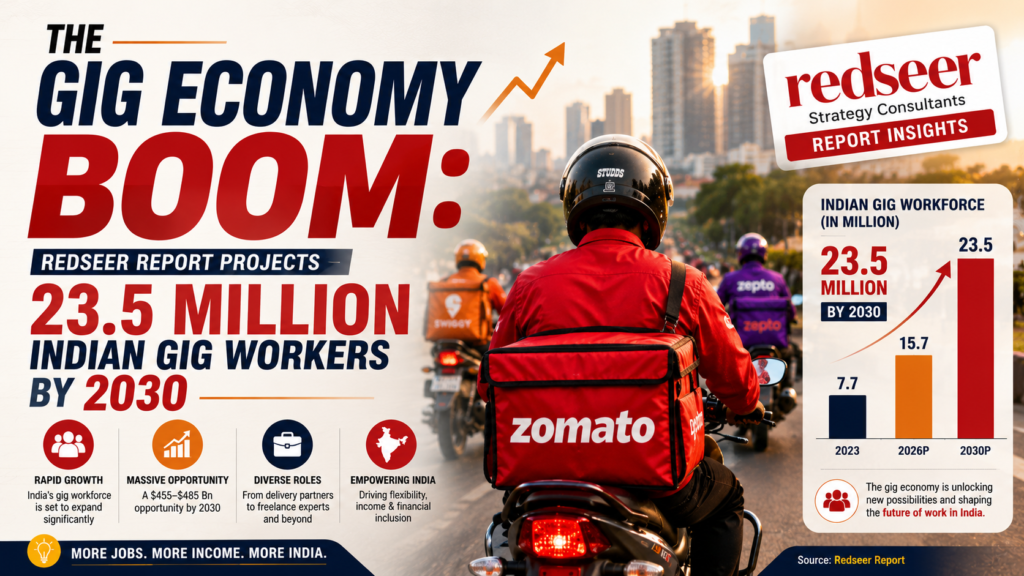
The narrative surrounding India’s gig economy has officially shifted from a “peripheral employment trend” to the absolute bedrock of the country’s future labor market. According to the newly released ‘India’s Gig Workers Report 2026’ by Redseer Strategy Consultants, the sector is growing significantly faster than any previous economic model predicted. Currently boasting over 6 million active gig internet workers, the workforce is projected to balloon to between 17 and 23.5 million workers by 2030. This translates to an astonishing compound annual growth rate of 24-29%, primarily driven by the explosion of quick commerce and the expansion of ride-hailing services deep into Tier 2 and Tier 3 cities.
Surprising Data on Gig Worker Earnings
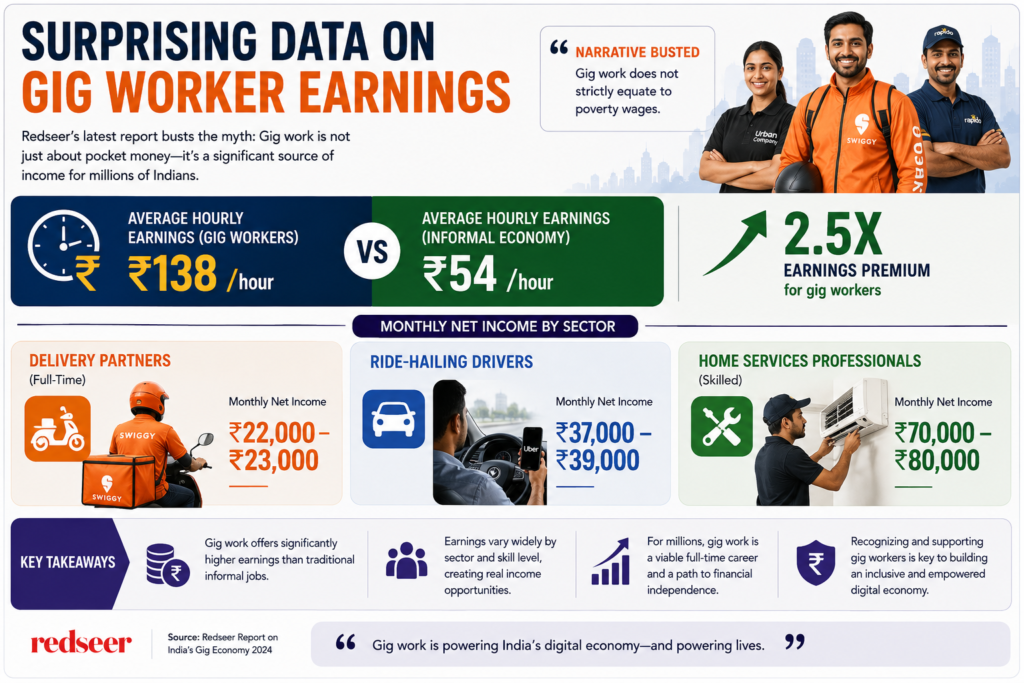
Perhaps the most narrative-busting finding in the Redseer report is the data on actual worker earnings. The report explicitly challenges the dominant narrative that gig work strictly equates to poverty wages. At an hourly level, the data reveals that gig internet workers in India earn an average of Rs 138 per hour. By direct comparison, similar roles in the traditional informal economy pay roughly Rs 54 per hour. This indicates a massive 2.5x earnings premium for platform workers. Monthly net income ranges dramatically by sector: full-time delivery partners pull in roughly Rs 22,000 to Rs 23,000, ride-hailing drivers net Rs 37,000 to Rs 39,000, and highly skilled home services professionals (like beauticians or AC technicians) take home a lucrative Rs 70,000 to Rs 80,000.
Bridging India’s Macro Job Gap
India faces immense macroeconomic pressure to create approximately 8 million new non-farm jobs annually to absorb its booming youth population. The Redseer analysis suggests that, at its current growth trajectory, gig internet work could bridge close to 70% of this massive annual job creation deficit. The report notes that for 54% of current platform workers, gig work is their first form of paid employment, proving that apps are actively expanding the labor market rather than just cannibalizing traditional jobs.
Final Word, Thought, and Conclusion
The Redseer 2026 report cements a crucial reality: gig work is no longer just a “side hustle” for college students; it is the primary economic engine keeping India’s employment statistics afloat. The 2.5x earnings premium over the informal sector explains exactly why millions are flocking to platforms like Swiggy and Uber. However, as the workforce scales toward 23 million, this initial earnings premium will naturally compress due to labor oversupply. The conclusion is stark: platforms must stop treating drivers and riders as disposable commodities. If aggregators fail to invest in worker retention and localized welfare today, the massive job-creation engine they built could collapse under the weight of worker burnout by 2030.