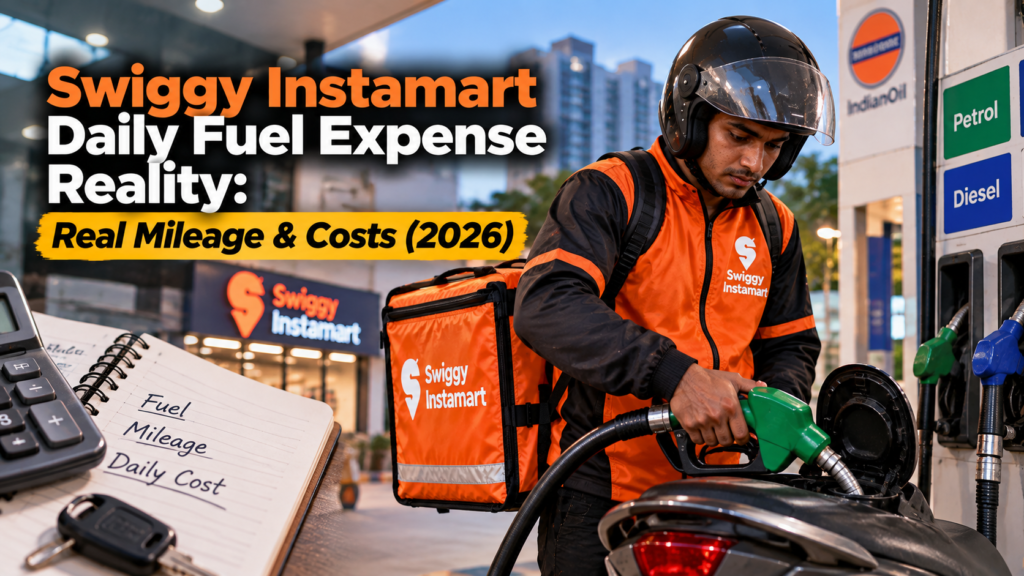
For thousands of quick-commerce couriers navigating crowded urban streets, gross earnings figures displayed on partner dashboards can be deceptive if vehicle operating expenses are ignored. Ambitious gig workers assessing delivery partner vacancies and grocery delivery shifts must factor in petrol consumption, payload drag, and stop-and-go metro traffic. Unpacking the swiggy instamart daily fuel expense reality reveals how heavy grocery crates, short delivery runs, tyre inflation, and engine displacement directly influence your net profit in 2026.
Delivering groceries is mechanically distinct from passenger transport or highway commuting. Carrying 15 to 20 kg of heavy groceries, idling during apartment gate check-ins, accelerating rapidly away from traffic lights, and mounting steep flyovers causes vehicle fuel economy to plunge well below factory claims.
This data-backed economic analysis explores actual on-road fuel consumption across popular 100cc, 125cc, and scooter models, calculates daily fuel expense ratios, exposes unpaid deadhead mileage, and outlines maintenance hacks to maximize your take-home income.
Mastering your vehicle operating budget ensures you retain maximum cash in your pocket at the end of every delivery shift.
The Fuel Economy Gap: Factory Claims vs 20 kg Grocery Payload Reality
Under standardized energy efficiency test cycles published by the Bureau of Energy Efficiency (BEE), commuter motorcycles report lab-tested fuel economies ranging from 65 km/l to 80 km/l. However, commercial quick-commerce grocery delivery operates under vastly harsher conditions.
In real-world metro delivery duty—carrying a 15 to 22 kg loaded crate bag, navigating bumper-to-bumper city traffic, frequent gear downshifts, and idling at apartment gates—actual fuel mileage drops by 20% to 30%.
A standard 110cc commuter bike delivering groceries achieves an actual city mileage of 45 to 52 km/l. A 125cc executive commuter yields 38 to 44 km/l, while gearless automatic scooters (such as Honda Activa or TVS Jupiter) drop to 32 to 38 km/l due to continuous variable transmission (CVT) frictional losses.
With petrol prices fluctuating between ₹95 and ₹105 per litre across Indian states, understanding your fuel cost per kilometer is the foundation of gig work profitability.
Daily Fuel Expense Matrix: 100cc vs 125cc vs Scooter on a 100 km Shift
The economic comparison table below outlines realistic fuel expenses, daily mileage, and net profit margins across common two-wheeler categories completing a standard 100 km daily Instamart shift in 2026:
| Vehicle Category & Popular Models | Real City Mileage (Grocery Load) | Daily Petrol Used (100 km) | Daily Fuel Cost (@ ₹100/L) | Gross Earnings (100 km) | Fuel Cost % of Revenue |
| 100cc Commuter (Hero Splendor / HF Deluxe) | 52 km/litre | 1.92 Litres | ₹192 | ₹1,200 | 16.0% (Highest Profit Margin) |
| 110cc City Bike (Honda Shine 100 / Platina) | 48 km/litre | 2.08 Litres | ₹208 | ₹1,200 | 17.3% (Optimal Performance) |
| 125cc Executive (Honda SP 125 / Pulsar 125) | 42 km/litre | 2.38 Litres | ₹238 | ₹1,200 | 19.8% (Moderate Fuel Bill) |
| 150cc–160cc Sport (Apache / Pulsar 150) | 34 km/litre | 2.94 Litres | ₹294 | ₹1,200 | 24.5% (High Fuel Drain) |
| 110cc Gearless Scooter (Activa / Jupiter) | 36 km/litre | 2.77 Litres | ₹277 | ₹1,200 | 23.1% (Heavy CVT Loss) |
Discover high-paying food and grocery delivery partner vacancies with flexible hours and weekly direct bank transfers. Explore verified gig jobs in your city today.
The Drain of Unpaid ‘Deadhead’ Return Kilometers
In grocery quick commerce, the greatest hidden fuel expense is deadhead mileage—the empty return journey from the customer’s doorstep back to the dark store pod:
• Hub-and-Spoke Logistics: Unlike food delivery where you might pick up your next order from a restaurant near your last drop, Instamart orders originate exclusively from the central dark store. You must drive back to the pod to collect your next parcel.
• Minimizing Empty Kilometers: If you drop an order 3.5 km away, that delivery entails 7 km of total driving. Top couriers accept batch deliveries (delivering 2 orders in one outward run) to cut deadhead return kilometers by 50%.
• Avoid Wandering: When returning to the pod, drive directly via the shortest route and park with the engine turned off rather than idling while waiting for the next dispatch ping.
4 Vehicle Tuning Secrets to Save ₹2,000+ in Monthly Fuel Bills
Proactive maintenance pays for itself by reducing fuel consumption:
• Check Cold Tyre Pressure Weekly: Carrying heavy grocery crates requires higher rear tyre pressure (typically 36 to 38 PSI) compared to solo riding (30 to 32 PSI). Underinflated tyres increase road friction and waste up to 8% more fuel.
• Clean Spark Plugs and Air Filters: Dusty urban delivery environments clog motorcycle air filters within 2,500 km. A choked filter creates a fuel-rich mixture that burns excess petrol without generating power.
• Chain Lubrication: Clean and lubricate your motorcycle chain every 500 km. A dry, gritty chain increases drivetrain friction and robs your bike of mileage.
• Smooth Throttle Modulation: Avoid aggressive full-throttle starts away from traffic signals. Anticipating traffic stops and decelerating smoothly preserves significant fuel over a 100 km shift.
Electric Two-Wheelers (EV) vs Petrol Economics for Instamart
With the rapid expansion of commercial EV rental fleets and battery-swapping networks across Indian metros, the economics of delivery are evolving:
• Petrol two-wheelers cost approximately ₹1.90 to ₹2.80 per kilometer in fuel expenses alone.
• Commercial electric scooters with battery-swapping subscriptions cost ₹0.80 to ₹1.20 per kilometer, slashing daily running expenses by over 50%.
• High-mileage couriers logging over 120 km daily can save between ₹3,500 and ₹5,000 per month by transitioning to commercial EV subscriptions.
When assessing total vehicle operating costs, quick-commerce couriers must budget for mechanical wear and tear alongside daily fuel bills. Every 1,000 kilometers of city delivery riding consumes approximately ₹120 in tyre tread wear, ₹130 in brake shoe wear, and ₹150 in semi-synthetic engine oil breakdown.
Adopting digital mileage log apps or tracking odometer readings weekly helps riders detect engine tuning degradations early. A sudden drop of 4 to 5 km/l typically indicates carbon buildup on spark plugs or a slipping clutch plate, allowing timely servicing before expensive fuel is wasted.
Switching to commercial electric two-wheelers with fixed monthly battery-swapping subscriptions also protects couriers from volatile global crude oil price hikes, providing predictable monthly operating expenses.
Frequently Asked Questions (FAQs)
How much does a Swiggy Instamart delivery partner spend on petrol daily?
A full-time courier covering 80 to 110 km daily spends between ₹190 and ₹290 on petrol, depending on engine capacity (100cc vs 125cc) and whether they ride a geared bike or an automatic scooter.
Which bike gives the best mileage for Swiggy Instamart grocery delivery?
100cc to 110cc commuter motorcycles such as the Hero Splendor Plus, Bajaj Platina 110, and Honda Shine 100 offer the best real-world city mileage (48 to 54 km/l with grocery payload) and minimal maintenance costs.
Are automatic scooters like Honda Activa good for Swiggy Instamart?
While automatic scooters offer great front footboard storage for grocery bags, their CVT transmission delivers lower mileage (32 to 38 km/l) compared to geared bikes, resulting in ₹60 to ₹90 higher daily fuel bills.
What percentage of daily Swiggy Instamart earnings goes into fuel?
Fuel typically consumes between 16% and 24% of a courier’s gross daily earnings. Riding a fuel-efficient 100cc bike keeps fuel expenses under 18%, preserving net profitability.
How can I reduce empty return kilometers at Swiggy Instamart?
Reduce empty return kilometers by accepting multi-order batches, taking direct return routes without detours, and using navigation shortcuts back to the pod.
Unlock higher earnings, flexible delivery hours, and verified shift bonuses across top platforms in India. Explore verified gig jobs in your city today.
Conclusion
In summary, understanding the swiggy instamart daily fuel expense reality is the key to running a profitable delivery business on two wheels. By choosing fuel-efficient commuter motorcycles, maintaining optimal tyre pressures, minimizing empty return kilometers, and considering EV alternatives, you can protect your margins and maximize your take-home earnings.

