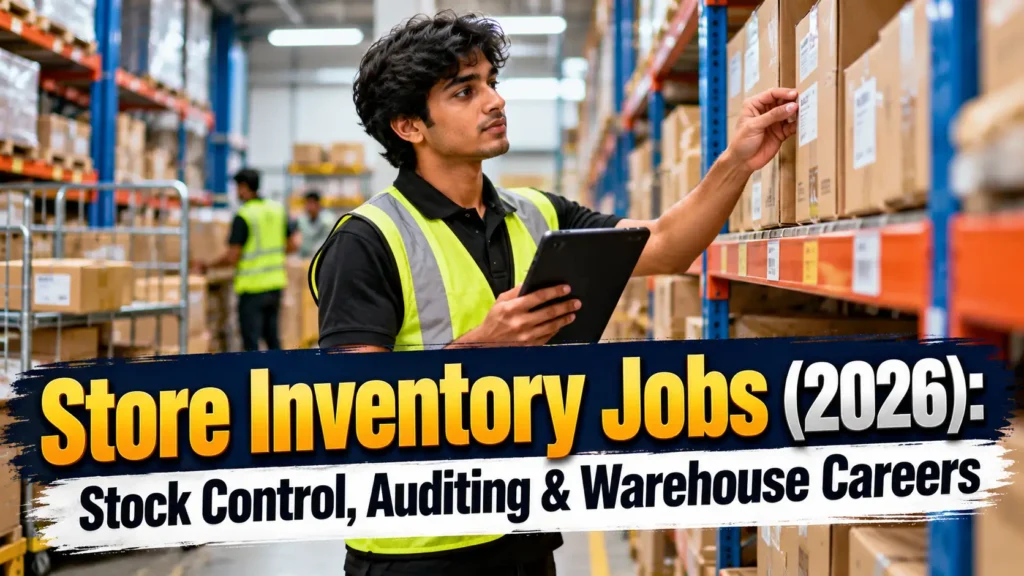
In modern retail, a store that cannot accurately account for its inventory cannot survive. When store computer systems report five units of a high-value smartphone or twenty bags of basmati rice in stock, but customers find empty shelves, sales are lost, customer trust collapses, and operational chaos ensues. The specialized professionals responsible for eliminating this discrepancy are store inventory specialists. For detail-oriented, analytical job seekers exploring store inventory jobs and retail stock controller careers, this field offers intellectual satisfaction, administrative authority, and clear executive career progression.
A store inventory professional (operating under titles such as inventory associate, stock auditor, cycle counter, or stock controller) manages the critical mathematical balance between physical merchandise on store shelves and digital book balances in the enterprise resource planning (ERP) system. Working across supermarkets, consumer electronics chains, apparel megastores, and e-commerce fulfillment centers, inventory associates conduct daily cycle counts, reconcile receiving discrepancies, investigate stock shrinkage, and audit barcode scan compliance. Because inventory represents a retailer’s largest financial investment, skilled inventory controllers are indispensable to corporate profitability.
National employment exchange programs coordinated by the National Career Service (NCS) portal list thousands of verified inventory control and stock auditing vacancies across India’s supply chain and retail sectors. Reviewing daily inventory audit routines, technological software tools, salary benchmarks, and required analytical proficiencies enables candidates to secure high-demand inventory positions.
1. The Strategic Role of Inventory Control in Modern Retail
Inventory control is the systematic management of stock availability, accuracy, and storage safety across the entire retail lifecycle.
Cycle Counting and Perpetual Auditing: In the past, retailers shut down stores for days to conduct painful annual physical inventory counts. Today, inventory specialists perform continuous ‘cycle counts’—counting 30 to 50 specific high-velocity or high-value SKUs each morning before store opening, identifying stock discrepancies immediately.
Variance Reconciliation and Root-Cause Analysis: When physical counts do not match ERP system numbers, the inventory associate investigates the discrepancy. Did a cashier scan the wrong barcode? Did the receiving dock accept 90 units instead of 100 on the invoice? Or did merchandise suffer shoplifting? Pinpointing the exact cause prevents recurring financial losses.
Managing Damaged Goods and Vendor Returns (RTV): Products damaged in transit or customer returns that cannot be resold are logged into Return-to-Vendor (RTV) or write-off ledgers, ensuring accurate accounting and supplier credit reimbursement.
Perpetual vs Periodic Inventory Tracking: Modern organized retailers maintain perpetual inventory systems, where every barcode scan at the cash counter or dispatch dock automatically updates master stock registers in real time. The inventory specialist monitors this live data stream to flag abnormal inventory spikes, zero-movement dead stock, and unusual stock write-offs before they escalate.
2. Comparative Overview of Store Inventory Positions and Compensation
Inventory roles span diverse operational environments, ranging from single retail store stockrooms to massive multi-acre distribution fulfillment centers.
While retail store inventory associates focus on shelf accuracy and customer returns, warehouse inventory controllers manage bulk pallet counts and high-bay racking systems.
The comparative table below outlines the five primary store inventory roles in India, detailing core responsibilities, software used, average monthly compensation, and required analytical skills.
| Inventory Job Role | Work Environment | Core Daily Focus | Software & Tools Used | Average Monthly Salary | Analytical Skill Benchmark |
| Retail Store Stock Auditor | Supermarket / Hypermarket Floor | Daily cycle counts, shelf variance audits, expiry checks | SAP Retail, handheld HHT scanners | ₹20,000 – ₹30,000 | Attention to barcode detail, basic Excel |
| Central Warehouse Inventory Lead | E-Commerce Regional Hub | Pallet location audits, inward GRN reconciliation | Manhattan WMS, Oracle SCM | ₹24,000 – ₹36,000 | Intermediate Excel (VLOOKUP, Pivot Tables) |
| Fashion Inventory Controller | High-Street Apparel Showroom | Size/color SKU audits, EAS security tag checks | Microsoft Dynamics Retail, RFID readers | ₹22,000 – ₹32,000 | High SKU variance tracking, shrinkage control |
| Electronics & Asset Auditor | Consumer Tech Megastore | Serial number tracking, IMEI logging, warranty matching | Custom ERP, handheld laser scanners | ₹23,000 – ₹35,000 | Flawless serial number auditing, zero tolerance |
| Perishables & Cold-Chain Auditor | Grocery Mart / Dark Store | Freshness grading, temperature logging, dump write-offs | Mobile inventory apps, digital scales | ₹19,000 – ₹28,000 | Speedy FIFO checks, waste reduction focus |
★ Verified Retail Store Vacancies: Looking for high-paying retail store jobs, supermarket vacancies, or billing executive positions? Explore verified retail opportunities on AlphaReach to connect with leading supermarket chains, departmental stores, and retail brands in your city.
3. The Technical Skill Stack: Barcodes, RFID, and Enterprise ERPs
Store inventory management in 2026 is powered by advanced digital scanning hardware and cloud inventory software.
Radio Frequency Identification (RFID) Auditing: Modern apparel and luxury retailers embed micro-RFID tags in price tickets. Rather than scanning each item individually, an inventory associate sweeps a handheld RFID wand across clothing racks, reading 300 garments per minute with 99.8% accuracy.
Spreadsheet Analysis with Microsoft Excel: Excel remains the essential tool for inventory reconciliation. Inventory specialists download system stock reports, compare them against physical scan files using VLOOKUP, calculate variance percentages, and generate management summary dashboards.
Operating Handheld Terminals (HHT): Ruggedized Android handheld computers equipped with 2D barcode imagers allow inventory controllers to scan product barcodes, verify stock locations, update shelf bins, and flag pricing discrepancies on the fly.
4. Step-by-Step Guide to Getting Hired in Store Inventory Control
Landing an inventory job requires demonstrating meticulous accuracy, numerical comfort, and process discipline.
Highlight Numerical Aptitude and Attention to Detail: In your resume, emphasize strong basic mathematics, accurate typing, and familiarity with spreadsheets or inventory tools. Mention past experiences where precision was paramount.
Prepare for Practical Inventory Tests: Interviewers frequently give candidates a sample sheet of 20 inventory items and ask them to find discrepancies between an invoice and a physical count sheet, or test their speed in identifying mislabeled barcodes.
Demonstrate Personal Honesty and Integrity: Because inventory associates have visibility into missing stock and high-value merchandise, hiring managers conduct rigorous character reference checks. A reputation for absolute honesty is your greatest asset.
Understanding Inventory Shrinkage Thresholds: During technical interview rounds, candidates should demonstrate knowledge of acceptable variance limits. Showing that you understand the difference between permissible shrinkage (like produce moisture weight loss) and preventable theft shrinkage immediately impresses hiring panels.
5. Career Progression: From Cycle Counter to Supply Chain Director
Inventory control is the premier training ground for high-level supply chain executive leadership.
Within 2 to 3 years, an inventory associate advances to Inventory Controller or Stock Audit Lead, supervising store-wide audit teams and managing multi-crore inventory reconciliations.
With 5 to 7 years of experience, professionals advance to Regional Inventory Manager, Demand Planning Analyst, or Head of Loss Prevention, earning lucrative corporate packages ranging from ₹10 to ₹25+ Lakhs per annum.
★ Fast-Track Your Retail Career Today: Ready to kickstart or advance your retail career with fast-track hiring, flexible shifts, and steady monthly earnings? Apply as a verified retail associate on AlphaReach today!
Frequently Asked Questions (FAQs)
What is the difference between inventory control and stock replenishment?
Stock replenishment is the physical act of moving merchandise from the backroom to fill empty store shelves, while inventory control is the administrative and analytical auditing of physical stock against digital records to ensure accuracy and prevent shrinkage.
What is the minimum educational qualification for store inventory jobs?
Entry-level cycle counters and stock audit assistants typically require a 12th pass certificate with basic computer skills, while inventory controllers and audit leads prefer a Bachelor’s degree (B.Com, BBA, B.Sc, or BCA).
What is a cycle count in retail inventory management?
A cycle count is an ongoing auditing procedure where a small subset of inventory is counted on a specified day without halting store operations, ensuring that all inventory items are audited multiple times throughout the year.
Do inventory associates work night shifts?
Most daily cycle counts take place during early morning hours before store opening (e.g., 6:30 AM to 9:30 AM). However, major quarterly stock audits in large hypermarkets may occur overnight after the store closes to avoid customer disruption.
What software should I learn to get a high-paying inventory job?
Mastering Microsoft Excel (especially VLOOKUP, XLOOKUP, Pivot Tables, and SUMIFS) along with foundational familiarity with ERP software such as SAP (Materials Management), Tally Prime, or Microsoft Dynamics significantly boosts your hiring prospects.
Conclusion
Store inventory jobs offer an intellectually stimulating, secure, and respected career at the core of retail and supply chain operations. By ensuring that every item of merchandise is accounted for, inventory controllers safeguard organizational assets and empower seamless commerce.
By sharpening your analytical skills, mastering digital scanning technologies, and upholding meticulous accuracy, you can build a thriving, high-growth executive career in inventory management and retail operations.