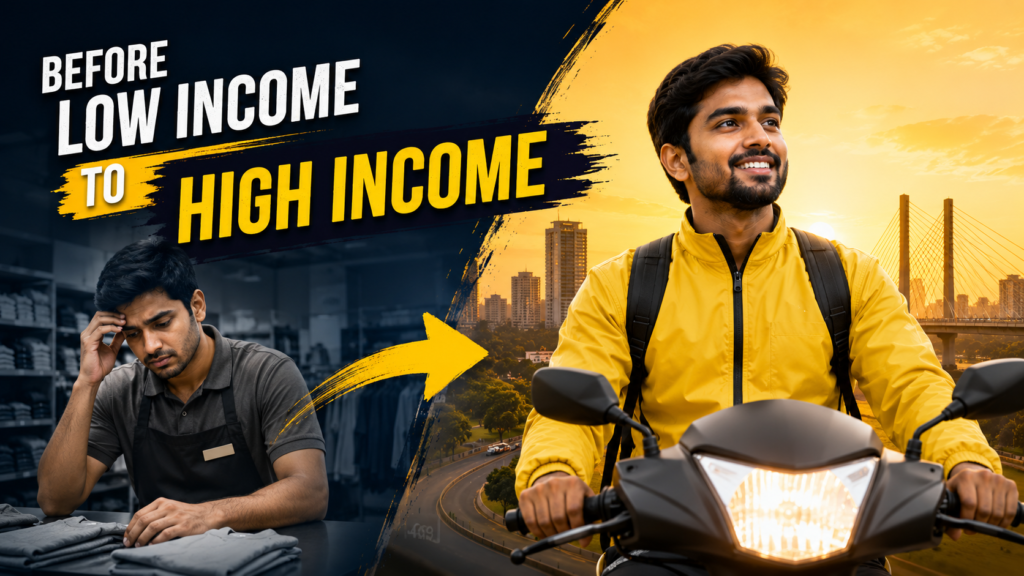
Rajesh’s story is a retail worker delivery partner success story we hear in some form from almost every city we recruit in — the details change, but the shape of it stays the same. This isn’t a verified individual case study; it’s an illustrative profile, but it isn’t invented from imagination either. It’s built from the sourced numbers already documented on this site plus real, reported accounts of retail-adjacent workers who made this exact move.
Note on this story: “Rajesh” is a representative composite, not a named, independently verified individual. His numbers come from the sourced 2026 salary data in our Retail Sales Job vs Delivery Partner Salary comparison. The shape of his story draws on two real, citable sources: Newslaundry’s 2021 reporting on Mumbai delivery riders, which interviewed a former mall duty manager who switched to Swiggy, and IDinsight’s 2023 survey of over 2,500 delivery riders across Indian cities on why they joined platform work. We link both below.
The Starting Point: A Fixed Wage With No Ceiling in Sight
Rajesh worked the floor at an electronics showroom in Pune for close to three years. Like most retail sales staff, his pay sat in the typical ₹16,000–25,000/month range — closer to the middle of that band, after a small annual bump that never quite kept pace with rent and fuel costs. Full-day shifts, mandatory weekend duty during sale season, and a promotion track to team lead that had been “under review” for over a year.
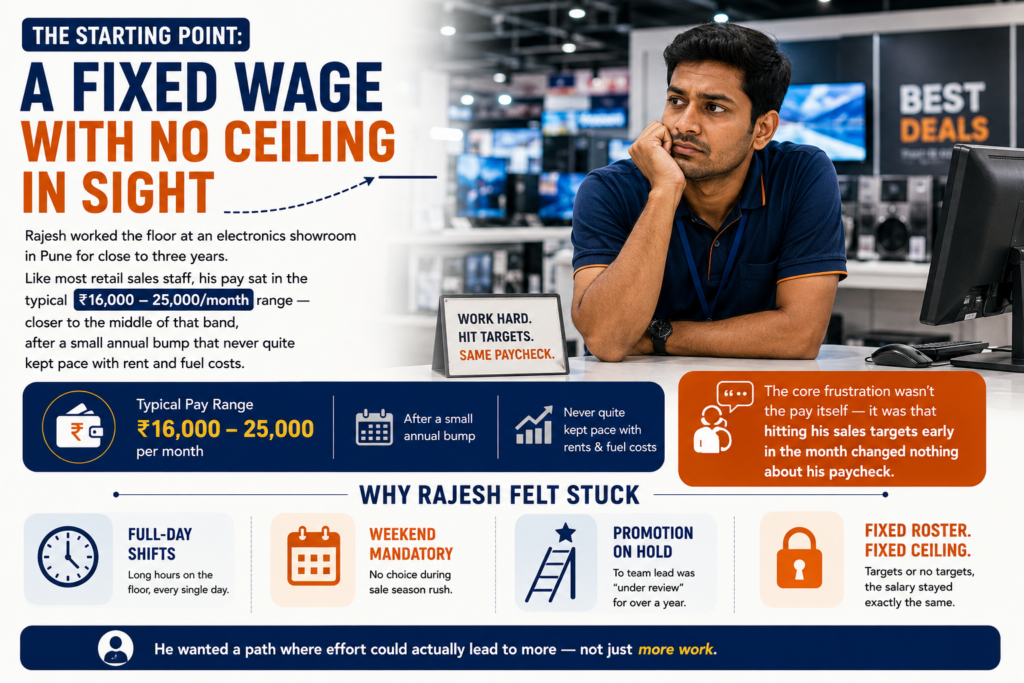
The core frustration wasn’t the pay itself — it was that hitting his sales targets early in the month changed nothing about his paycheck. The roster stayed fixed. The ceiling stayed fixed.
Why Riders Like Rajesh Consider the Switch
Many retail workers who make this move describe the same tipping point: realizing that a job with no upside caps how much overtime effort is even worth putting in. Delivery partner income works structurally differently — pay is per completed order rather than per shift, currently running ₹15–35 per order depending on platform and distance, with short-distance Blinkit and Zepto orders typically at the higher end. See current Blinkit and Zomato payout pages for city-specific rates.
This isn’t just a pitch — it shows up in real accounts. Prakash, a Swiggy rider in Mumbai who’d previously worked as a duty manager at a mall before losing that job, told Newslaundry in 2021 that per-order pay is exactly what he counts on — and what platforms can quietly cut: “If we don’t do this for Rs 20, they will find someone who can do the same for Rs 15.” It’s a blunter picture than a marketing pitch: per-order pay rewards hustle, but rates move, which is why this site links current per-order and per-city numbers instead of a flat promise.
For someone like Rajesh, that meant the extra effort he was already putting in at the store — the reliability, the customer-facing patience — could translate directly into more income once applied to a job structure that actually rewards hours worked.
The First Month: Part-Time, Then Full-Time
Most retail staff who switch well don’t quit on day one. A common pattern — and one that fits Rajesh’s story — is starting part-time: early mornings or evenings after the store shift, for a week or two, to see what a specific city zone actually pays before committing fully.
After validating real local earnings over roughly two to three weeks, many riders in Rajesh’s position move to full-time hours. At that point, the sourced full-time metro take-home of ₹25,000–30,000/month (see the delivery partner earnings breakdown for how riders build toward the higher end) starts to clear his old retail wage by a meaningful margin — which is where “doubled his income” comes from for riders starting near the bottom of the retail pay band and reaching the top of the metro delivery range.
What Actually Changed
- Income ceiling: Retail pay stayed fixed regardless of effort. Delivery pay scales with active hours and completed orders.
- Schedule control: No more fixed store roster — Rajesh set his own working windows around peak order times.
- Skills that transferred: Customer-facing habits from retail — politeness, reliability, handling complaints calmly — carried over directly, since delivery partner ratings affect order allocation and incentives.
- What didn’t change immediately: No formal appointment letter, no employer-provided PF. Riders in this position typically register on the government’s e-Shram portal (register.eshram.gov.in) to access accident insurance and other unorganized-worker benefits — see our government schemes for delivery partners guide for the full list.
Is This Realistic for Every Retail Worker?
Not automatically — the metro-level income jump assumes consistent full-time hours and a city with strong order demand. Tier-2/3 cities see a smaller but still real gap, with realistic delivery take-home around ₹12,000–15,000/month, closer to or slightly above typical retail pay rather than double it.
Worth being upfront about: IDinsight’s 2023 survey of over 2,500 Indian delivery riders found most people join platform work out of economic necessity (57%) rather than because it clearly out-earns what they had — and many riders surveyed said their previous formal job had actually paid more than platform work does. That’s the honest counterweight to any “doubled income” story: the upside is real for someone who can commit consistent full-time hours in a strong-demand city, the way Rajesh’s numbers assume, but it isn’t automatic, and it isn’t every rider’s experience. The honest takeaway isn’t “everyone doubles their income” — it’s that delivery income has no structural ceiling the way a retail wage does, and how far it goes depends on your city, hours, and consistency.
For the full numbers behind this story, see Retail Sales Job vs Delivery Partner Salary: Which Pays More in 2026?, or the broader Blue-Collar to Delivery Partner Career Switch Hub for warehouse, hotel, and construction comparisons too.
Frequently Asked Questions
Is this a real, verified individual’s story?
No — “Rajesh” is a representative, illustrative profile, not a verified account from one named individual. It’s built on real, sourced 2026 salary data plus real reported accounts of retail-adjacent workers who made this switch, including Newslaundry’s 2021 interview with a Mumbai mall duty manager turned Swiggy rider and IDinsight’s 2023 survey of over 2,500 Indian delivery riders. It’s meant to show a realistic, sourced pattern, not report one specific case.
How long does it typically take to see a real income difference?
Most retail staff who switch validate real local earnings within 1–2 weeks of part-time riding before deciding to go full-time. A full month of consistent hours gives the clearest picture of your actual monthly take-home.
Do retail skills actually help as a delivery partner?
Yes — customer-facing habits like politeness and reliability transfer well, since delivery partner ratings directly affect order allocation and incentive eligibility.
What’s the realistic income range, not just the best case?
Full-time delivery partner take-home runs ₹25,000–30,000/month in metros and ₹12,000–15,000/month in Tier-2/3 cities, against typical retail pay of ₹16,000–25,000/month — see the full comparison for the complete breakdown.
How do I start if my situation looks like this?
Apply online, get document-verified (typically 24–48 hours), and most applicants are completing orders within 3 days — many while still working out notice at their retail job.
Ready to See What You’d Actually Earn?
Rajesh’s numbers are illustrative, but the underlying math is real and sourced. Apply to become a delivery partner and find out what the switch looks like for your city and hours.