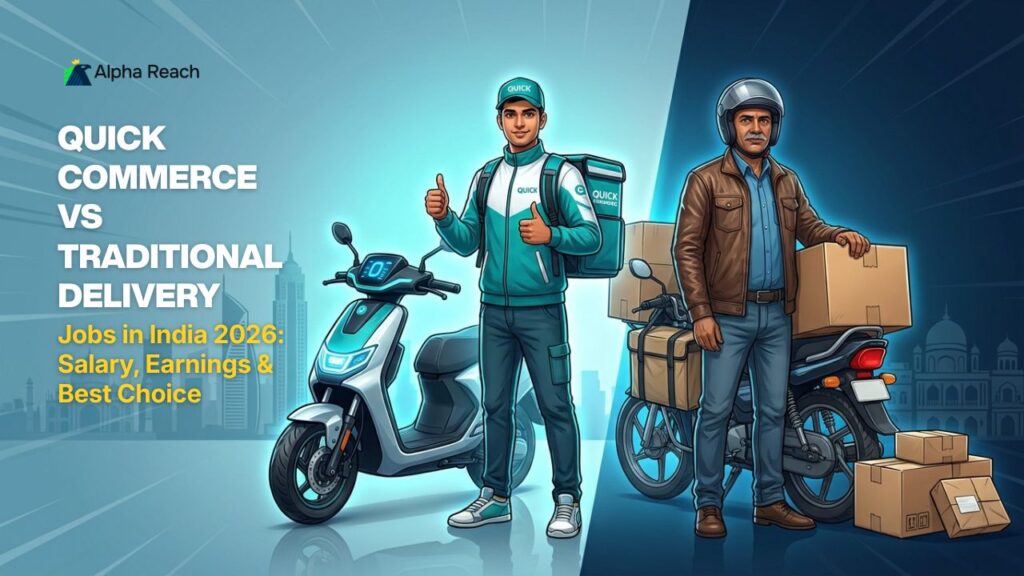
Quick commerce vs Traditional Delivery is the most frequent question young job seekers ask in 2026. With India’s gig economy projected to contribute over ₹2.35 lakh crore to the GDP by 2030, the delivery sector has split into two massive worlds. Whether you are looking for a rider job in Delhi, a delivery partner role in Bangalore, or a van driver job in Mumbai, choosing between 10-minute “Quick Commerce” and 24-hour “Traditional Delivery” will define your monthly take-home pay and work-life balance.
In this deep dive, we compare the latest 2026 trends, salary structures, and hidden challenges to help you find the highest-paying gig work in India today.
What exactly is the Difference? (The 2026 Landscape)
What is Quick Commerce (Q-Commerce)?
Quick Commerce is all about ultra-fast speed. Platforms like Blinkit, Zepto, Swiggy Instamart, and Flipkart Minutes deliver groceries and electronics within 10–20 minutes. They operate through “Dark Stores”—small warehouses hidden in every neighborhood (like Indiranagar in Bangalore or Rohini in Delhi).
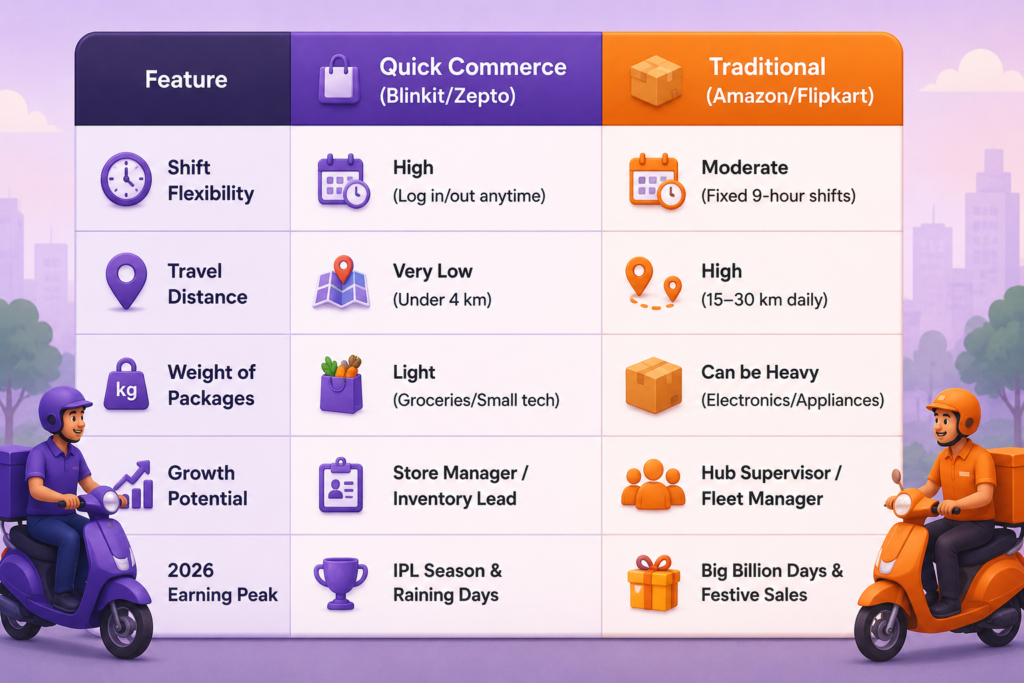
- The Job: You stay near one dark store and deliver within a 2–4 km radius.
What is Traditional Delivery?
This is the classic E-commerce model used by Amazon, Flipkart, and BlueDart. These services handle everything from heavy furniture to mobile phones, with delivery times ranging from 4 hours to 3 days.
- The Job: You pick up a large batch of orders from a central hub and follow a long route across the city.
Salary & Earning Potential: The 2026 Reality Check
In 2026, delivery earnings are no longer just “fixed salaries.” They are a mix of base pay, per-order fees, and performance incentives.
Quick Commerce Earning Structure
Because Q-commerce relies on high volume, you can finish more orders in less time.
- Average Earnings: ₹28,000 – ₹48,000 per month.
- Per-Order Rate: ₹25 – ₹55 (varies by city and time).
- Peak Incentives: Massive bonuses during breakfast (7 AM – 10 AM) and late-night snacks (9 PM – 12 AM).
- 2026 Trend: Many riders in Hyderabad and Pune now use Electric Cycles (EVs) provided by the company, saving ₹4,000 – ₹6,000 on petrol monthly.
Traditional Delivery Earning Structure
Traditional models offer more “stability” but fewer “bursts” of high income.
- Average Earnings: ₹22,000 – ₹35,000 per month.
- Per-Delivery Rate: ₹15 – ₹30 per parcel (but you deliver 40–60 parcels in one go).
- Bonus: Reliability and attendance bonuses (e.g., ₹2,000 for not taking a leave during the Diwali sale).
👉 Limited Openings in 2026! High-demand delivery roles are filling up in Delhi NCR and Bangalore. Apply now on AlphaReach to lock in your spot!
Comparison Table: Quick Commerce vs Traditional Delivery
City-Wise Scope: Where Should You Work?
The demand for rider jobs and delivery partner vacancies depends heavily on your location.
1. Bangalore & Hyderabad (The Tech Hubs)
- Top Choice: Quick Commerce.
- Why: These cities have the highest density of dark stores. You will never sit idle. Earning ₹1,500/day is very common here.
2. Delhi, Gurgaon, & Noida (The High-Volume Zone)
- Top Choice: Both.
- Why: Delhi NCR has the largest e-commerce warehouses in India. If you prefer a long-distance bike ride with fewer stops, traditional delivery is great here.
3. Mumbai (The Traffic Challenge)
- Top Choice: Quick Commerce (on Electric Cycles).
- Why: Mumbai traffic makes long-distance delivery difficult. Q-commerce allows you to navigate small “gallis” and finish more orders locally.
4. Tier 2 Cities (Jaipur, Lucknow, Patna)
- Top Choice: Traditional Delivery.
- Why: Q-commerce is still expanding. E-commerce platforms like Meesho and Amazon have a stronger presence here for now.
The 2026 Gig Worker Benefits & Safety
A major update in 2026 is the Code on Social Security.
- Insurance: Most platforms now offer accidental insurance of up to ₹5–10 Lakhs.
- Health Benefits: After 90 days of work, many riders qualify for basic health checkups and OPD discounts.
- Safety AI: Algorithms in 2026 are smarter. They no longer penalize you for traffic delays, reducing the “rush” and accidental risks.
For official updates on gig worker rights, you can check the Ministry of Labour & Employment website.
How to Apply: A Step-by-Step Guide
If you are ready to start, don’t just walk into a warehouse. Use a professional platform to avoid scams and ensure you get your joining bonus.
- Register on AlphaReach: Create your profile with your name and city.
- Upload Documents: You need an Aadhaar card, PAN card, and bank details (for payouts).
- Choose Your Vehicle: Mark if you have a Bike, Electric Scooter, or Cycle.
- Complete the KYC: Some platforms do a quick video-based background check.
- Get Your Kit: Collect your bag and T-shirt from the nearest hub and start earning within 24 hours!
Conclusion: Final Verdict
If you love the “hustle,” short trips, and frequent payouts, Quick Commerce (Blinkit/Zepto) is your best bet in 2026. If you want a more structured day with a fixed route and less “10-minute” pressure, go with Traditional Delivery (Amazon/Flipkart).
The delivery sector is the fastest way to start earning today without a degree.
🚀 High Paying Rider Jobs are Live! Don’t wait for the slots to fill up. Thousands of riders are joining the 2026 delivery revolution.
👉Click here to Apply now on AlphaReach and start earning tomorrow!