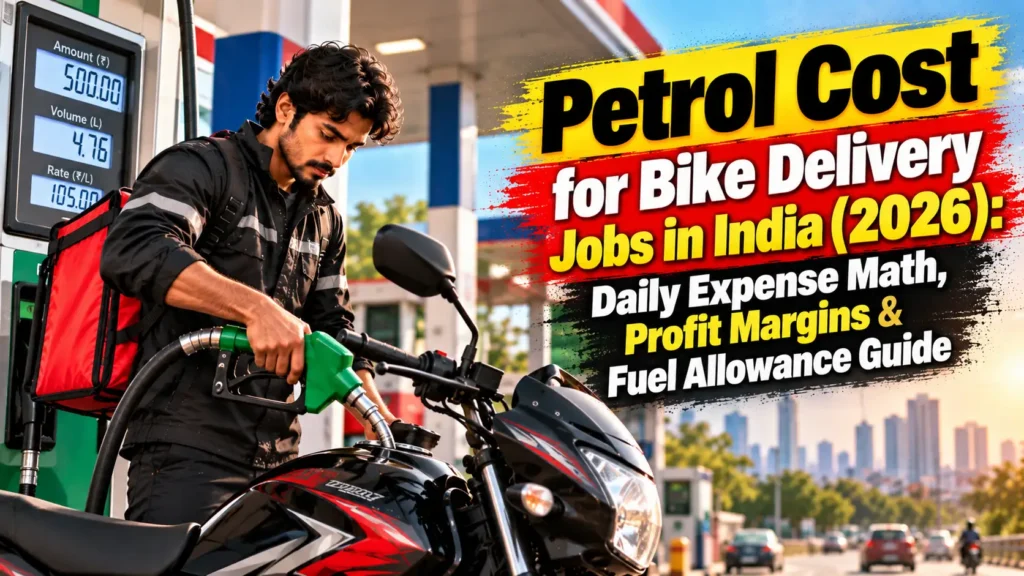
In modern India’s rapidly growing on-demand delivery economy, calculating and managing the petrol cost for bike delivery jobs is the most vital financial skill every delivery executive must master. When delivering food for Zomato and Swiggy, fulfilling 10-minute grocery drops for Blinkit and Zepto, or distributing parcels for Shadowfax and Delhivery, fuel expense represents the single largest operational cost subtracted from gross daily payouts. With petrol prices averaging between ₹95 and ₹105 per liter across Indian cities, a delivery rider covering 80 to 120 kilometers daily can easily spend ₹3,500 to ₹5,500 every month on fuel alone. In 2026, understanding how platforms calculate distance pay, how fuel allowances are credited, and how bike fuel efficiency directly impacts your net bank take-home is the difference between thriving financially or merely breaking even. If you are ready to turn your motorcycle into a profitable income asset with verified, high-volume delivery beats, you can explore verified delivery partner jobs on AlphaReach to locate top hiring hubs in your area today.
Navigating delivery fuel economics requires distinguishing between raw gross earnings and true net operating profit. Many first-time gig workers see gross daily payouts of ₹1,000 to ₹1,200 and assume the entire amount is take-home income, only to find their bank accounts depleted after refueling their petrol tanks every other day. Professional riders treat their motorcycle like a commercial transport business: they track kilometers logged per shift, measure fuel consumed down to the milliliter, and optimize their delivery radius to maximize pay per kilometer traveled. By choosing a high-mileage commuter bike and leveraging platform distance multipliers, disciplined riders keep their fuel overhead under 15% of gross earnings.
Under petroleum distribution regulations and consumer transport advisories published by the Petroleum Planning and Analysis Cell (PPAC), fuel prices fluctuate based on international crude oil benchmarks and domestic tax duties, reinforcing the need for delivery workers to budget fuel costs proactively. In this comprehensive 2026 fuel expense handbook, we break down real-world daily petrol math across major delivery sectors, analyze platform fuel reimbursement models, contrast part-time versus full-time fuel burn, and provide actionable techniques to maximize net earnings per liter of petrol.
The 5 Structural Drivers of Daily Petrol Expenses in Delivery Work
A delivery rider’s daily fuel bill is determined by five primary operational variables:
- Daily Distance Traveled (Commercial Mileage): A part-time rider (4 hours) typically logs 40 to 60 km daily, while a full-time delivery partner (8 to 10 hours) covers 80 to 120 km daily across customer drops, pickup runs, and deadhead return miles.
- Vehicle Fuel Economy Under Load: A frugal 100cc commuter motorcycle (68 to 72 km/l) burns roughly 1.3 liters of petrol for an 80 km shift, while a 110cc automatic scooter (48 to 52 km/l) consumes 1.8 liters for the exact same distance.
- ‘Deadhead’ Unpaid Travel Kilometers: Driving back from a remote suburban customer drop to your base commercial zone without an active order burns uncompensated petrol. Keeping deadhead riding under 15% of total shift mileage is critical for profitability.
- Traffic Congestion & Stop-and-Go Intensity: Crawling through dense evening peak traffic burns up to 25% more fuel per kilometer than cruising along suburban arterials or peripheral bypass roads.
- Local City Petrol Retail Prices: Retail petrol prices vary across Indian states due to differential state Value Added Tax (VAT), ranging from ~₹94/L in union territories to ~₹105/L in higher-tax metro regions.
Daily, Weekly & Monthly Petrol Expense Matrix Across Delivery Formats (2026)
To understand the true cost of fuel across different work schedules and vehicle models (based on ₹100/liter petrol), examine the detailed expense matrix below:
| Delivery Schedule & Vehicle Type | Daily Distance (km) | Real-World Mileage (km/l) | Daily Petrol Cost (₹) | Weekly Petrol Cost (6 Days) (₹) | Monthly Petrol Cost (26 Days) (₹) |
| Part-Time Evening (100cc Commuter Bike) | 45 km | 70 km/l | ₹64 | ₹384 | ₹1,664 |
| Part-Time Evening (110cc Automatic Scooter) | 45 km | 50 km/l | ₹90 | ₹540 | ₹2,340 |
| Full-Time 8-Hr Shift (100cc Commuter Bike) | 85 km | 68 km/l | ₹125 | ₹750 | ₹3,250 |
| Full-Time 8-Hr Shift (110cc Automatic Scooter) | 85 km | 48 km/l | ₹177 | ₹1,062 | ₹4,602 |
| Full-Time 10-Hr Peak Rider (100cc Commuter) | 115 km | 68 km/l | ₹169 | ₹1,014 | ₹4,394 |
| Full-Time 10-Hr Peak Rider (125cc Bike) | 115 km | 58 km/l | ₹198 | ₹1,188 | ₹5,148 |
★ High-Paying Delivery Fleet Opportunities: Are you seeking high-paying delivery partner jobs with competitive weekly earnings, fuel distance allowances, same-day onboarding, and flexible shifts? explore verified delivery partner jobs on AlphaReach to discover immediate vacancies across top quick-commerce dark stores, food delivery platforms, and courier hubs in your city today.
How Delivery Platforms Compensate Fuel: Distance Pay & Surcharges
Delivery aggregators do not pay separate fuel allowances; instead, fuel costs are factored directly into algorithm-driven payout rate cards:
- Base Delivery Pay + Distance Pay: Most platforms (like Zomato and Swiggy) pay a base fee (e.g., ₹25 for the first 2 km) plus a variable distance pay of ₹6 to ₹8 per additional kilometer. Since a 70 km/l bike costs roughly ₹1.45 per km in petrol, every extra kilometer earned at ₹7/km yields a healthy ₹5.55/km gross margin.
- Long-Distance Surcharges: Deliveries exceeding 6 to 8 km from the restaurant or dark store trigger special long-distance surge multipliers (+₹15 to +₹35), ensuring partners are fairly compensated for higher fuel burn.
- Return Surge Allowances: When riders deliver to sparsely populated outer suburban sectors with low order density, select platforms add a ‘Return Distance Allowance’ (₹4 to ₹6/km) to subsidize the fuel required to ride back to the commercial cluster.
Net Income Math: Gross Earnings vs. Fuel Expense Case Study
To see how managing fuel costs transforms monthly take-home earnings, review this real-world comparison of two full-time delivery riders working identical 8-hour shifts (26 days, 2,210 km total):
- Rider A (Riding a 70 km/l Hero Splendor):
- Gross Monthly Earnings: ₹28,500.
- Monthly Petrol Consumed (2,210 km / 70 km/l = 31.5L at ₹100/L): ₹3,150.
- Routine Maintenance (Oil change, chain lube): ₹400.
- Net Monthly In-Hand Income: ₹28,500 – ₹3,550 = ₹24,950.
- Rider B (Riding an older 45 km/l 150cc Sports Bike):
- Gross Monthly Earnings: ₹28,500.
- Monthly Petrol Consumed (2,210 km / 45 km/l = 49.1L at ₹100/L): ₹4,910.
- Routine Maintenance (Higher spare costs): ₹650.
- Net Monthly In-Hand Income: ₹28,500 – ₹5,560 = ₹22,940.
- The Result: Rider A takes home an extra ₹2,010 in clear profit every single month—amounting to over ₹24,000 in additional annual bank savings for the exact same physical delivery effort!
Top 5 Tactical Strategies to Slash Daily Fuel Expenditure
Top-earning delivery executives use these five operational tactics to maximize earnings per liter:
- Target High-Density Quick-Commerce Dark Stores: Quick-commerce grocery delivery (Zepto, Blinkit) operates within tight 2 to 3 km delivery radii, allowing you to complete 25 to 30 orders with just 50 to 60 km of total daily riding, cutting fuel spend in half.
- Avoid Roaming While Waiting for Pings: Do not ride aimlessly around the city searching for orders. Park in the shade near high-volume cloud kitchen clusters with the engine off while awaiting dispatch alerts.
- Maintain 40 to 50 km/h Cruising Speeds: Speeding between delivery drops wastes fuel without saving meaningful time. Riding at 45 km/h rather than 65 km/h improves mileage by up to 20%.
- Use Fuel Credit Cards or UPI Cashback Apps: Refuel using UPI apps (like Google Pay or Paytm) or co-branded fuel cards (like IndianOil / BPCL cards) that offer 2% to 4% cashbacks and reward points on petrol spends.
- Keep Tires Properly Inflated (Check Every 5 Days): Under-inflated tires increase road friction, wasting up to ₹300 in unnecessary petrol every month. Maintain recommended PSI rigorously.
★ Maximize Your Delivery Earnings Today: Ready to maximize your delivery income, optimize your vehicle running costs, and achieve financial independence with top platform fleets? apply as a verified delivery partner on AlphaReach to access fast onboarding, guaranteed shift schedules, and priority route dispatches today.
Frequently Asked Questions (FAQs)
How much does a food delivery boy spend on petrol every day in India?
A food delivery boy working a full-time 8 to 10-hour shift (covering 80 to 100 km daily) typically spends between ₹120 and ₹150 per day on petrol when riding a high-mileage commuter bike (68-72 km/l). On a less efficient bike or scooter (45-50 km/l), daily petrol costs rise to ₹180 to ₹220 per day.
Do delivery companies like Zomato and Swiggy pay extra money for petrol?
Delivery platforms do not pay a separate direct petrol allowance; instead, petrol costs are incorporated directly into the per-kilometer distance pay. Platforms pay a base fee plus ₹6 to ₹8 for every kilometer traveled beyond the base pickup distance. Because a fuel-efficient bike costs around ₹1.50/km in fuel, the distance pay comfortably covers petrol while generating profit.
Is quick-commerce delivery better for saving petrol than food delivery?
Yes, quick-commerce grocery delivery (Blinkit, Zepto, Swiggy Instamart) is significantly more fuel-efficient. Dark stores operate within tight 2 to 3 km hyper-local delivery radii, meaning you complete 25 to 35 drops with only 50 to 65 km of total daily travel. Food delivery often involves longer 5 to 8 km runs with higher total fuel burn.
How can I track my daily fuel costs accurately as a gig worker?
Use the full-tank method: fill your petrol tank to full, reset your bike’s trip meter to zero, and ride for 2 to 3 shifts. When refilling to full again, divide the total money spent on petrol by the kilometers logged. This gives your exact cost per kilometer, allowing you to budget accurately against daily app payouts.
Does switching to an electric vehicle eliminate delivery fuel costs entirely?
Yes. Switching to an electric scooter reduces your daily energy cost by 75% to 80%. Instead of spending ₹120 to ₹150 daily on petrol, charging an EV at domestic electricity rates costs just ₹25 to ₹35 per day for 80 to 100 km of range, instantly saving ₹2,500 to ₹3,500 every month.
Conclusion
Managing petrol cost for bike delivery jobs in 2026 is the single most critical financial competency for anyone seeking sustainable success in India’s gig logistics economy. In an industry where fuel represents up to 15% to 20% of gross earnings, treating petrol consumption with business discipline directly dictates how much money you take home to your family at the end of each month.
By choosing an ultra-efficient 100cc to 110cc commuter motorcycle, minimizing empty deadhead riding miles, adopting smooth 40 to 50 km/h cruising habits, and leveraging platform distance multipliers, you transform fuel expense from an uncontrollable leak into a tightly managed operational budget. In the delivery game, every rupee saved on petrol is a rupee added directly to your personal wealth.