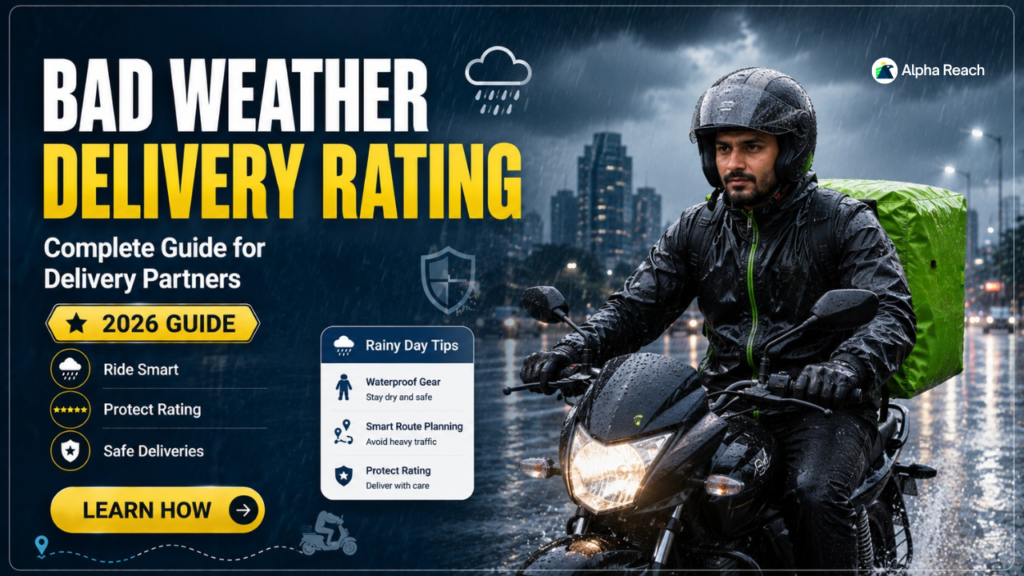
Maintain Delivery Rating in Bad Weather – Every experienced delivery rider knows that weather is the great equalizer. It doesn’t care about your daily targets, your weekly bonuses, or your status as a “Top Rider.” A monsoon downpour can flood the roads, and a heatwave can turn your bike into a furnace, all while customer expectations for 10-minute delivery remain unchanged.
The biggest fear for a rider during these conditions isn’t just the physical toll—it’s the potential for a low rating. You know the customer is watching their app, hungry or in need, and they may not realize that the road is flooded or traffic has come to a standstill. However, you do not have to choose between your safety and your rating.
This guide is designed to help you balance weather delivery safety with high service standards, showing you exactly how to manage traffic delay customer ratings and turn challenging conditions into an opportunity to demonstrate professionalism.
> If you’re looking for flexible delivery earning opportunities, you can apply for delivery partner jobs on AlphaReach and explore roles that match your preferred city and working hours.
The Safety-First Mindset: Your Rating Is Not Worth Your Life
Before discussing tactics for delivery during rain tips or heat management, we must establish a non-negotiable principle: Your safety is the foundation of your career. A low rating can be recovered, but an accident can end your earning capability permanently.
When the weather turns, your pace will slow down. This is physics and reality. Customers, when informed, are far more empathetic to a late delivery due to a thunderstorm than they are to a delivery that arrives while the rider is injured or traumatized. Never take unnecessary risks like driving through deep water or speeding on slick roads just to save two minutes.
The “Rating Shield”: Proactive Communication
The primary reason riders receive low ratings during bad weather is a lack of communication. If a customer is left staring at an app that says “Arriving in 5 minutes” for half an hour, their anxiety turns into anger.
Your goal is to eliminate the “unknown.” By using customer communication tips early and often, you can effectively prevent the “late delivery” frustration.
1. The Pre-Delay Notification
If you know the weather is deteriorating or traffic is building up, do not wait until you are late to send a message. As soon as you accept an order in bad weather:
- Message Template: “Hi! I have accepted your order. Please note that there is [heavy rain/severe traffic] in the area, so my travel time may be slightly longer than usual. I am driving carefully to ensure your order arrives safely. Thank you for your patience!”
- Why it works: You have set an expectation before they even get a chance to get angry. By explicitly mentioning “driving carefully,” you invoke empathy—most customers will feel guilty for even thinking about complaining after reading that.
2. The “Update” during Transit
If you are stuck in traffic or waiting for shelter to pass during a storm:
- Message Template: “Hi again! I’m currently stuck in [traffic/heavy rain] on [Street Name/Area]. I’m monitoring the road and will be moving as soon as it is safe to do so. Your order is secure in my thermal bag. I apologize for the wait!”
- Why it works: You reassure them that the food is safe (thermal bag mention) and that you are actively monitoring the situation.
Tactical Tips for Specific Weather Conditions
Different weather challenges require different strategies to maintain a high rider rating.
Handling Delivery During Rain (The Monsoon Strategy)
- Waterproof Everything: Invest in high-quality waterproof covers for your phone and bag. If a customer opens the door to find their package soaked because you didn’t have a cover, they will blame you for negligence.
- The “Dry Drop” Rule: If you are doing a contactless delivery, do not place the package in a puddle or under a leaky drain. Find a dry, sheltered spot, take the photo, and if the area is completely wet, consider bagging the package in an extra plastic bag. A dry package in the rain is the ultimate sign of a 5-star professional.
- Be Realistic with ETA: If the rain is severe, always add a 5-10 minute “weather buffer” to your estimated arrival time when messaging the customer. It is better to arrive 5 minutes early than 2 minutes late.
Handling Delivery During Heatwaves
- The “Cold/Hot Integrity” Rule: When it’s 40°C+ outside, your thermal bag is your best friend. Ensure it is zipped completely. The customer will appreciate that their drink is still cold or their meal is still hot despite the heat outside.
- Take Care of Yourself: Dehydration causes mental fatigue, which leads to poor decision-making on the road. If you need to stop for water, make a quick, 2-minute stop. A hydrated, alert rider is safer and more efficient.
Managing Traffic Delays and Road Closures
- Use the In-App “Report Delay” Button: Most platforms have an option in the app to report “Restaurant Delay” or “Traffic Delay.” Always use this. This creates a digital record. If a customer gives you a one-star rating for a late delivery, the platform’s algorithm will often cross-reference your “Traffic Delay” report and automatically filter out the negative review, protecting your score.
- Know the Detours: If you are a local lucknow driver or operating in any large city, learn the inner lanes. When main roads are blocked due to VIP movement or construction, these “internal” routes are your secret weapon.
Handling the “Traffic Delay Customer Rating” Conflict
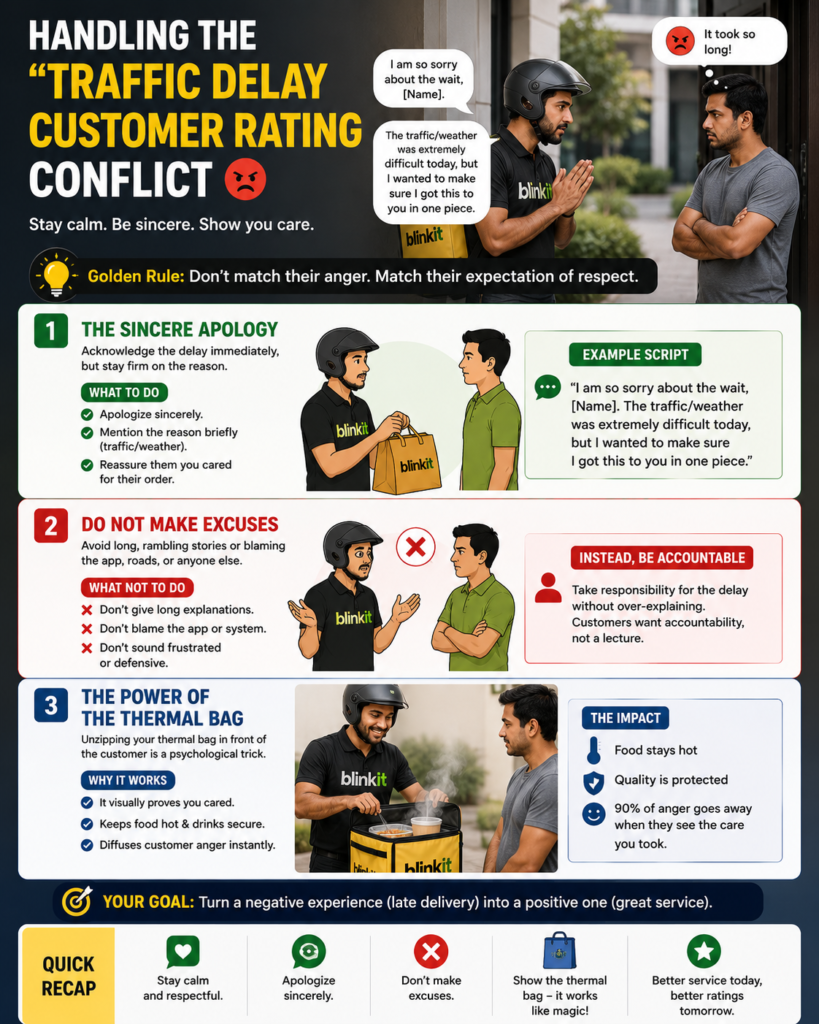
If a customer is already angry when you arrive at their door, do not match their energy.
- The Sincere Apology: Acknowledge the delay immediately, but stay firm on the reason. “I am so sorry about the wait, [Name]. The traffic/weather was extremely difficult today, but I wanted to make sure I got this to you in one piece.”
- Do Not Make Excuses: Avoid long, rambling stories about how bad the roads are or how “the app is broken.” Customers want accountability, not a lecture.
- The Power of the Thermal Bag: Unzipping your thermal bag in front of the customer is a psychological trick. It visually proves that you cared for their order. Even if the delivery was late, seeing the steam come off the food or the condensation on a cold drink diffuses 90% of customer anger.
The “What Not To Do” List
To ensure your weather delivery safety and rating remain intact, avoid these common errors:
- Don’t ever lie about your location: If you are stuck in traffic, don’t say you are “just around the corner.” The customer is likely watching your live GPS map. If they see you aren’t moving, they will mark you as a liar, which is a guaranteed 1-star rating.
- Don’t ignore the chat: Even if you are busy, a 10-second text reply when you stop at a signal can save your rating.
- Don’t compromise your vehicle’s health: Driving through deep water can destroy your engine. If the road is flooded, stop. Contact rider support, explain the situation, and let them know the route is impassable. It is much better to have an order cancelled for safety reasons than to have a broken-down bike and a stranded order.
How to Leverage Platform Safety Features
Modern delivery platforms have invested millions into safety algorithms. You need to leverage them:
- In-App Safety Reports: If a road is closed or blocked, report it via the app. Platforms use this data to update maps for all riders in the area.
- Contact Support Early: If a storm is so severe that you truly cannot continue, contact support before you abandon an order. They have protocols for “Rider Safety First.” When you follow these, your account health remains protected.
> Ready to start earning as a delivery partner? Explore delivery partner opportunities on AlphaReach and find flexible delivery jobs that fit your schedule.
Frequently Asked Questions About Maintain Delivery Rating in Bad Weather (FAQs)
Q1: What if the app gives me a penalty for being late due to rain?
Ans: If the platform penalizes you unfairly for a weather-related delay, contact rider support immediately. Provide them with the order ID and mention that the route was severely impacted by weather. Most platforms have a policy to review and reverse unfair penalties if there is proof of extreme weather in the area.
Q2: Should I ask the customer for a 5-star rating if the delivery was delayed due to weather?
Ans: No. Asking for a rating after a stressful, delayed delivery often highlights the problem to the customer and can backfire. Let your professional conduct speak for itself. A genuinely satisfied customer will rate you without being asked.
Q3: Is it better to cancel the order if the weather is too dangerous?
Ans: If the weather is life-threatening (like a severe cyclone or major flooding), your life is more important than an order. Contact support immediately, explain that the conditions are unsafe to continue, and ask them to reassign the order. Prioritizing safety is a standard that professional riders should always follow.
Conclusion
Managing a high rating in bad weather isn’t about driving faster; it’s about managing the customer’s emotions and protecting yourself through documentation. By being proactive, honest, and safety-conscious, you transform the perception of the delivery. You stop being a “late delivery guy” and start being a “resilient partner who braved the storm to get me my food.”
Customers are humans. If you treat them with the same respect you want them to have for your safety, they will almost always be kind in return. Stay dry, stay cool, stay safe, and let the rating take care of itself.