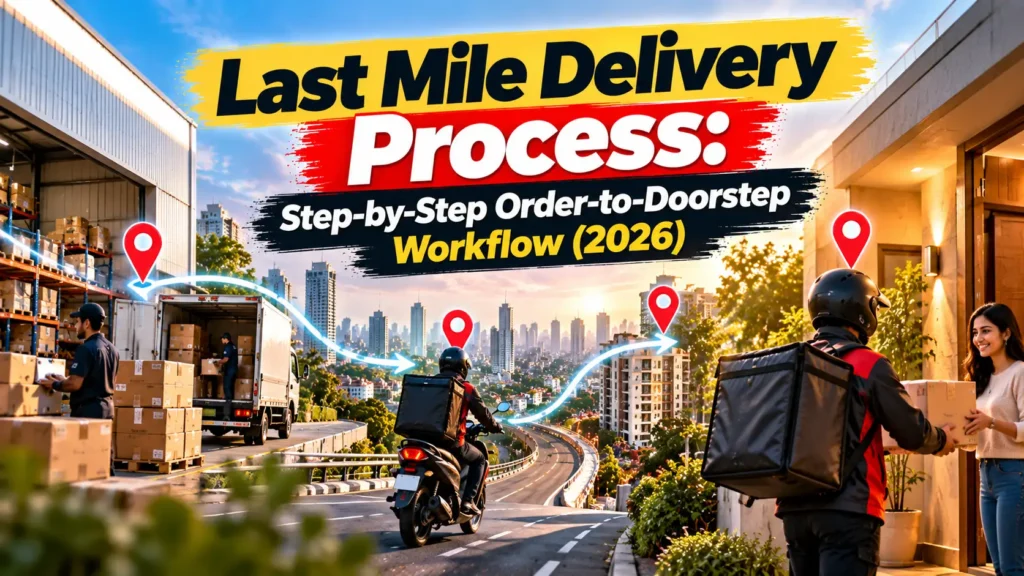
Every time a consumer taps ‘Place Order’ on a smartphone screen, an intricate, finely tuned operational symphony begins behind the scenes. From that initial digital click to the moment a delivery rider rings the doorbell with a neatly packed parcel, the last mile delivery process executes a rapid series of synchronized actions designed to eliminate friction, minimize transit time, and guarantee package safety. While the entire journey may take only ten minutes in quick commerce or a few hours in express e-commerce, the underlying workflow relies on automated data exchange, real-time algorithmic dispatching, physical inventory handling, and strict verification protocols. If you are exploring career opportunities across this dynamic operational workflow, you can explore verified logistics and delivery operations jobs on AlphaReach to find immediate-joining roles across leading Indian fleets today.
Understanding the step-by-step mechanics of last-mile fulfillment is essential for logistics professionals, e-commerce entrepreneurs, operations managers, and frontline delivery personnel alike. Each phase in the workflow—from order ingestion and warehouse sorting to route clustering, dispatch, and final proof of delivery—contains vital checkpoints that dictate whether an order succeeds or results in costly delays.
In modern India, where multi-tenant dark stores and high-density apartment clusters dominate the consumer landscape, the last-mile process has evolved into a masterclass in operational efficiency. In this detailed 2026 operational handbook, we dissect the five core stages of the last-mile delivery workflow, map out critical technological touchpoints, examine real-world contingency handling, and reveal the operational metrics that define world-class execution.
Stage 1: Order Ingestion, Validation, and Inventory Allocation
The last-mile delivery process initiates the precise millisecond a customer completes checkout on an e-commerce platform or quick-commerce mobile application. The order management system (OMS) ingests the transaction payload, verifying payment authentication, billing details, and delivery address formatting.
Instantly, the system cross-references the destination pincode against the platform’s micro-fulfillment network to identify the optimal dispatch node. In quick commerce, this node is a hyper-local dark store situated within 2 to 3 kilometers of the customer. In traditional e-commerce, it is a city delivery station (last-mile hub) that received consolidated line-haul shipments overnight.
Once the appropriate node is identified, automated inventory allocation occurs. The warehouse management system (WMS) locks the purchased Stock Keeping Units (SKUs) in real time to prevent double-selling. If any SKU is out of stock, automated logic flags the discrepancy immediately, triggering either alternate hub fulfillment or instant customer notification, ensuring that downstream picking workflows proceed without inventory discrepancies.
Stage 2: Dark Store Picking, Quality Inspection, and Staging
Once inventory is allocated at the local hub, the physical fulfillment process begins. In high-speed environments such as quick-commerce dark stores, this entire stage is engineered to execute in under two to three minutes through automated pick-lists delivered to warehouse associates’ handheld scanning devices.
Pickers navigate optimized warehouse aisles organized by velocity: high-demand items (like milk, bread, and fresh snacks) are positioned near packing stations, while slower-moving SKUs occupy deeper shelving. The picker scans each item’s barcode to verify product accuracy and batch expiry dates, eliminating incorrect dispatches.
The items are then transferred to the packing and staging station. Here, packers separate cold, perishable goods into insulated thermal sleeves, place fragile items in cushioned packaging, and seal the parcel inside a tamper-evident delivery bag affixed with a scannable dispatch QR code. The sealed parcel is placed in an outbound staging bin categorized by route sector, awaiting courier handover.
Eager to be part of the technology-driven last-mile delivery workflow with top logistics and quick-commerce brands? Explore verified vacancies across delivery hubs, dark stores, and fleets: explore verified logistics and delivery operations jobs on AlphaReach and apply today.
Comparative Breakdown: The 5 Core Stages of the Last-Mile Process
To visualize how data, physical labor, and software interact across the fulfillment lifecycle, it is helpful to examine the complete order-to-customer journey as an integrated process flow.
The detailed table below outlines the five operational stages of the last-mile delivery process, detailing typical duration, primary personnel involved, and key technological tools:
| Stage Name | Operational Focus | Avg. Time (Quick Comm. vs E-Comm) | Primary Personnel | Core Technology Stack |
| 1. Order Ingestion & Allocation | Digital validation, hub assignment, SKU lock | Instant (< 5 seconds) | Automated System / OMS | API Gateways, ERP, Geofencing Engine |
| 2. Picking, Packing & Staging | Physical picking, barcode scanning, bagging | 90 sec – 3 min (QC) / 2 – 4 hrs (E-Comm) | Warehouse Pickers & Packers | Handheld Terminals (HHT), WMS, Barcode Scanners |
| 3. Dispatch & Rider Assignment | Algorithm matching, batching, physical handover | 1 – 2 min (QC) / 30 min (E-Comm) | Dispatch Coordinator, Fleet Captain | Automated Dispatch Engine, Rider App |
| 4. Transit & Dynamic Routing | Urban transit, turn-by-turn GPS navigation | 5 – 8 min (QC) / 4 – 8 hrs (E-Comm) | Delivery Partner / Fleet Driver | GPS Navigation API, Traffic Telematics |
| 5. Doorstep Handover & POD | Customer verification, payment, digital POD | 1 – 3 minutes | Delivery Partner, End Customer | OTP Verification, Digital Signature, In-App Camera |
Stage 3 & 4: Intelligent Dispatch, Route Optimization, and Urban Transit
The handoff from warehouse staging to on-road transit represents the technological core of the last-mile workflow. Modern platforms utilize AI-driven dispatch engines that evaluate hundreds of live parameters—including rider proximity, vehicle capacity, historical transit speeds, weather conditions, and live traffic bottlenecks—to assign orders.
In quick commerce, the system frequently assigns an incoming order to a delivery partner who is already returning to the dark store, timing their arrival exactly with the completion of packaging. In parcel logistics, the routing engine groups dozens of consignments into geographically contiguous delivery clusters, generating a sequential turn-by-turn route that eliminates backtracking and maximizes drops per hour.
National trade and infrastructure guidelines established by the Ministry of Commerce & Industry emphasize that automated route optimization and real-time fleet telematics are essential for reducing intra-city congestion, cutting vehicular emissions, and boosting frontline driver safety across India’s rapidly expanding commercial corridors.
Stage 5: Doorstep Handover, Proof of Delivery (POD), and Exceptions
The culminating stage of the last-mile process occurs at the customer’s physical doorstep. While it takes only a couple of minutes, this stage requires strict adherence to verification protocols to ensure package integrity and eliminate fraudulent delivery claims.
For prepaid orders, the delivery partner requests a secure One-Time Password (OTP) displayed on the customer’s mobile application, confirming recipient identity before handing over the parcel. For Cash on Delivery (COD) orders, the rider collects the exact cash amount or presents a dynamic UPI QR code on their smartphone for instant digital settlement. For contactless drops, the rider takes a timestamped, geotagged photograph of the package left at the doorstep, which is uploaded instantly as electronic Proof of Delivery (e-POD).
If an exception occurs—such as a customer being unavailable, an incorrect address, or a refused package—the rider logs a non-delivery report (NDR) in the partner app. The system automatically triggers automated Interactive Voice Response (IVR) calls to the customer to reschedule the delivery, ensuring that failed consignments are safely re-routed back to the hub without loss or inventory discrepancies.
Join India’s leading delivery fleets and earn Rs. 22,000 to Rs. 38,000+ monthly! Enjoy rapid digital onboarding, flexible shift timings, fuel bonuses, and weekly bank settlements. apply directly through AlphaReach now.
Frequently Asked Questions (FAQs)
What are the 5 main stages of the last mile delivery process?
The five stages are: 1) Order ingestion and inventory allocation, 2) Dark store picking and staging, 3) Intelligent dispatch and rider assignment, 4) Urban transit and route navigation, and 5) Doorstep handover with Proof of Delivery (POD).
How does quick commerce complete the entire process in under 10 minutes?
Quick commerce achieves 10-minute delivery by establishing neighborhood dark stores within a 2-3 km radius, completing warehouse picking in under 2 minutes, and using algorithm-assisted dispatch to send riders on 5-7 minute transit routes.
What is Proof of Delivery (POD) and why is it important?
Proof of Delivery is digital verification—such as an OTP, customer digital signature, or timestamped photograph—confirming that the correct recipient received the order, protecting both the customer and delivery partner from disputes.
What happens if a customer is not home during delivery?
The delivery partner logs an exception in the app, which triggers an automated customer call or message to reschedule. The parcel is then returned to the local hub for re-attempt during the next delivery window.
How do routing algorithms improve the delivery process?
Routing algorithms analyze live traffic, road conditions, and package stops to calculate the most efficient sequence of deliveries, reducing transit times, fuel consumption, and unnecessary backtracking.
Conclusion
The last mile delivery process represents the pinnacle of modern operational engineering, seamlessly integrating automated software algorithms, organized warehouse fulfillment, and dedicated frontline delivery personnel into a cohesive order-to-doorstep journey.
As consumer demand for instant gratification accelerates across Indian metros and emerging Tier-2 hubs, mastering every stage of this workflow—from picking accuracy to doorstep verification—remains the definitive benchmark for customer loyalty, operational profitability, and sustainable logistics growth.