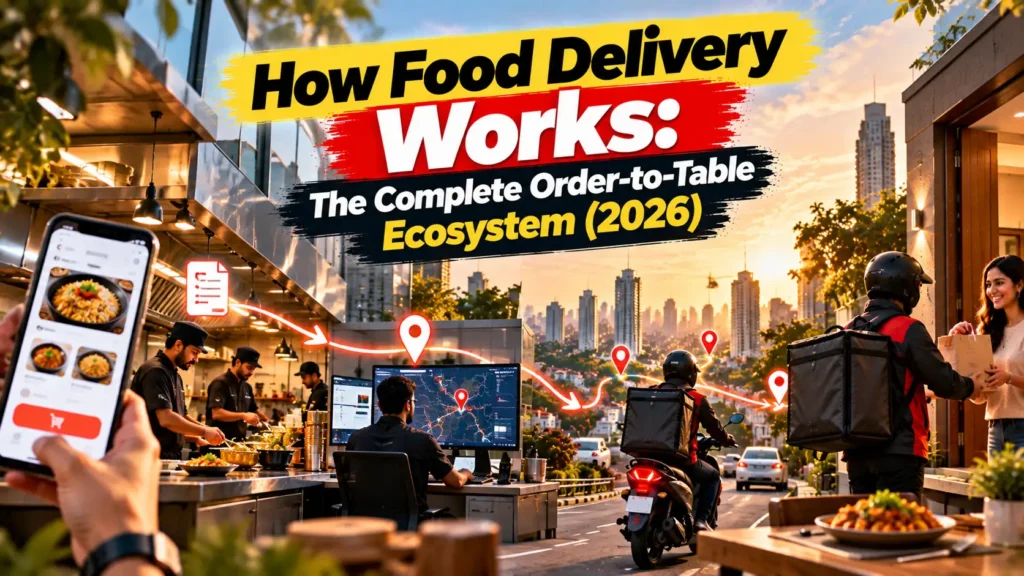
In modern urban India, ordering a piping hot biryani, a fresh pizza, or a gourmet dessert delivered to your dining table within 30 to 45 minutes has become an everyday ritual for tens of millions of households. Yet, having how food delivery works explained in full operational detail reveals an astonishingly synchronized high-wire act of predictive software engineering, restaurant culinary timing, and rapid on-road navigation. Unlike non-perishable e-commerce parcels that can wait hours in warehouse staging bins, prepared food is intensely perishable: it loses heat, texture, and flavor with every passing minute. Managing this delicate transaction at scale across sprawling metropolises represents one of modern logistics’ greatest operational achievements. If you want to be part of this vibrant, high-earning industry, you can explore verified food delivery and rider jobs on AlphaReach to join leading fleets hiring in your area today.
At its core, modern food delivery operates as a dynamic Three-Sided Marketplace connecting three distinct stakeholders: hungry diners, partner restaurants and cloud kitchens, and independent delivery partners. The platform aggregator functions as the digital orchestrator—handling customer discovery, processing digital transactions, transmitting kitchen orders, and dispatching riders with millisecond precision.
Furthermore, food delivery logistics is governed by rigorous quality and hygiene standards. In this detailed 2026 industry handbook, we deconstruct the complete order-to-table lifecycle, examine Kitchen Preparation Time (KPT) algorithms, unpack rider batching economics, and explore the rise of cloud kitchens and thermal food transit technology.
The 3-Sided Marketplace: The Foundation of Food Delivery
To understand food delivery, one must first understand its foundational business architecture: the three-sided marketplace. The platform operates as an asset-light digital matchmaker balancing diner demand, restaurant kitchen capacity, and mobile delivery rider supply in real time.
For consumers, the mobile application provides personalized restaurant discovery, menu browsing, customer reviews, promotional discounting, and seamless UPI payments. For restaurant partners, the platform provides incremental sales volume, customer acquisition without dedicated waitstaff, and automated kitchen order tickets (KOT). For delivery partners, the platform provides flexible, on-demand earning opportunities complete with automated dispatching, GPS routing, and performance incentives.
From a public health and regulatory standpoint, food delivery platforms and participating cloud kitchens must comply with statutory hygiene and packaging standards established by the Food Safety and Standards Authority of India (FSSAI). Under FSSAI regulations, delivery aggregators must ensure food safety licensing compliance across all onboarded restaurants, enforce tamper-evident packaging, and maintain sanitary thermal transit containers.
Comparative Breakdown: The 5 Phases of the Food Delivery Order Lifecycle
The journey of a food order is a tightly choreographed sequence where digital data streams, physical cooking, and on-road transit occur in synchronized harmony.
The analytical table below outlines the five distinct phases of the food delivery lifecycle, detailing typical time allocations, responsible stakeholders, and primary technological tools:
| Order Phase | Operational Focus | Typical Duration | Responsible Stakeholder | Core Technology Used |
| 1. Order Placement & Validation | Menu selection, payment, kitchen ping | 30 – 60 Seconds | Customer & Platform Engine | Payment Gateway, Recommendation Engine |
| 2. Kitchen Prep Time (KPT) | Food preparation, cooking, bagging | 12 – 22 Minutes | Restaurant Chef / Cloud Kitchen | Merchant Partner App, Kitchen Display System (KDS) |
| 3. Intelligent Rider Dispatch | Proximity matching, transit timing | Parallel (Assigned at KPT min 8) | Platform Dispatch Engine | Algorithmic Dispatching, Geofencing |
| 4. Pickup & Hot-Bag Handover | Arrival verification, order check, stowage | 2 – 4 Minutes | Delivery Partner & Kitchen Staff | Order Verification Code, Insulated Thermal Bag |
| 5. Urban Transit & Doorstep Drop | Road transit, customer contact, OTP drop | 10 – 18 Minutes | Delivery Partner & Diner | Turn-by-turn GPS, Live Customer Tracking, OTP |
Love the energy of food delivery logistics and want to turn your two-wheeler into a high-earning asset? Discover verified vacancies with top food delivery aggregators: explore verified food delivery and rider jobs on AlphaReach and start riding today.
The Science of KPT: Why Kitchen Prep Timing Dictates Success
The most difficult variable in food delivery operations is predicting Kitchen Preparation Time (KPT). If a delivery rider arrives at a restaurant too early, they waste valuable minutes waiting outside the kitchen, reducing their hourly delivery capacity and growing frustrated. If the rider arrives too late, freshly cooked food sits on the counter cooling, degrading customer satisfaction.
To solve this challenge, modern food delivery platforms deploy machine learning models trained on millions of historical cooking logs. The algorithm calculates dynamic KPT based on the specific dishes ordered (a raw salad takes 5 minutes, while a slow-cooked tandoori platter takes 20 minutes), real-time kitchen order backlog, time of day, and weather conditions.
Instead of dispatching a delivery partner the moment an order is confirmed, the system intentionally delays rider assignment. It calculates how long a nearby rider will take to ride to the restaurant and times the dispatch so the rider arrives at the exact minute the chef places the sealed meal into the pickup staging area. This just-in-time synchronization minimizes rider wait times and guarantees maximum food freshness.
Thermal Logistics: How Hot Bags and Tamper Seals Protect the Meal
Maintaining food temperature and hygiene across bumpy city streets and challenging weather is a major engineering and operational feat. Professional food delivery relies on specialized thermal logistics equipment.
Delivery partners are equipped with heavy-duty, multi-layered insulated delivery backpacks featuring expanded polyethylene (EPE) foam insulation and reflective aluminum foil linings. These thermal bags maintain internal temperatures between 55°C and 65°C for up to 45 minutes, preventing hot meals from becoming lukewarm during transit. For cold items (such as ice cream or chilled beverages), internal dividers separate cold and hot compartments.
Simultaneously, restaurants utilize tamper-evident packaging: heat-sealed plastic containers, branded security tape, and sturdy outer carry bags. If a seal is broken, the customer is instructed to reject the delivery, ensuring zero tampering or food contamination during transit.
The Rise of Cloud Kitchens and Algorithmic Order Batching
The economics of food delivery have been supercharged by two major industry innovations: cloud kitchens (ghost kitchens) and algorithmic order batching.
Cloud kitchens are commercial cooking facilities purpose-built exclusively for delivery, featuring zero dine-in seating, no waitstaff, and no high-rent storefront real estate. Located in lower-rent urban industrial pockets or backstreets, cloud kitchens operate multiple digital restaurant brands from a single kitchen. This model dramatically reduces operating overheads and optimizes order assembly for instant rider pickup.
Simultaneously, dispatch engines practice Order Batching: assigning two separate customer orders from the same restaurant (or nearby restaurants) to a single delivery partner whose drop-off locations are along the same travel corridor. Batching allows riders to earn double delivery fees in a single transit trip while lowering delivery costs for platforms, driving the economic viability of the entire ecosystem.
Earn Rs. 20,000 to Rs. 36,000+ monthly delivering food on your own schedule! Enjoy flexible lunch and dinner shifts, high surge multipliers, weekly payouts, and free onboarding. apply directly through AlphaReach now.
Frequently Asked Questions (FAQs)
How does the food delivery app decide which rider gets an order?
Algorithms evaluate the rider’s real-time GPS proximity to the restaurant, predicted kitchen prep time (KPT), vehicle type, the rider’s historical order acceptance rate, and current traffic conditions to select the optimal partner.
What is Kitchen Preparation Time (KPT) in food delivery?
KPT is the estimated duration required for a restaurant to prepare, cook, and pack an order. Dispatch engines use KPT to time rider arrival exactly when food is ready.
What is a cloud kitchen and how does it operate?
A cloud kitchen is a delivery-only restaurant with no physical dining space. It prepares orders placed exclusively through delivery apps, operating with lower overhead costs and high operational efficiency.
How do food delivery companies keep food hot during delivery?
Delivery riders use insulated delivery bags lined with thermal foil and high-density foam that preserve heat for 30 to 45 minutes, along with tamper-evident heat-sealed containers.
What are order batching and pooled deliveries?
Order batching occurs when an algorithm assigns two orders from the same or nearby restaurants to one rider if the delivery destinations lie along the same travel path, maximizing efficiency and rider earnings.
Conclusion
Food delivery in modern India is a masterclass in real-time operational synchronization, fusing digital marketplace convenience, machine-learning kitchen predictions, and dedicated frontline rider logistics into a seamless everyday luxury.
As consumer adoption continues to surge and innovations in cloud kitchen automation and thermal delivery technology mature, food delivery will remain a cornerstone of urban lifestyle and a powerhouse of flexible employment nationwide.