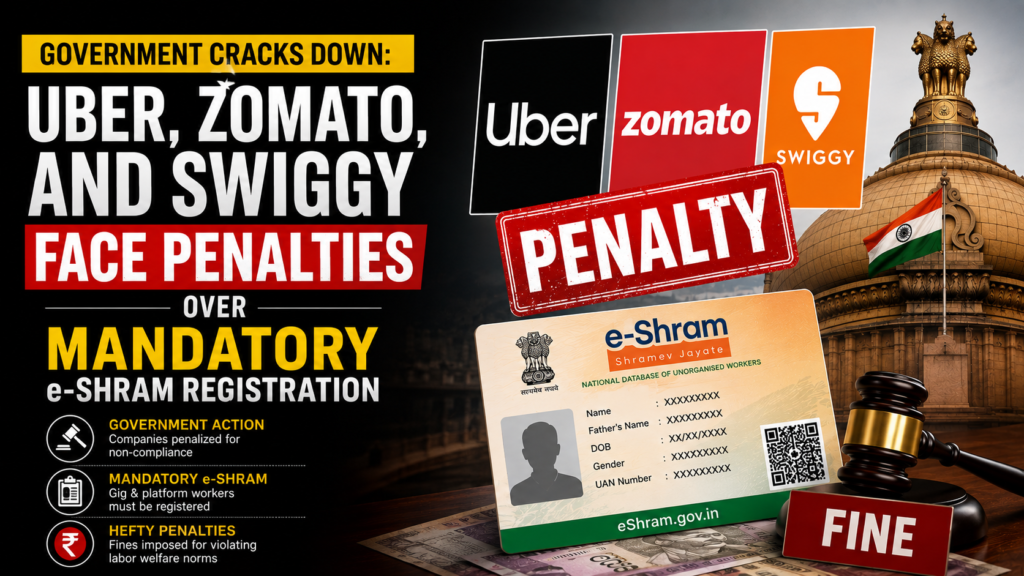
In a massive step toward formalizing India’s unorganized workforce, the Ministry of Labour and Employment issued a strict directive to all major app-based aggregators, including Swiggy, Zomato, Uber, Ola, Rapido, Blinkit, and Zepto. The government mandated these multi-billion-dollar tech platforms to officially register their entire fleet of gig workers on the central e-Shram portal by June 21, 2026. This directive followed the May 2026 notification of rules under the Code on Social Security, which strictly requires the mandatory registration of all gig and platform workers within a 45-day window from the notification date.
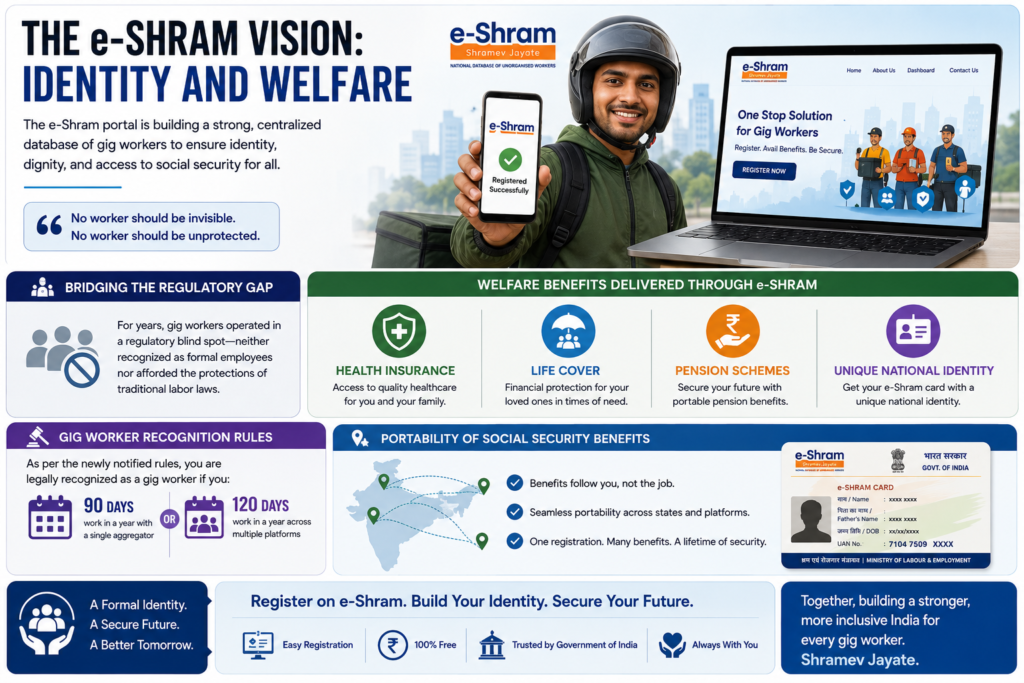
The e-Shram Vision: Identity and Welfare
The central objective of this aggressive registration drive is to create a robust, centralized database of platform workers. For years, gig workers have operated in a regulatory blind spot—neither recognized as formal employees nor afforded the protections of traditional labor laws. By onboarding them onto the e-Shram portal, the government can directly roll out targeted welfare measures, including health insurance, life cover, and portable pension schemes. Furthermore, this registration provides workers with a unique national identity card, greatly improving the portability of their social security benefits across different states and platforms. Under the newly notified rules, any individual who works for at least 90 days a year with a single aggregator, or 120 days across multiple platforms, is legally recognized as a gig worker.
Pushback and Union Frustrations
The Ministry explicitly warned platform aggregators that failure to meet the June 21 integration deadline would invite severe penal action under the Social Security Code. Furthermore, aggregators are now legally mandated to report all new worker onboardings and exits on a real-time or daily basis through API integration with the central portal. Despite the government’s push, labor advocates remain skeptical of corporate compliance. Sheikh Salauddin, co-founder of the Indian Federation of App-Based Transport Workers (IFAT), stated that several aggregators have historically failed to take government directives seriously. The union is demanding transparent compliance audits, arguing that workers cannot continue to wait endlessly for their legal welfare entitlements while platforms delay administrative processes.
Final Word, Thought, and Conclusion
The June 21 e-Shram registration deadline marks the definitive end of the “informal” era of digital gig work in India. By forcing aggregators to integrate their databases with the government on a real-time basis, the state has eliminated the anonymity that platforms previously used to avoid welfare obligations. However, simply registering a worker on a portal is only half the battle. The true test of this policy will be the actual, frictionless delivery of health and pension benefits to a delivery partner the moment they face a medical emergency. If enforced rigorously, the e-Shram integration will go down as the most consequential labor reform for India’s digital economy in this decade.