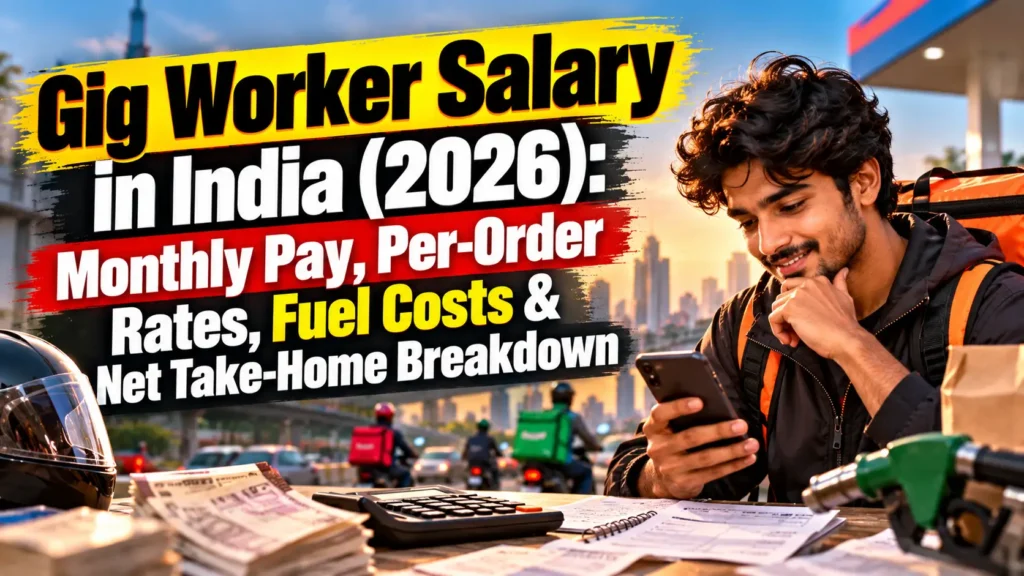
As India’s platform economy scales to engage millions of workers across e-commerce, food logistics, quick-commerce, and ride-hailing, understanding the real-world gig worker salary in India has become essential for job seekers evaluating frontline employment options. In 2026, a gig worker’s income is no longer a simple fixed wage; it is a dynamic, multi-layered compensation model composed of base order payouts, distance allowances, customer tips, peak-hour surge multipliers, and weekly milestone incentives. Full-time gig professionals working 8 to 10 hours daily across leading platforms—such as Zomato, Swiggy, Zepto, Blinkit, Rapido, and Shadowfax—earn gross monthly incomes ranging from ₹24,000 to ₹38,000. However, calculating true net take-home pay requires factoring in fuel expenses, vehicle maintenance, and mobile recharge costs, leaving an average net monthly income of ₹19,500 to ₹32,000. If you are seeking verified, high-paying gig worker vacancies in your city, you can explore verified delivery partner jobs on AlphaReach to locate active openings today.
The compensation structure in the gig economy provides distinct financial advantages over unorganized daily-wage manual labor. While informal casual labor leaves workers vulnerable to wage theft and long unpaid delays, gig platforms disburse earnings automatically every week directly into verified savings bank accounts. Furthermore, gig workers maintain complete control over their earning potential: delivering during severe rainstorms, festive holidays, and nocturnal midnight windows unlocks lucrative surge multipliers that can double normal hourly earnings.
National employment monitoring, wage rate index benchmarking, and fair labor remuneration surveys conducted by the Labour Bureau highlight the growing formalization of platform service wages, demonstrating that technology-enabled logistics hubs offer competitive living standards and upward financial mobility for frontline workers. In this detailed 2026 salary guide, we break down every component of a gig worker’s earnings, compare rate cards across major platforms, analyze real-world operating expenses, and reveal practical strategies to maximize your monthly take-home pay.
The 5 Core Components of a Gig Worker’s Compensation Model
A typical gig partner’s earnings ledger is composed of five distinct financial streams:
- Base Delivery Fee (Touch Point Pay): The guaranteed minimum fee paid for picking up and completing an order drop within the standard base radius (typically ₹25 to ₹40 per order).
- Distance Pay (Kilometer Allowance): Additional compensation paid for travel exceeding the base radius, calculated at ₹6 to ₹10 per additional kilometer traveled.
- Peak-Hour & Weather Surges: Special multipliers applied during high-demand lunch/dinner windows or extreme weather events (rain, heatwaves), adding ₹15 to ₹45 extra per completed trip.
- Weekly Milestone Bonuses (Target Compounding): Platform incentives awarded for hitting weekly order thresholds (e.g., completing 100 orders in 6 days yields a ₹1,800 to ₹2,500 bonus).
- Customer Digital Tips: 100% of customer tips added through the app are passed directly to the delivery partner, contributing ₹1,000 to ₹2,500 in supplemental monthly income.
- Special Weather & Rain Surges: During torrential monsoon rainstorms or extreme weather events, aggregators activate specialized disaster surge rates ranging from ₹25 to ₹60 extra per drop. Riders equipped with high-grade waterproof gear capitalize on these surges to double their daily earnings.
Gig Worker Salary & Rate Card Comparison Across Top Platforms (2026)
Monthly platform earnings vary based on order density, delivery distance, and platform sector. The benchmark matrix below outlines realistic 2026 earnings across leading operators:
| Platform & Sector | Average Daily Orders | Gross Monthly Pay (₹) | Monthly Petrol Cost (₹) | Bike Maintenance & Phone (₹) | Net Monthly Take-Home (₹) |
| Quick-Commerce (Zepto / Blinkit) | 22 – 30 drops / day | ₹26,000 – ₹35,000 | ₹3,500 – ₹4,500 | ₹1,000 – ₹1,400 | ₹21,500 – ₹29,500 |
| Food Delivery (Zomato / Swiggy) | 18 – 25 drops / day | ₹24,000 – ₹33,000 | ₹4,200 – ₹5,500 | ₹1,200 – ₹1,600 | ₹18,500 – ₹26,000 |
| Bike Taxi (Rapido / Uber Moto) | 15 – 22 trips / day | ₹27,000 – ₹38,000 | ₹4,800 – ₹6,500 | ₹1,400 – ₹1,800 | ₹20,800 – ₹30,000 |
| E-Commerce Parcel Courier | 45 – 65 packets / day | ₹22,000 – ₹30,000 | ₹3,200 – ₹4,200 | ₹1,000 – ₹1,400 | ₹17,800 – ₹24,500 |
| Electric Vehicle (EV) Rider | 22 – 30 drops / day | ₹25,000 – ₹34,000 | ₹1,500 – ₹2,000 (Battery) | ₹800 – ₹1,000 | ₹22,500 – ₹31,000 |
★ Flexible Gig & Warehouse Career Opportunities: Are you seeking flexible, high-paying gig worker or warehouse jobs with competitive weekly earnings, fuel allowances, PF/ESI benefits, and same-day joining? explore verified delivery partner and warehouse jobs on AlphaReach to discover immediate vacancies across top quick-commerce dark stores, food delivery platforms, and logistics hubs in your city today.
Analyzing Real-World Operating Costs: Petrol, Wear & Maintenance
To understand true net take-home earnings, gig workers must manage three essential operational expenses:
- Daily Petrol Expenditure: Riding 80 to 120 km daily on a 100cc commuter motorcycle (Hero Splendor, Honda Shine) consumes 1.5 to 2.2 liters of petrol daily (costing ₹150 to ₹220 per day, or ₹4,000 to ₹5,500 monthly).
- Routine Bike Maintenance: Covering 2,500 to 3,500 km per month requires monthly engine oil changes (₹350 to ₹450), brake shoe adjustments (₹150), and chain lubrication (₹100), totaling ₹800 to ₹1,200 monthly.
- Mobile Data Recharge: Heavy GPS navigation, continuous background app sync, and customer calling require an unlimited high-speed data plan costing ₹250 to ₹350 per month.
Understanding the Weekly Minimum Guarantee (MG): Platforms frequently guarantee baseline daily earnings (e.g., ₹900 for 9 logged-in peak hours and 10 attempted orders) even if customer demand dips unexpectedly. Satisfying minimum login hours and maintaining an acceptance rate above 90% ensures your income floor remains protected.
The EV Advantage: How Electric Two-Wheelers Boost Net Take-Home Pay
Switching from a petrol two-wheeler to a commercial electric scooter (EV) has revolutionized gig worker economics:
Fuel Cost Reduction: Commercial EV battery-swapping subscriptions cost roughly ₹60 to ₹80 per day, compared to ₹180 to ₹220 per day for petrol, saving ₹3,500 to ₹4,500 every month.
Zero Engine Oil Costs: Electric motors have zero engine oil, spark plugs, or clutch plates, cutting monthly servicing expenditures by over 60%.
Net Income Expansion: Over an entire year, an EV delivery rider saves ₹40,000 to ₹55,000 in operating costs, directly expanding net family savings.
Pro Tips to Maximize Monthly Gig Worker Salary
Top-earning gig partners consistently maximize their weekly earnings by applying disciplined habits:
- Never Miss Weekly Milestones: Focus on completing the final 5 to 8 orders required to unlock the top milestone bonus tier; missing it by 1 order costs ₹1,500 to ₹2,500.
- Leverage Multi-Apping During Lulls: If food orders slow down between 3:30 PM and 6:30 PM, switch to bike taxi or grocery delivery apps to maintain consistent hourly earnings.
- Work Friday, Saturday, and Sunday Evenings: Weekend dinner peaks generate the highest surge pricing and tip volumes, accounting for nearly 45% of total weekly earnings.
- Maintain Smooth Throttle Riding: Avoid aggressive rapid acceleration and harsh braking; gentle throttle riding delivers 65+ km/l fuel efficiency, preserving hundreds of rupees in petrol weekly.
Managing Smart Mobile Data Plans for Seamless App Connectivity: Because gig apps rely on continuous GPS location pings and barcode uploads, top-earning partners subscribe to dual-SIM mobile data packages (e.g., Jio and Airtel), ensuring zero connection dropouts when entering suburban basements or high-rise residential towers.
★ Maximize Your Earnings Today: Ready to unlock top-tier gig earnings, achieve financial flexibility, and advance your logistics career with leading platform employers? apply as a verified delivery partner on AlphaReach to access fast onboarding, guaranteed shift schedules, and priority route dispatches today.
Frequently Asked Questions (FAQs)
What is the starting salary for a gig worker in India?
Starting net take-home earnings typically range from ₹18,000 to ₹24,000 per month for entry-level riders working 8 hours daily, increasing to ₹30,000+ as riders master peak surges and milestone bonuses.
Do gig workers get paid weekly or monthly in India?
Nearly all major gig platforms (Zomato, Swiggy, Zepto, Blinkit, Rapido) pay partners on a weekly cycle (typically every Tuesday or Wednesday), with several apps offering instant daily cash-out options.
How much does a gig worker spend on petrol every month?
A full-time delivery rider traveling 80 to 110 kilometers daily spends approximately ₹3,800 to ₹5,500 per month on petrol, depending on city fuel rates and bike mileage.
Can I earn more by renting an electric scooter for delivery work?
Yes. Renting an EV with battery swapping cuts daily fueling costs from ₹200 to under ₹75, allowing riders to save an extra ₹3,500 to ₹4,500 per month in net take-home income.
Are gig workers penalized financially for customer order cancellations?
No. Legitimate platforms do not penalize riders for customer-initiated cancellations, provided the delivery partner followed standard operating procedures.
Conclusion
A gig worker salary in India provides a transparent, flexible, and performance-driven livelihood that rewards discipline, route efficiency, and smart operational choices. With weekly direct bank payouts, surge incentives, and significant cost savings from electric vehicles, gig workers enjoy stable and self-directed financial independence.
By targeting peak demand hours, maintaining fuel efficiency, and consistently unlocking weekly milestone bonuses, motivated platform professionals can maximize their earnings while building a strong financial future. Explore verified gig worker openings today and unlock your true earning potential.