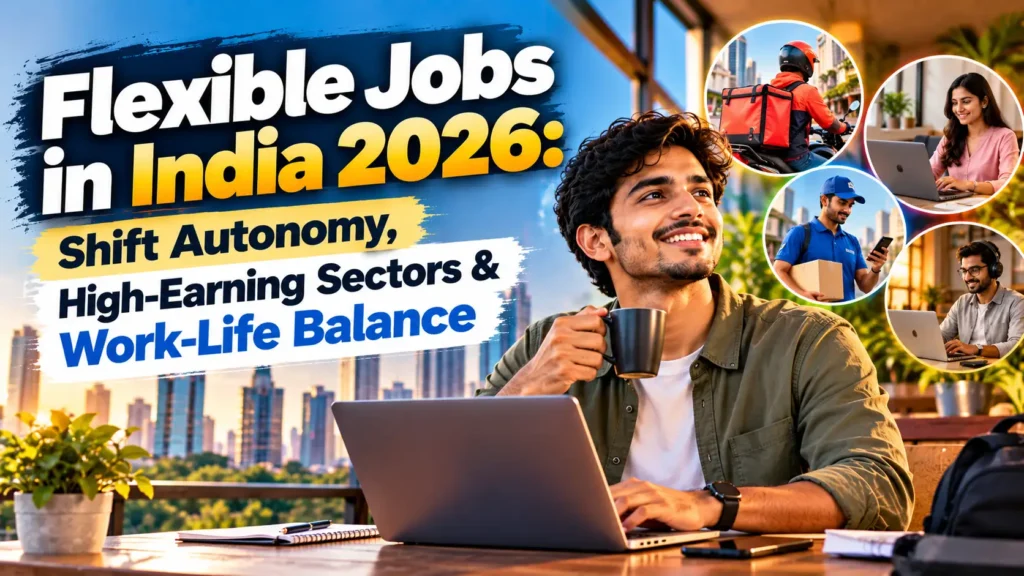
For generations, Indian workers operated under a rigid employment compact: commute to a centralized workplace, report to a hierarchical supervisor, and remain tied to a desk for nine to ten continuous hours a day, five to six days a week. However, the rise of the digital economy, shifting lifestyle priorities, and the desire for true work-life balance have ignited a nationwide workforce movement toward flexible jobs in India. Today, professionals, students, parents, and career changers are demanding employment arrangements where work conforms to their personal lives—rather than forcing their personal lives to conform to work.
From on-demand quick commerce delivery and ride-hailing fleets to flexible retail merchandising, tele-sales, and independent consulting, flexible earning models empower individuals to choose precisely when, where, and how much they work. Job seekers eager to break free from rigid schedules while securing dependable weekly compensation can explore verified openings on flexible jobs in India to locate top hiring hubs. In this comprehensive career guide, we explore the leading flexible employment sectors in India, break down the economics of autonomous shift scheduling, analyze legal protections, and share practical roadmaps to build a thriving, balanced livelihood.
The Philosophy of Flexibility: Why Autonomy Is the New Workplace Currency
Workplace flexibility in modern India is no longer viewed merely as a casual luxury; it has become an essential strategy for career sustainability and mental wellbeing. The rapid growth of urban centers has brought crushing traffic congestion, extended commute times, and escalating cost of living. For millions of workers, spending three hours every day trapped in bumper-to-bumper traffic to sit at an office desk creates chronic exhaustion and burnout.
Flexible jobs fundamentally alter this dynamic by replacing presence-based evaluation with output-based compensation. In a flexible work arrangement, workers are judged and compensated purely on results: deliveries completed, customer calls handled, parcels dispatched, or projects delivered. If an individual finishes their daily target in five hours, their remaining time belongs entirely to them—to spend with family, pursue higher education, or focus on personal health.
Furthermore, flexible roles provide an indispensable economic buffer against sudden life disruptions. If a child falls ill, an elder parent requires medical escort, or college examinations demand intense study, a flexible worker simply toggles their availability offline without fear of managerial reprimands or job termination.
Top High-Earning Sectors Offering Flexible Jobs in 2026
India’s modern service economy features several thriving verticals optimized for complete schedule autonomy:
- On-Demand Logistics & Quick Commerce (Blinkit, Zepto, Swiggy, Zomato): Couriers log into rider apps whenever convenient. Shift flexibility is unmatched: workers can operate for 2 hours in the morning, take a 5-hour afternoon study break, and log in for 3 hours during the evening dinner rush. Monthly earnings range from ₹22,000 to ₹35,000.
- Ride-Hailing & Passenger Mobility (Rapido, Uber, Ola): Drivers set their own daily targets. Many drivers operate exclusively during morning (8 AM – 11 AM) and evening (5 PM – 9 PM) office commute surges, capturing high fares while avoiding afternoon gridlock. Monthly earnings range from ₹25,000 to ₹40,000.
- Flexible Retail Merchandising & Audit: Field associates visit retail supermarkets and dark stores on flexible schedules to verify product stock, install brand promotional banners, and audit shelf inventory, earning ₹18,000 to ₹26,000 monthly.
- Remote Tele-Calling & Inside Sales: Customer support and sales executives work from home on flexible shift rosters (e.g., 4-hour morning or evening slots) handling customer inquiries and loan verifications, earning ₹16,000 to ₹30,000 monthly.
- Freelance Teaching & Ed-Tech Tutoring: Subject experts conduct online tutoring sessions during evening hours or weekends, earning ₹300 to ₹800 per hour.
| Flexible Employment Sector | Typical Shift Flexibility | Target Demographic | Primary Earning Trigger | Monthly Net Income Range |
| Quick Commerce Delivery | 100% On-Demand (Hour-by-Hour) | Students, Freshers, Full-Timers | Per-order drop fee + Peak surge | ₹20,000 – ₹34,000 |
| Ride-Hailing Fleet | Self-Determined Commute Slots | Car / Two-Wheeler Owners | Per-km fare + Demand multipliers | ₹24,000 – ₹42,000 |
| Retail Merchandising Audit | Task-Based Neighborhood Visits | Youth, Career Starters | Per-store audit completion fee | ₹18,000 – ₹26,000 |
| Remote Tele-Sales / Support | Rostered 4-to-6 Hour Slots | Homemakers, Students | Hourly base + Conversion incentives | ₹16,000 – ₹28,000 |
| Online Evening Tutoring | Pre-Booked 1-Hour Slots | Graduates, Teachers, Subject Pros | Hourly teaching fee | ₹20,000 – ₹45,000 |
Ready to trade rigid corporate schedules for total shift freedom and dependable weekly earnings? Explore verified flexible job openings across India on AlphaReach Jobs and start earning today.
National Employment Frameworks and Workforce Inclusion
The promotion of flexible, dignified employment is a core strategic objective of the Directorate General of Employment (DGE), operating under the Ministry of Labour and Employment. The DGE’s national employment policies actively encourage labor market flexibilization that facilitates women’s labor force participation, youth employment, and inclusive economic growth.
Through digital employment exchanges and partnerships with platform aggregators, government welfare policies are adapting to ensure that flexible workers retain social security protections—such as portable accidental insurance, micro-pensions, and access to formal banking credit—without sacrificing the schedule freedom that makes flexible work so empowering.
The Economics of Shift Stacking: How to Earn More in Fewer Hours
To achieve maximum income while preserving work-life balance, high-earning flexible professionals practice ‘Shift Stacking’—strategically deploying their hours exclusively during peak commercial multipliers:
The 80/20 Rule of Flexible Work: In on-demand platforms, 80% of daily bonus incentives and customer tips are generated during 20% of the day: specifically during lunch (12:30 PM to 3:00 PM) and dinner (7:30 PM to 11:00 PM). Working six concentrated peak hours routinely yields higher gross income than driving twelve sluggish midday hours—saving six hours of physical wear and half a tank of fuel.
Multi-Platform Diversification: Keep active onboarding credentials across two complementary platforms (e.g., an instant grocery delivery app and an evening food delivery app). If order demand slows down on one platform, switch seamlessly to the other to eliminate unpaid waiting time.
Automated Payout Management: Direct weekly settlements into an automated savings account, allocating 60% for immediate living expenses, 25% for vehicle/equipment maintenance and fuel, and 15% for long-term emergency savings.
Overcoming Challenges: Self-Discipline and Burnout Prevention
The greatest advantage of flexible work—being your own boss—is also its greatest psychological challenge. Without a supervisor enforcing attendance, success demands exceptional personal discipline:
Set Fixed Personal Working Windows: Treat your chosen flexible hours with the same professional rigor as an office shift. If you commit to working 7:00 PM to 11:00 PM, eliminate smartphone distractions, log in punctually, and stay focused.
Enforce Uncompromising Rest Days: Because you can work every day, it is easy to fall into the trap of seven-day exhaustion. Designate at least one full day per week (e.g., every Tuesday) as an absolute rest day to rejuvenate your mind and body.
Maintain Ergonomic Self-Care: Wear supportive footwear, practice daily stretching, stay hydrated, and use comfortable vehicle seating to ensure long-term physical longevity.
Work on your own terms! Apply now via AlphaReach Flexible Partner Recruitment to access prime earning hubs, customizable shifts, and instant onboarding support.
Frequently Asked Questions (FAQs)
What are the most popular flexible jobs in India in 2026?
The most popular flexible jobs include on-demand quick commerce delivery (Blinkit, Zepto, Instamart), food delivery (Zomato, Swiggy), bike-taxi passenger mobility (Rapido, Uber), remote customer chat support, and retail field audit merchandising.
Can I choose my own shift hours in flexible delivery jobs?
Yes! Platforms operate on complete on-demand flexibility. You log into the partner app whenever you want to work and log out whenever you need to stop. There are no mandatory fixed daily hours, allowing you to tailor shifts around studies or family.
How much can I earn working 4 hours a day in a flexible job?
A worker operating 4 focused peak hours daily (e.g., during evening dinner rushes or morning commutes) typically earns between ₹11,000 and ₹16,000 net monthly in Tier-1 cities, capturing high surge multipliers while conserving energy and fuel.
Do flexible jobs provide medical or accidental insurance?
Yes. Leading gig platforms provide active delivery partners with Group Personal Accident Insurance (₹5 to ₹10 Lakh accidental death cover and ₹1 to ₹2.5 Lakh hospitalization). Furthermore, registering on e-Shram provides ₹2 Lakh PMSBY government accidental cover.
What documents do I need to start a flexible delivery job in India?
You need an Aadhaar Card, PAN Card, active personal savings bank account passbook/cheque, an Android smartphone, and a driving license with vehicle RC (if operating a motorized two-wheeler). Bicycle couriers do not need a driving license or vehicle registration.
Conclusion
Flexible jobs in India are fundamentally reshaping the relationship between effort, time, and financial compensation. By replacing outdated nine-to-five mandates with true schedule autonomy, flexible work arrangements empower individuals to build dignified, independent, and balanced lives on their own terms.
Whether you leverage workplace flexibility to fund higher education, balance domestic responsibilities, or maximize multi-platform earnings, success comes from disciplined goal-setting, strategic peak-hour focus, and personal health preservation. In the modern economy, autonomy is true wealth—and flexible jobs provide the key to unlocking it.